Regulations Prohibiting Capital Restructuring That Dilutes Voting Rights of Existing Shareholders on Exchanges in the US, Japan, and Others
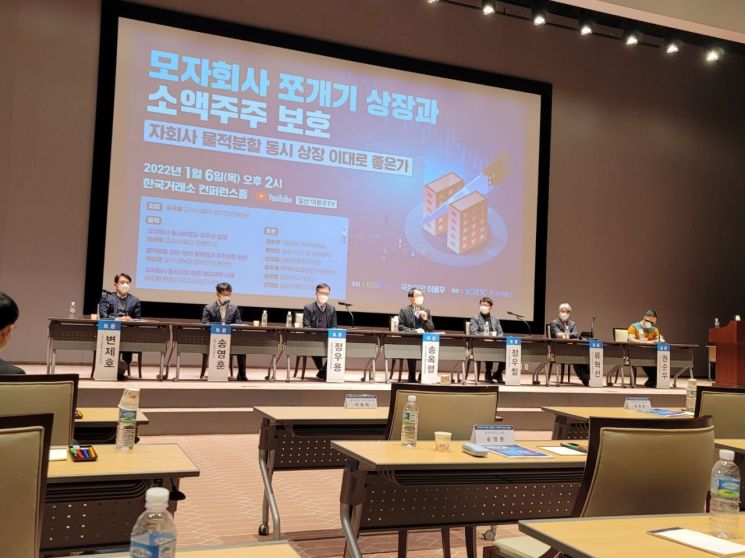
[Asia Economy Reporter Ji Yeon-jin] "Physical division is the core of the Korea discount."
At the discussion held on the 6th at the Korea Exchange in Yeouido, Seoul, titled 'Subsidiary Split Listing and Protection of Minority Shareholders,' opinions flooded that urgent regulation is needed because listing after physical division benefits only major shareholders, while existing minority shareholders suffer losses due to the decline in the parent company's value. However, there were also concerns about the possibility of overseas listing of newly established subsidiaries after physical division if regulations are introduced, as large-scale fundraising is necessary for new business growth.
Professor Lee Sang-hoon of Kyungpook National University Law School, who presented at the event, stated, "Physical division separates and makes independent profitable businesses and raises funds while preventing dilution of controlling shareholders' control." He added, "Although the voting rights of the newly established subsidiary are blankly delegated to the parent company's CEO, the management does not bear the duty to protect shareholders' proportional interests, so a Shareholder Interest Safeguard (SIS) to prevent proportional interest infringement should be introduced."
Professor Lee Kwan-hwi of Seoul National University’s Business Administration Department also pointed out, "When problematic subsidiaries are under the parent company at the time of listing, shareholders receive the business performance, but when the subsidiary is listed, existing shareholders cannot fully benefit, causing damage." He added, "If the company’s core business lacks funds, it can increase capital, but because this affects the controlling shareholder’s control, the subsidiary is listed instead."
According to Lee Su-hwan, Legislative Researcher of the Financial Fair Trade Team at the National Assembly Legislative Research Office, the New York Stock Exchange listing rules stipulate that the voting rights of existing common shareholders cannot be heterogeneously reduced or restricted through corporate activities or issuance. Nasdaq market rules have similar provisions. However, in Japan, simultaneous listing of subsidiaries is possible but has been decreasing since 2018. The researcher noted, "Japan also has regulations prohibiting capital restructuring that dilutes voting rights."
Lee Yong-woo, a member of the Democratic Party of Korea who hosted the discussion, criticized, "Subsidiary split listings through physical division cause stock prices to plummet after disclosure, and the listing is done through a public offering excluding parent company shareholders, which is problematic." He added, "Major shareholders use such split listings to maintain and strengthen control and profits, while minority shareholders suffer unilateral damage." However, he emphasized, "Physical division is one method of fundraising, so it cannot be banned, but since it strengthens major shareholders' control and profits while minority shareholders suffer unilateral damage, a mechanism to treat all shareholders equally is necessary."
On the other hand, Song Young-hoon, Executive Director of the Korea Exchange, said, "Debt financing for new business growth burdens the financial structure, and paid-in capital increases can cause stock prices to plummet, harming minority shareholders including major shareholders." He added, "In the case of LG Energy Solution, which was physically divided from LG Chem, there is a possibility of overseas listing due to domestic regulations."
Jung Woo-yong, Vice Chairman of Policy at the Korea Listed Companies Association, also stated, "Providing shares of physically divided subsidiaries to parent company shareholders in the form of new share subscription rights has weak legal grounds." He added, "For example, in the case of LG Chem, we propose a preferential allocation method of shares of the newly established subsidiary to shareholders who held shares from the division decision until the subsidiary's listing."
© The Asia Business Daily(www.asiae.co.kr). All rights reserved.
![User Who Sold Erroneously Deposited Bitcoins to Repay Debt and Fund Entertainment... What Did the Supreme Court Decide in 2021? [Legal Issue Check]](https://cwcontent.asiae.co.kr/asiaresize/183/2026020910431234020_1770601391.png)















