DGIST Professor Um Ji-won’s Team Identifies Protein Regulating Fear Memory
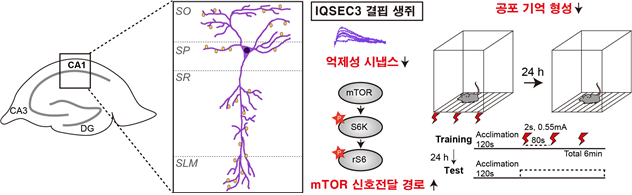 Operating mechanism of the inhibitory synaptic protein IQSEC3 that regulates fear memory. Image provided by DGIST
[Asia Economy Reporter Kim Bong-su] Domestic researchers have opened a new path for the development of treatments for post-traumatic stress disorder (PTSD), which currently has no clear therapeutic drugs. They have identified a protein that erases fearful memories in animal experiments.
The research team led by Professor Um Ji-won of the Department of Brain and Cognitive Sciences at Daegu Gyeongbuk Institute of Science and Technology (DGIST) announced on the 6th that inhibitory synapse function within neural circuits is involved in the formation of fear memories, and they discovered a new candidate target that can regulate fear memories. This research outcome is expected to suggest a new research direction for developing treatments for PTSD, one of the intractable brain disorders.
PTSD is a common syndrome experienced at least once in a lifetime by 1 in 20 men and 1 in 10 women. It is a fatal brain disorder that negatively affects normal social life. Currently, cognitive behavioral therapy and selective serotonin reuptake inhibitors (SSRIs) used for depression are combined for treatment. However, since there are no drugs targeting PTSD itself, discovering candidate substances with new mechanisms is urgently needed.
The research team had already discovered a protein called ‘IQSEC3’ in 2016, and based on this, they created conditional knockout mice. Using these mice, they found a new molecular mechanism in which the IQSEC3 protein in excitatory neurons of the hippocampus?a brain region responsible for learning and memory?regulates the target protein signaling of downstream mTOR.
Specifically, in IQSEC3 knockout mice, the number of inhibitory synapses, neurotransmission, and long-term plasticity in hippocampal neurons were reduced. They also found that the downstream mTOR-S6K signaling was excessively activated, resulting in poor formation of fear memories. When a virus inhibiting the activity of the S6K phosphorylation enzyme was injected into the hippocampus of mice to reduce the overactive mTOR signaling, the decrease in inhibitory synapses and the impairment of fear memory observed in IQSEC3 knockout mice were completely restored.
Professor Um said, "We have secured important evidence proving that IQSEC3 is a key factor mediating fear memory formation by maintaining excitatory-inhibitory balance and regulating mTOR signaling." He added, "By utilizing the molecular mechanism information related to IQSEC3 discovered this time, it can be considered as a new therapeutic strategy for brain disorders accompanied by PTSD."
The research results were published online on the 31st of last month in ‘Biological Psychiatry,’ an international journal in the field of psychiatry.
© The Asia Business Daily(www.asiae.co.kr). All rights reserved.