Rising International Oil Prices... Impact of Decreased US Crude Oil Inventories
Domestic Gasoline Price Decline Narrows
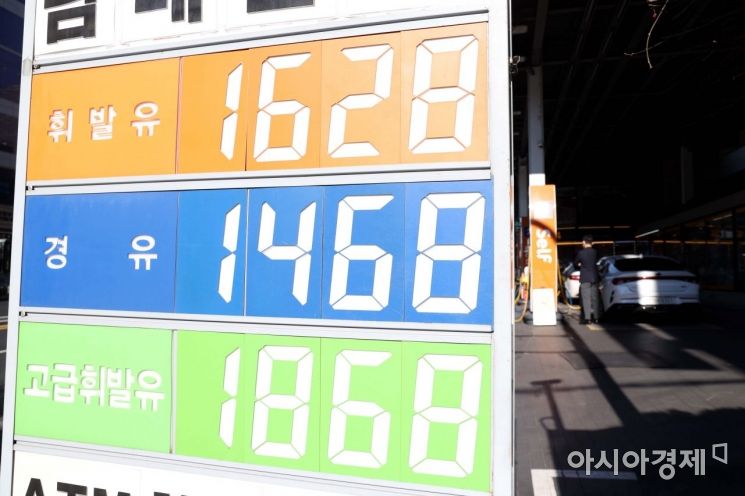 Gasoline prices at gas stations nationwide have been declining for six consecutive weeks since the government's fuel tax reduction measure in November. The price of gasoline in Seoul has dropped to the 1,600 won per liter range for the first time in five months. According to Opinet, the oil price information site operated by the Korea National Oil Corporation, the gasoline selling price in the fourth week of this month recorded 1,634.6 won per liter, down 14.3 won from the previous week. Photo by Moon Honam, taken on the 26th at a gas station in Seoul.
[Asia Economy Reporter Hwang Yoon-joo] Gasoline prices at gas stations nationwide have fallen for eight consecutive weeks following the government's fuel tax reduction measure (November 12).
According to Opinet, the oil price information site of the Korea National Oil Corporation, the gasoline retail price at gas stations nationwide in the fourth week of this month recorded 1,622.4 KRW per liter, down 3.8 KRW from the previous week.
However, the decline in gasoline prices has gradually decreased since the fuel tax cut, from 90.4 KRW → 29.1 KRW → 9.8 KRW → 13.0 KRW → 15.8 KRW → 14.3 KRW → 9.9 KRW.
By region, the gasoline price in Seoul, the highest-priced area nationwide, fell by 1.1 KRW to 1,690.4 KRW per liter, while Busan, the lowest-priced area, dropped by 4.7 KRW to 1,591.3 KRW per liter. By brand, GS Caltex gas stations were the most expensive at 1,450.7 KRW per liter, and budget gas stations were the cheapest at 1,411.1 KRW per liter.
The nationwide diesel retail price at gas stations also fell by 4.9 KRW to 1,440.9 KRW per liter.
International oil prices rose for two consecutive weeks. The average price of Dubai crude, the benchmark for imported crude oil in Korea, increased by 1.0 USD to 77.9 USD per barrel. International gasoline prices rose by 0.8 USD to 91.2 USD per barrel.
The Korea National Oil Corporation explained, "This week, international oil prices are on the rise due to factors such as a decrease in U.S. crude oil inventories and OPEC's failure to meet production increase targets."
© The Asia Business Daily(www.asiae.co.kr). All rights reserved.

















