[Seoul District News] Gangbuk-gu Provides Useful District Administration and Local Life Information to Residents · Expands Communication Channels Through Real-Time Interaction via Comments... Eunpyeong-gu Publishes 2021 Statistical Yearbook Covering Land, Population, Economy, Culture, and Overall Social Data... Gangseo-gu Operates Non-Face-to-Face Direct Market for Lunar New Year from January 10 to 24... Dongjak-gu Expands Ice Pack Recycling Project This Year
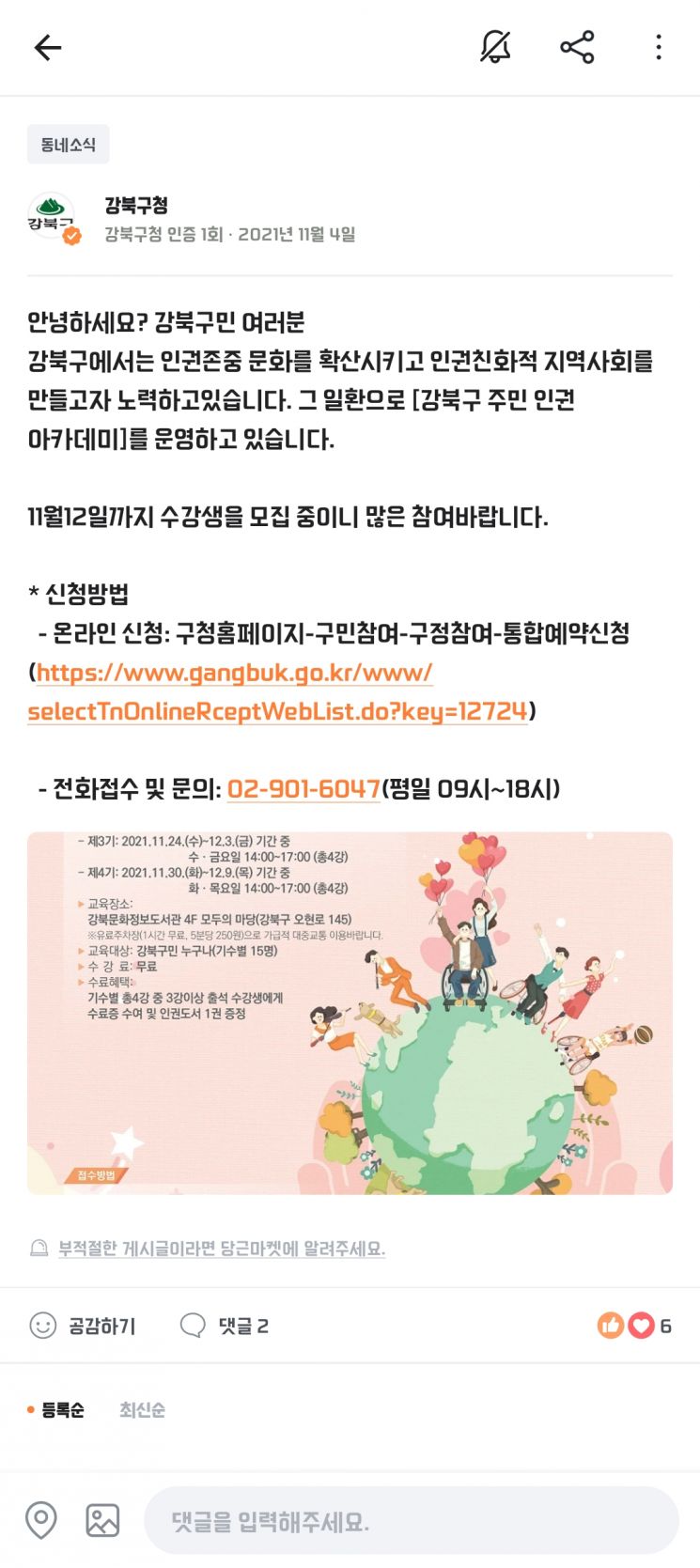
[Asia Economy Reporter Park Jong-il] Gangbuk-gu (District Mayor Park Gyeom-su) is promoting the operation of district administration publicity linked with Danggeun Market.
Danggeun Market is a location-based mobile secondhand trading application launched in July 2015, used by all age groups. Danggeun Market has been activated from a ‘neighborhood trading platform’ for secondhand transactions to a ‘location-based community platform’ where local lifestyle information can be accessed.
Accordingly, Gangbuk-gu provides useful local lifestyle information to residents through collaboration with Danggeun Market, such as public holiday household waste disposal days, Seoul Love Gift Certificate discount sales, the 2022 academic year regular admission strategy online entrance exam briefing, and recruitment information for Gangbuk-gu residents’ human rights academy students. Gangbuk-gu has expanded communication channels with residents through Danggeun Market, following newsletters, blogs, YouTube, Facebook, and IPTV.
District administration promotional materials can be found in the Neighborhood Life > Neighborhood News section within the Danggeun Market application, and communication through comments on each neighborhood news post enables quick and diverse lifestyle information delivery to residents.
Gangbuk-gu Mayor Park Gyeom-su said, “Not only through Danggeun Market but also in places closer to residents, we will deliver district administration news and become a friendlier and more comfortable Gangbuk-gu.”
Eunpyeong-gu (District Mayor Kim Mi-kyung) announced on the 4th that it has published the ‘2021 Eunpyeong-gu Statistical Yearbook,’ which contains general district status and major statistics in various fields.
The ‘2021 Eunpyeong-gu Statistical Yearbook’ is basic statistical data of Eunpyeong-gu produced in accordance with Article 18 of the Statistics Act, covering land, population, economy, culture, and other social aspects. It is used to satisfy residents’ right to know and as district policy data. The final recorded year is 2020, and annual figures are compiled based on the end of each year.
The survey items cover 17 fields with a total of 198 items, including land and climate, population, labor and businesses, housing and construction, environment, education, and culture. It features a summary of major district administration contents by year, allowing a glance at past changes and development.
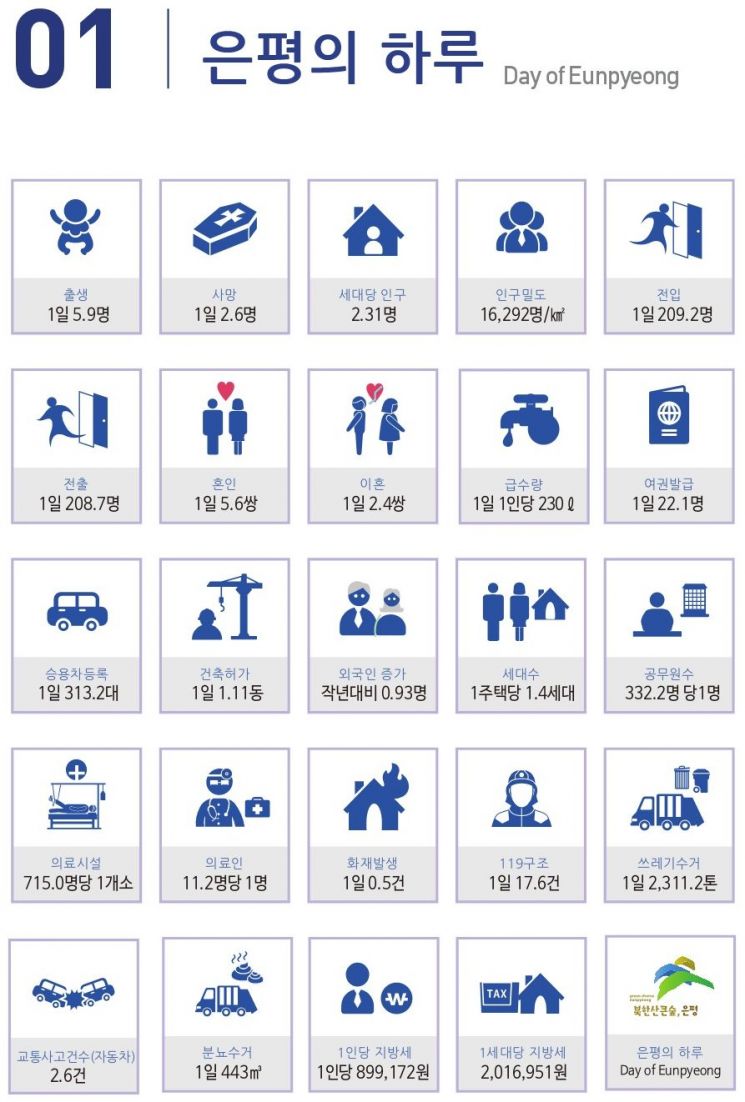
At the front of the yearbook is a statistical chart called ‘A Day in Eunpyeong,’ which provides an easy overview of Eunpyeong-gu’s 2020 statistics. The average daily statistics for 2020 in Eunpyeong-gu included ▲5.9 births, 2.6 deaths ▲2.31 persons per household ▲209.2 people moving in, 208.7 moving out ▲5.6 marriages, 2.4 divorces ▲22.1 passport issuances ▲313.2 registered passenger cars ▲0.93 increase in foreigners (compared to the previous year) ▲2,311.2 tons of garbage collected, among others.
The statistical yearbook can be viewed at libraries in the Eunpyeong area or checked on the district website’s ‘Statistical Yearbook’ bulletin board.
A district official said, “The 2021 Eunpyeong-gu Statistical Yearbook was produced so that all residents can easily access it to fulfill their right to know. We will continue to do our best to produce and provide accurate statistical data for Eunpyeong-gu.”
Let’s go shopping more safely and conveniently this upcoming Seollal holiday.
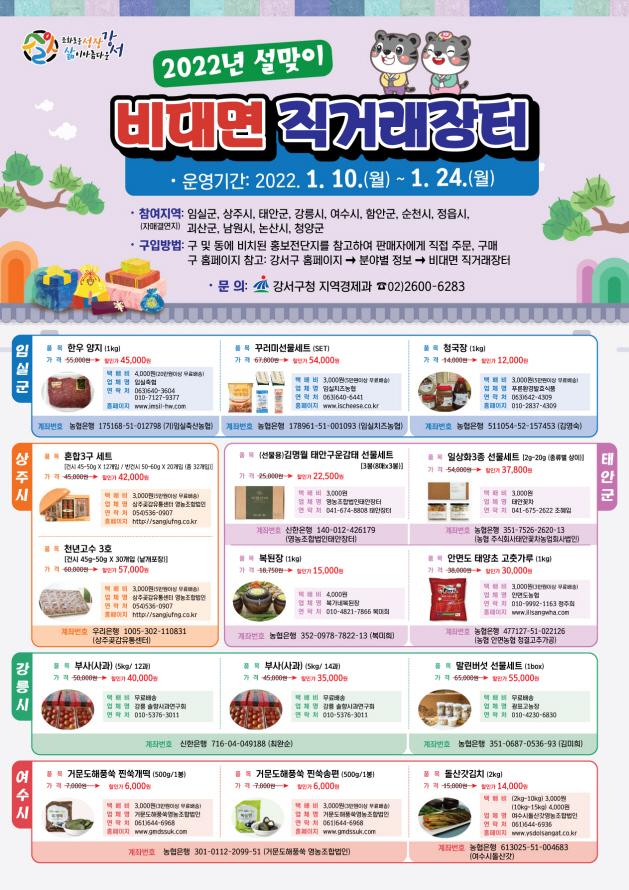
Gangseo-gu, Seoul (District Mayor Noh Hyun-song) announced that it will operate a ‘non-face-to-face direct transaction market’ for two weeks from the 10th to the 24th in celebration of the nation’s major holiday, Seollal.
The purpose is to help farms struggling due to the prolonged COVID-19 pandemic and to provide local residents with fresh local specialties and holiday ritual items more conveniently.
This market will include 12 sister cities: Imsil-gun, Sangju-si, Taean-gun, Gangneung-si, Yeosu-si, Haman-gun, Suncheon-si, Jeongeup-si, Goesan-gun, Namwon-si, Nonsan-si, and Cheongyang-gun.
More than 40 fresh and excellent quality agricultural and specialty products directly produced and processed in sister cities, such as fruits, Korean beef, traditional sweets, and kimchi, will be sold at prices cheaper than the market.
By accessing the ‘Non-face-to-face Direct Transaction Market’ banner on the Gangseo-gu website, you can check more detailed information such as items and prices.
Also, for residents unfamiliar with the internet, promotional leaflets are placed at each neighborhood community center, allowing orders by phone without accessing the website.
A district official said, “We intend to supply consumers with carefully selected high-quality agricultural and specialty products from sister cities through direct transactions for Seollal. We hope the non-face-to-face market will be of great help to farms and residents struggling due to COVID-19.”
Dongjak-gu (District Mayor Lee Chang-woo) is taking the lead in smart resource circulation by expanding the ‘ice pack recycling project’ starting this year.
The district began the ice pack reuse project in February last year. The amount of discarded ice packs increased significantly due to the surge in online transactions and deliveries caused by the prolonged COVID-19 pandemic.
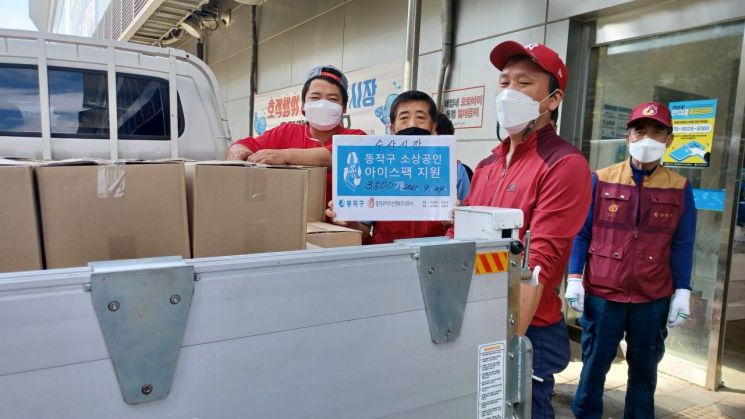
Seventeen locations, including community centers, installed and operated dedicated collection boxes, receiving high resident response. Initially expecting to collect 30,000 ice packs, the project reused 100,000 ice packs, saving about 5.8 tons in waste disposal costs.
Considering high on-site demand, the number of dedicated ice pack collection boxes will be expanded to 37 near residents’ homes. Additional locations include 20 places such as the Dongjak-gu Citizens Sports Center. Detailed locations can be checked on the district website’s village map and the ‘Separation Disposal in My Hand’ app.
Collectible ice packs are only gel-type that are uncontaminated and undamaged and can be reused; water-type ice packs should be separated by residents into water and packaging for disposal.
Ice packs disposed of by residents are collected every other day by the Dongjak-gu Senior Happiness Corporation, then go through sorting by size and capacity, bubble washing and disinfection, and repackaging before being provided to 326 stores in five locations including local traditional markets and fish markets.
This year, the recycling project strengthened its operational system by reinforcing sorting personnel at recycling sites to ensure timely delivery of collected ice packs to demand locations. This effort is not only to increase the quantity of collected ice packs but also to improve reuse rates through thorough sorting and disinfection.
Additionally, the district is promoting various recycling projects to establish a resource circulation recycling system, including ▲separation disposal day system ▲installation of AI recycling automatic collection machines ‘Nephron’ ▲expansion of recycling stations in residential areas ▲coffee grounds recycling, among others.
Choi Seung-baek, head of the Cleaning Administration Division, said, “The ice pack recycling project is evolving into an administrative service that reduces daily waste, creates local jobs, and satisfies the needs of residents and traditional markets. We will continue to actively promote various projects for waste reduction and environmental protection.”
© The Asia Business Daily(www.asiae.co.kr). All rights reserved.



















