Institute for Basic Science Finds Method to Control 'Oje Recombination Phenomenon' Hindering Light Emission Efficiency Improvement

[Asia Economy Reporter Kim Bong-su] South Korea, which is leading the global display market, has once again developed advanced technology that can solidify its position. It has found a way to suppress the 'Auger recombination phenomenon,' considered a 'challenging issue' in increasing the luminous efficiency of the most advanced technology, Quantum Dot Display (QLED). This means that a fundamental technology surpassing the world's best resolution 8K (7680×4320) QLED developed by Samsung Electronics has been developed.
The Institute for Basic Science (IBS) announced on the 5th that the research team led by Min-Haeng Cho, head of the Molecular Spectroscopy and Dynamics Research Center (professor of chemistry at Korea University), has developed a new technology that can improve the luminous efficiency of optoelectronic devices using quantum dots, such as Quantum Dot Displays (QLED).
Quantum dots are semiconductor particles with diameters on the order of a few nanometers (nm). They have unique optical properties, such as emitting light at different frequencies depending on the particle size, and are applied in various optoelectronic devices like QLEDs. Semiconductors like quantum dots have two bands where electrons can exist. The lower band filled with electrons is called the 'valence band,' the upper band without electrons is the 'conduction band,' and the energy difference between these two is called the band gap. When external energy (light) greater than the band gap is applied, electrons in the valence band are excited to the conduction band.
At this time, the empty spot left by the electron is called a hole, and the hole pairs with the electron in the conduction band to form a quasiparticle called an exciton. Over time, the exciton loses energy and recombines with the hole. The light emitted externally, which we observe in optoelectronic devices like QLEDs, is the energy initially supplied to the electron being released in the form of light.
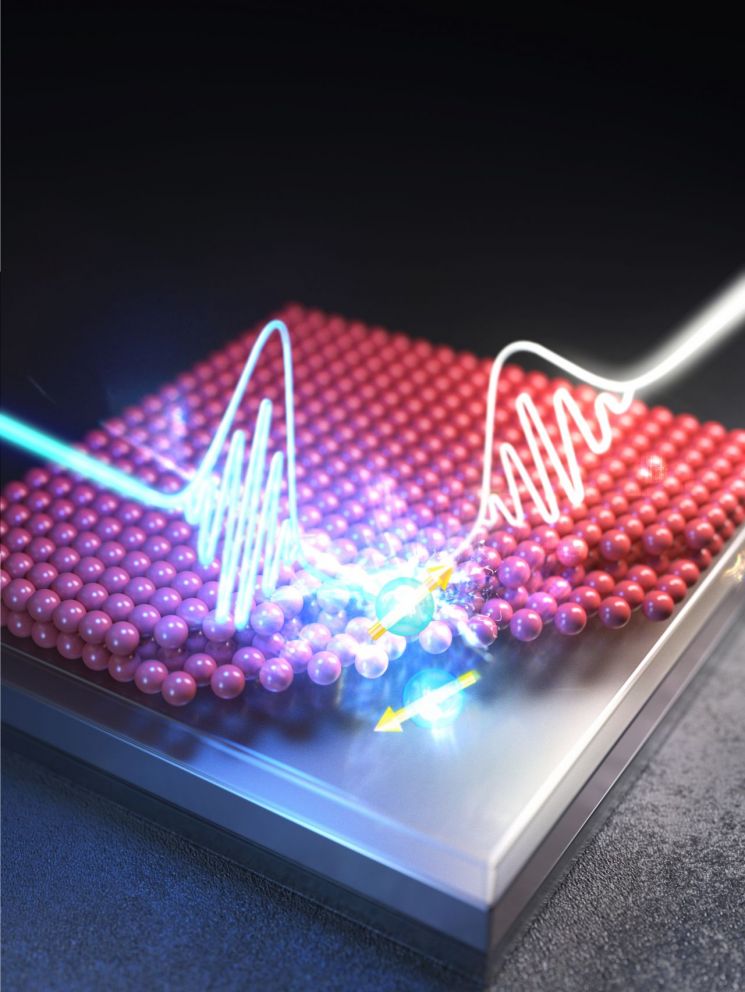
The transition dipole moment generated by the exciton in the quantum dot is reduced as a result of interaction with the image dipole induced by the nanostructure introduced by the research team, demonstrating the suppression of Auger recombination.
The problem is that not all excitons emit light ideally like this. Depending on the properties of the quantum dot material, exciton recombination can occur through other processes. A representative phenomenon is the 'Auger recombination' caused by the interaction of two excitons.
Auger recombination is a phenomenon where, when an electron and a hole recombine, light is not emitted externally but energy is transferred to another exciton nearby. In other words, since light does not come out, it is a major obstacle to improving the efficiency of optoelectronic devices based on quantum dots, especially displays.
Many spectroscopic studies have been conducted to suppress Auger recombination so far. However, previous research mainly focused on modifying the structural characteristics of the quantum dots themselves or synthesizing new types of quantum dot structures, so they did not actively control the Auger recombination phenomenon itself.
The research team explored Auger recombination by fabricating quantum dots made of thin films smaller than 100 nm on metamaterial nanostructures. During this process, they observed Auger recombination occurring in an extremely short time on the order of a few picoseconds (ps, one trillionth of a second) and discovered that the Auger recombination phenomenon was suppressed due to the nanostructures.
Furthermore, the team elucidated the mechanism by which the nanostructures suppress Auger recombination. Generally, Auger recombination occurs more actively when the transition dipole moment value is large, and when metal exists near the dipole, an image dipole is formed. The researchers explained that the image dipole formed by the nanostructure interacts with the quantum dot’s transition dipole moment, reducing the overall transition dipole moment magnitude, thereby suppressing Auger recombination.
Director Min-Haeng Cho said, “We have demonstrated for the first time that the frequently occurring Auger recombination phenomenon inside quantum dots can be controlled through nanostructures,” adding, “By introducing external structures, it is possible to suppress Auger recombination, one of the non-radiative processes, which will contribute to improving the efficiency of optoelectronic devices.”
The research results were published online on the 23rd of last month in the international optical journal ‘Advanced Optical Materials’ (IF 9.926).
Co-corresponding author Kwang-Seop Jung, a research fellow at IBS, explained, “Increasing luminous efficiency means producing brighter light with the same power,” and added, “It provides a fundamental scientific principle that can be utilized in device applications.”
© The Asia Business Daily(www.asiae.co.kr). All rights reserved.


















