First Legislative Notice at the End of the 2007 Participatory Government
Strong Opposition from Conservative Christian Groups... Issue with 'Sexual Orientation' Clause
Multiple Legislative Attempts Since Then, All Repeatedly Thwarted
Human Rights Organizations: "Sexual Minorities Face Routine Discrimination in Society"
"Anti-Discrimination Law Can Resolve Human Rights Violations"
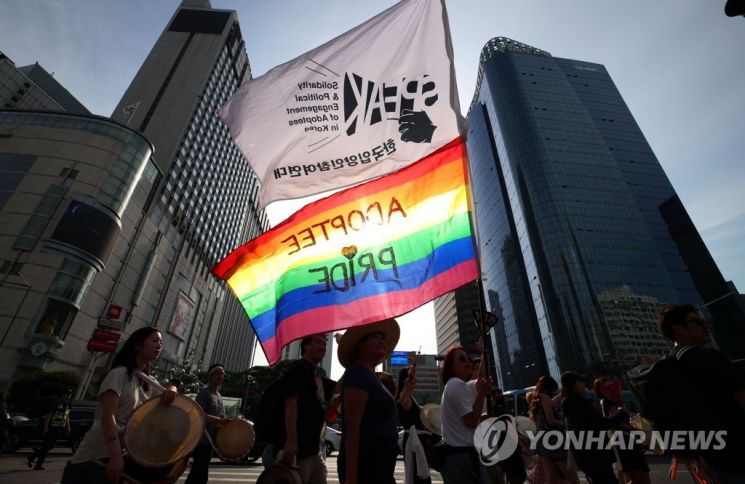
[Asia Economy Reporter Lim Juhyung] As the year 2022, the Year of the Black Tiger (Im In Year, 壬寅年), began, it has now been 15 years since attempts to legislate the 'Anti-Discrimination Act' started in South Korea. This bill, which aims to prevent discrimination in employment and education based on gender, disability, age, sexual orientation, and more, has been embroiled in intense debates between supporters and opponents and has ultimately failed to pass.
Human rights organizations are now raising their voices, urging the political sphere to take an active lead in enacting the Anti-Discrimination Act. They argue that while the bill has been stalled in the National Assembly, countless domestic sexual minorities have suffered, and public opinion has shifted in favor of the legislation.
◆The Anti-Discrimination Act Knocking on the National Assembly's Door for 15 Years
The Anti-Discrimination Act was first proposed in December 2007, during the final days of the Roh Moo-hyun administration. At that time, the government announced the legislative proposal for the 'Anti-Discrimination Act' through the Ministry of Justice. However, the bill was thwarted before it could properly enter the National Assembly due to strong opposition from conservative groups, including some Christian organizations.
The contentious issue was the scope of discrimination prohibited in the bill. The Ministry of Justice had set 20 categories of prohibited discrimination, including military service, academic background, country of origin and ethnicity, and sexual orientation. Among these, Christian groups took issue with the sexual orientation clause. Some Christian organizations criticized the bill as a 'law to legalize homosexuality.'
To oppose the legislation, Christian groups organized campaigns such as collecting signatures from professors and sending faxes with opposing opinions from related organizations. The 'Parliamentary Mission Alliance to Block the Anti-Homosexuality Discrimination Bill' was formed and held press conferences demanding the removal of the sexual orientation clause.
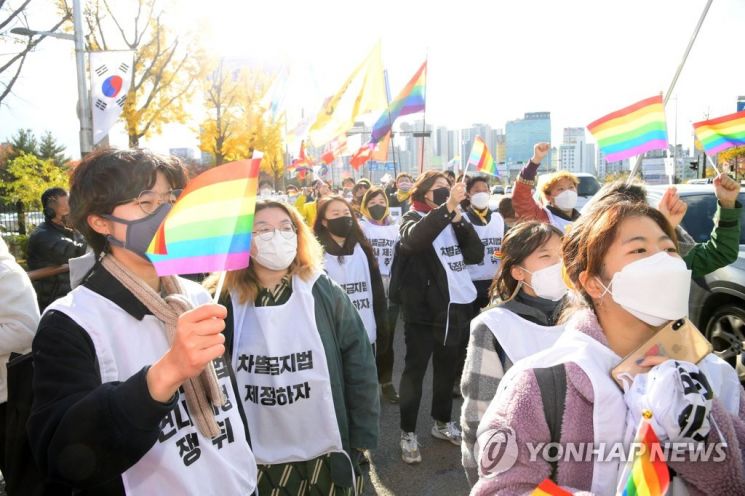 Human rights activists are participating in a walking march called the "Equality Walk for the Enactment of the Anti-Discrimination Act within the Year" near the National Assembly building in Yeouido, Seoul, on November 10 last year. / Photo by Yonhap News
Ultimately, in the following year, 2008, seven grounds for discrimination, including 'sexual orientation' and 'academic background,' were removed, but the bill was discarded due to the expiration of the 17th National Assembly's term.
Since then, attempts to legislate the Anti-Discrimination Act have continued steadily. In 2011 and 2012, progressive parties such as the Democratic United Party and the Unified Progressive Party led the bill's proposals. In 2013, lawmakers Kim Han-gil and Choi Won-sik of the Democratic United Party jointly introduced the bill, but these efforts also ended with the expiration of the National Assembly session or withdrawal.
In the 21st National Assembly, four related bills, including the 'Anti-Discrimination Act' proposed by Justice Party lawmaker Jang Hye-young, were introduced. Additionally, in June last year, a national petition for the enactment of the Anti-Discrimination Act gathered over 100,000 citizen signatures and was referred to the National Assembly's Legislation and Judiciary Committee (Law Committee). However, the committee decided to extend the review period for this petition until May 29, 2024, the last day of the 21st National Assembly's term.
◆"Later," "National Consensus Needed"?Political Sphere's Lukewarm Attitude
The political sphere's lukewarm attitude is also pointed out as one of the reasons the Anti-Discrimination Act has repeatedly failed to be enacted. Critics say lawmakers have been hesitant to actively push legislation, wary of religious voters' sentiments.
For example, President Moon Jae-in pledged to enact the Anti-Discrimination Act during his 2012 presidential campaign as the Democratic United Party candidate (predecessor of the Democratic Party of Korea), but in the 2017 presidential election, he withdrew the pledge citing the need for 'social consensus.' During the campaign, when a sexual minority woman asked him, "Do you oppose the Anti-Discrimination Act?" he deferred the answer by saying, "I will give you a chance to talk about it later," which drew criticism.
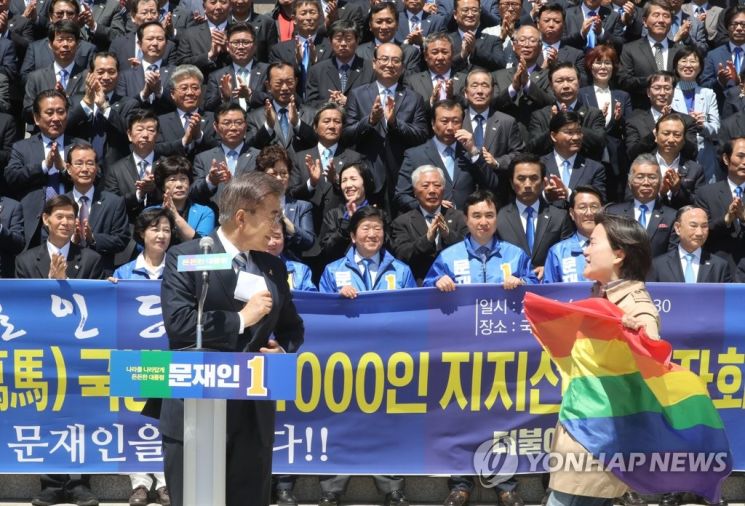 On April 26, 2017, Moon Jae-in, then the Democratic Party presidential candidate, attended a press conference for the "Cheongunmanma National Defense and Security 1,000-Person Support Declaration" held on the steps in front of the National Assembly main building, where a protest urging the enactment of the Anti-Discrimination Act for Sexual Minorities took place during his greeting. / Photo by Yonhap News
However, on November 25 last year, at the 20th anniversary ceremony of the National Human Rights Commission, President Moon emphasized the necessity of enacting the Anti-Discrimination Act, stating, "Creating a basic law on prohibition of discrimination is an attitude we must overcome to become a human rights advanced country."
Nonetheless, some in the political sphere criticized this as a belated move with only a few months left in his term. Kang Min-jin, leader of the Youth Justice Party, sarcastically remarked, "What is this double play of raising the Anti-Discrimination Act only now? Is it a 'gye-reuk' (a chicken rib?something not worth keeping but hard to discard) that they dislike pushing forward but don't want to abandon?"
The major party candidates preparing for the 20th presidential election have also not shown proactive attitudes. Democratic Party candidate Lee Jae-myung said during a visit to the Korea Christian Federation in November last year, "The Anti-Discrimination Act should reach national consensus through sufficient discussion," adding, "Unilateral processing is not desirable." During a visit to Chosun University in Gwangju the same month, he emphasized the necessity of the Anti-Discrimination Act but maintained a cautious stance, saying, "It must reach sufficient social consensus."
Meanwhile, People Power Party candidate Yoon Seok-youl expressed a reserved opinion at a Kwanhun Club debate in December last year, stating, "There are many controversies, so it must be carefully reviewed." Yoon explained, "(The Anti-Discrimination Act) is not about individual tendencies but about how to harmonize freedom and equality guaranteed by the Constitution," adding, "We should not emphasize equality alone."
◆"The Anti-Discrimination Act Can Resolve Basic Rights Violations of Sexual Minorities," Human Rights Groups Urge
Human rights organizations strongly oppose the political sphere's attitude. They point out that while the Anti-Discrimination Act remains stalled in the National Assembly, cases of actual harm to sexual minorities occur frequently.
 Former Corporal Byeon Hee-su saluting after stating his position on the military's forced discharge measure in January 2020 / Photo by Yonhap News
A representative case is former Sergeant Byeon Hee-soo, who was forcibly discharged after undergoing gender reassignment (gender confirmation) surgery during military service. In November 2019, Byeon used leave to undergo gender reassignment surgery abroad and returned to South Korea. After returning to the military, Byeon wished to continue serving as a female soldier, but the military held a discharge review committee and decided to discharge her, citing that she fell under the grounds for discharge according to the Military Personnel Act and related laws.
Byeon filed a personnel appeal requesting cancellation of the discharge decision, but the military rejected it. Eventually, Byeon's side filed an administrative lawsuit to cancel the discharge order. However, before the first hearing, she tragically passed away by suicide in March last year.
Regarding this, Bae Jin-kyo, representative of the civic group 'Rainbow Human Rights Solidarity,' said at a press conference, "Transgender people experience discrimination in all areas of daily life, such as using stores, insurance, banks, government offices, hospitals, and lease contracts," adding, "Hatred and discrimination against sexual minorities violate the basic rights of victims. The state must resolve this through the Anti-Discrimination Act."
Public opinion also overwhelmingly supports the enactment of the Anti-Discrimination Act. According to a national perception survey conducted by the National Human Rights Commission in June last year with 1,000 adults nationwide, 88.5% of respondents supported the enactment of anti-discrimination legislation. Additionally, 73.6% of respondents said, "Sexual minorities such as homosexuals and transgender people should be respected and treated equally like others." Nearly nine out of ten citizens supported the Anti-Discrimination Act.
Experts emphasize that enacting the Anti-Discrimination Act can be a cornerstone for a more inclusive society. Kim Ji-hak, director of the Korea Diversity Research Institute, explained, "The Anti-Discrimination Act is not a law created to impose criminal penalties for specific discriminatory acts but is significant in that the state stipulates that discrimination based on identity should not occur."
He continued, "For example, the perception that discriminating against or violently treating women or people with disabilities is wrong is already widespread in our society, and there are also penalty provisions for this. However, regarding sexual minorities, there is neither a bill nor even a proper awareness," adding, "If the Anti-Discrimination Act had been enacted 10 or 15 years ago, Korea might have become a more inclusive society by now."
He concluded, "The Anti-Discrimination Act recognizes that discrimination based on sexual orientation and other factors is a bad act and lays the foundational cornerstone for moving toward a society more friendly to all identities," urging prompt legislation.
© The Asia Business Daily(www.asiae.co.kr). All rights reserved.
![User Who Sold Erroneously Deposited Bitcoins to Repay Debt and Fund Entertainment... What Did the Supreme Court Decide in 2021? [Legal Issue Check]](https://cwcontent.asiae.co.kr/asiaresize/183/2026020910431234020_1770601391.png)