Import Volume Down 20% in Indonesia, Ban Imposed... Government Holds Emergency Resource Supply Management TF Meeting
[Sejong=Asia Economy Reporters Haeyoung Kwon and Sangdon Joo] Indonesia, the world's largest coal exporter, has decided to ban coal exports due to domestic supply shortages, raising alarms in the domestic power generation industry from the very beginning of the new year. With energy prices such as crude oil and liquefied natural gas (LNG) already rising, the coal export ban from Indonesia adds to concerns that supply shortages could further fuel price increases. The Ministry of Trade, Industry and Energy has formed a response team and begun preparing countermeasures.
According to the Ministry of Trade, Industry and Energy and foreign media on the 3rd, the Indonesian government has decided to ban coal exports for the entire month of January. After Indonesia set a domestic coal price cap at $70 per ton, local companies shifted supply to overseas exports priced at $90?100 per ton, making it difficult to secure coal needed for domestic power generation.
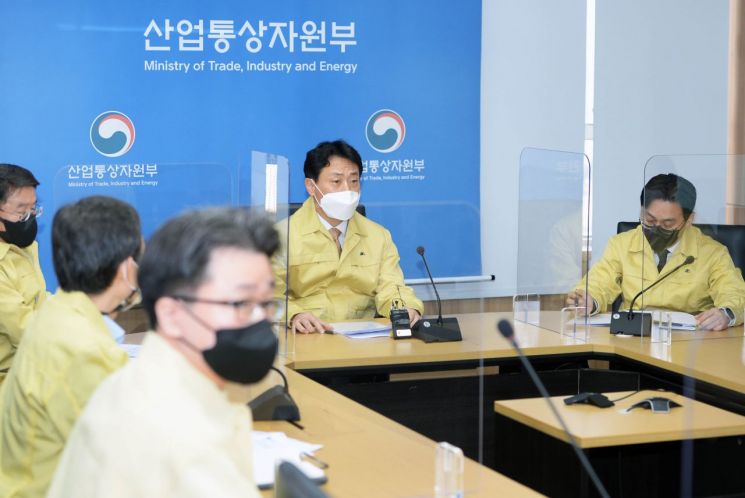
In response to Indonesia’s decision, the Ministry of Trade, Industry and Energy launched an emergency inspection. On the same day, the ministry held an "Energy and Resource Supply Management Task Force (TF) Emergency Meeting" chaired by Vice Minister of Energy Ki-young Park to review domestic energy and power supply trends following the coal export ban. The meeting was attended by presidents of five power generation public enterprises, the chairman of the Korea Power Exchange, a vice president of Korea Electric Power Corporation, representatives from coal trader KCH Energy, and commercial attach?s from Indonesia and China.
The ministry stated that the immediate impact on the domestic market is not significant. A ministry official said, "55% of Indonesian imported coal has already been shipped and is scheduled to arrive normally in the country. Considering inventory levels and normal imports from other countries, the short-term impact on domestic power supply is limited."
However, since Indonesia accounts for 20% of domestic coal imports, the possibility of a coal crisis cannot be completely ruled out. Indonesia is the world's largest coal exporter, having exported 400 million tons of coal for power generation last year. If the coal export ban period is extended citing domestic supply reasons, it will inevitably affect South Korea directly or indirectly through global price increases. Relatedly, Indonesian President Joko Widodo has instructed coal export reductions and the development of derivative industries since last year.
The International Energy Agency (IEA) reported that coal demand reached an all-time high last year and is likely to continue this year. In this context, Indonesia’s coal export ban is expected to cause supply instability centered on major importers such as China and India, potentially leading to a sharp rise in international coal prices.
According to the Ministry of Trade, Industry and Energy, the price of Australian Newcastle coal doubled from $83.72 per ton on January 1 last year to $165.86 per ton on December 31. Coal prices, which surged to $235.55 per ton in October of the same year before declining, could be further fueled by this situation. Previously, when Indonesia, which accounts for a quarter of the world’s nickel ore supply, halted nickel exports in 2019, nickel prices surged; a second nickel crisis could potentially recur.
The coal export ban during the winter season, when power demand is high, is also a cause for concern. Although the government has stopped operating some coal-fired power plants to reduce fine dust in winter, 45 out of 53 plants are currently operating this month. LNG power generation is also operating at maximum capacity, leaving little room for further expansion, according to the government. A ministry official said, "We are reviewing plans to secure additional inventory by limiting coal power generation output in preparation for the possibility of a prolonged situation," adding, "We are also operating a 'Indonesia Coal Export Ban Response Team.'"
A representative from a power generation public enterprise said, "There is no immediate impact on the power sector," but added, "There are concerns about price increases and long-term supply instability due to this export ban."
Vice Minister Park Ki-young emphasized, "Since the Indonesian measure occurred in January, when power demand is highest, a serious awareness and response are necessary," and urged, "Power companies should analyze the domestic impact of Indonesia’s coal export ban and prepare thorough contingency plans for various scenarios."
© The Asia Business Daily(www.asiae.co.kr). All rights reserved.