Documenting the Oral Histories of Public Officials Who Actively Served on the Frontlines During the Early Days of Seoul City’s Establishment
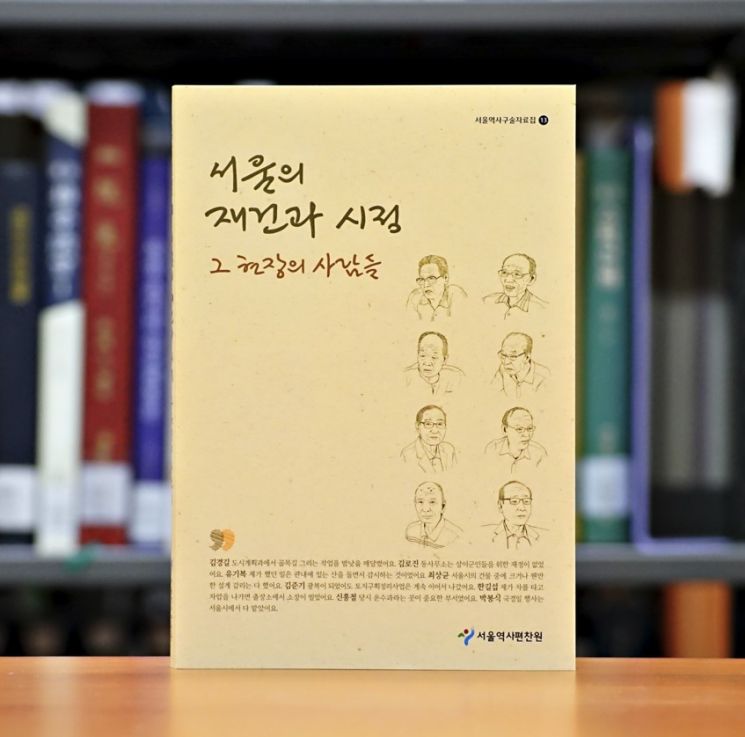
[Asia Economy Reporter Lim Cheol-young] The Seoul History Compilation Center announced on the 3rd that it has published Volume 13 of the Seoul Oral History Collection titled "Reconstruction and Municipal Administration of Seoul, The People on the Scene," which narrates the activities of early Seoul city officials through oral accounts.
Since 2009, the Seoul History Compilation Center has been conducting an oral recording project to deliver the vivid history of modern Seoul to its citizens and has published a total of 12 volumes in the Seoul Oral History Collection series.
The newly published Volume 13 records and organizes oral testimonies of officials who were active during the early days of Seoul's establishment. This book compiles accounts from those who worked on the front lines in Seoul during the late Japanese colonial period, immediately after liberation, the Korean War, and the post-war reconstruction period. It vividly contains testimonies about Seoul during the harsh late Japanese colonial era, the chaos following liberation, the horrors witnessed and experienced when Seoul was occupied by North Korean forces during the Korean War, and the efforts of those who worked tirelessly on-site for Seoul’s post-war reconstruction.
The book features a total of eight narrators. They began working as early as the late Japanese colonial period and remember the early administration of Seoul after liberation, including the appearance of the Seoul city hall building when it was occupied by North Korean forces during the Korean War. They also handled on-site duties during the post-war reconstruction process. Furthermore, they provide vivid accounts of Seoul city officials during the April 19 Revolution and the May 16 military coup, as well as the roles of Seoul city employees during the 1960s economic development and the large-scale construction that marked the beginning of a period of great change.
First, Kim Kyung-gil, born in 1919, began working in the Seoul City Urban Planning Department in 1947. During the Korean War, he was unable to evacuate and nearly taken by the People’s Volunteer Army. He also recalls the Seoul City liaison office that operated in the evacuation area after the January 4th retreat. After returning, he worked day and night on urban planning necessary for city reconstruction. From the 1960s onward, he worked as the head of district office construction.
Kim Ro-jin, born in 1921, started his public service career in 1952 as a clerk in Gwanggyo-dong, Jongno-gu. In his memories, the most important task of the local community offices in the 1950s and 1960s was election affairs. He talks about the election scenes and the secretly conducted fraudulent elections of the time. He also recalls the unfortunate situation where there was no government support for wounded veterans from the Korean War, making it impossible to provide proper assistance despite the desire to help.
Yu Ki-bok, born in 1921, worked from 1951 as a forest patrol officer at Yongsan District Office, overseeing logging and slash-and-burn farming in the area. As post-war reconstruction began, the demand for timber in Seoul increased, and forest products from Gyeonggi-do and Gangwon-do regions were brought into Seoul. The narrator was responsible for issuing permits for the removal of these materials.
Next, Choi Sang-gyun, born in 1923, began working as an architectural engineer for Seoul City in 1952. At that time, Seoul City directly designed and supervised buildings, and he recalls having worked on many buildings himself. Among them, he remembers most vividly being in charge of the restoration of Sungnyemun Gate, which was destroyed during the war. He also expressed his sorrow over the 2008 fire at Sungnyemun Gate.
All eight narrators featured in the oral history collection were frontline workers in Seoul’s municipal administration, not high-ranking officials or politicians. Seven of them have already passed away.
Lee Sang-bae, Director of the Seoul History Compilation Center, said, "I hope this serves as an opportunity to understand what the first steps taken by Seoul, which has risen to become a world-class city today through the dedicated sacrifice and active efforts of early Seoul city officials, looked like," and added, "we express our gratitude for the hard work of the late narrators and offer our sincere condolences through the publication of this book."
© The Asia Business Daily(www.asiae.co.kr). All rights reserved.
![User Who Sold Erroneously Deposited Bitcoins to Repay Debt and Fund Entertainment... What Did the Supreme Court Decide in 2021? [Legal Issue Check]](https://cwcontent.asiae.co.kr/asiaresize/183/2026020910431234020_1770601391.png)















