CU Domestic Beer Accounts for 58%
Gompyo Wheat Beer and Other 'Craft' Beers Popular
Diverse Flavors and Types Through Collaboration
Liquor Tax Law Revision Offers '41,000 Won' Discount
Sales Growth Rate Over 200% for 3 Consecutive Years
Traditional Liquor Online Sales Allowed
Rapid Growth Driven by MZ Generation Preferences
Gmarket Sales Volume Up 89%
[Asia Economy Reporter Seungjin Lee] Domestic alcoholic beverages are soaring in the COVID-19 era. In the beer market, craft beer is rapidly taking the place of imported beer. After craft beer introduced various flavors to the domestic beer market, which was dominated by lagers, it has stimulated the curiosity of the MZ generation (Millennials + Generation Z) through various intriguing collaborations. Domestic traditional liquors are also rapidly growing online in the non-face-to-face era brought on by COVID-19.
Rapid Growth of Craft Beer
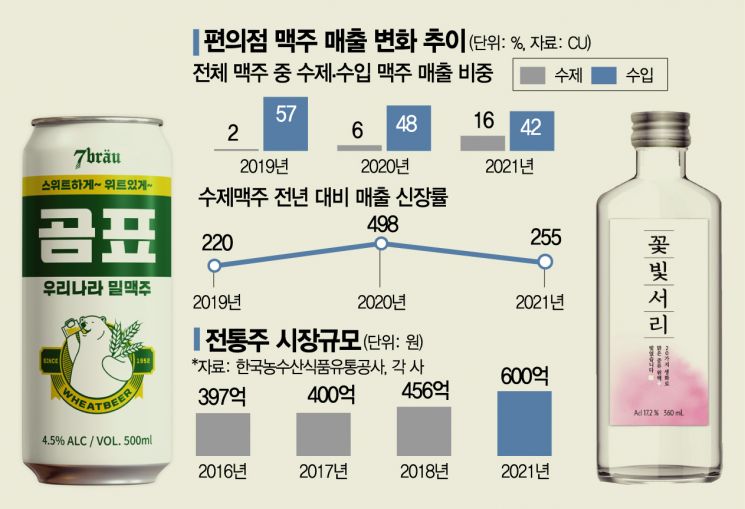
According to convenience store CU on the 31st, domestic beer accounted for 58.4% of the total beer sales this year, significantly surpassing imported beer at 41.6%. This is a stark contrast to just two years ago in 2019, when imported beer held 56.6% compared to domestic beer's 43.4%.
The shrinking market share of imported beer is due to the rapid growth of craft beer. Interest in craft beer surged sharply starting with the craze for Sevenbrau’s ‘Gompyo Wheat Beer’ last year. Since then, the three major convenience stores (CU, GS25, 7-Eleven) and the food industry have jumped into collaborations on craft beer, greatly increasing the variety of flavors and types. Young consumers previously favored imported beers, which offered diverse flavors and brands such as stouts and IPAs, due to the lack of variety in domestic beers that were mainly lagers.
Additionally, the revision of the Liquor Tax Act in January last year included craft beer in the ‘4 cans for 10,000 won’ discount promotions, which were previously unavailable for craft beer, leading to a surge in sales. CU’s year-over-year sales growth rate for craft beer was 220% in 2019, 498% in 2020, and 255% this year, marking over 200% growth for three consecutive years.
Imported Beer’s Shrinking Market Share
Starting January next year, it will be difficult to find imported beers participating in the ‘4 cans for 10,000 won’ discount promotions. As imported beers face rising raw material costs and are losing ground to domestic craft beers, they are raising prices to ‘4 cans for 11,000 won.’ Heineken, the top imported beer brand, raised its discount price in November. From January, discount prices for Budweiser, Stella Artois, Hoegaarden, Blanc 1664, San Miguel, and others will also increase.
The sharp rise in prices of beer raw materials such as hops and wheat last year due to COVID-19 had a significant impact. International prices for hops and wheat reached their highest levels since 2012, and transportation costs surged due to the pandemic, maintaining upward pressure on prices. The inclusion of craft beer in the ‘4 cans for 10,000 won’ promotion also significantly reduced profits for imported beers, according to the liquor industry.
The ‘4 cans for 10,000 won’ promotion holds an absolute position in the home beer market, so concerns are rising that the price increase for imported beer discount promotions will further narrow their market share. Imported beer has already been on a decline since 2018. According to customs import-export statistics, beer imports decreased by about 100,000 tons from approximately 390,000 tons in 2018 to 280,000 tons in 2020. As of November this year, beer imports were about 230,000 tons, down from last year.
An industry insider explained, "The cost burden has become too great, making the price increase unavoidable, but it is uncertain how consumers will react to the additional 1,000 won burden," adding, "The upward trend of craft beer is expected to continue for the time being."
Traditional Liquor Flourishing Online
In the non-face-to-face era, traditional liquors, which are allowed to be sold online, are also rapidly growing. Interest from the MZ generation seeking novelty has contributed to the traditional liquor market growing by nearly 40% over five years. According to online shopping site Gmarket, traditional liquor sales increased by 89% year-over-year from the 13th of last month to the 13th of this month. Makgeolli sales surged by 180%, driving the rise of traditional liquors. Sales of traditional soju representing various regions increased by 127%, fruit wines by 29%, and liqueurs, a mixed-flavor category, by 13%.
Preference for traditional liquor has increased among those under 40. Sales increased by 63% and 78% among people in their 20s and 30s, respectively, showing higher growth rates than those in their 50s (60%) and 60s (46%). People in their 40s purchased about twice as much traditional liquor compared to last year.
The overall traditional liquor market size is also growing annually. According to the Korea Agro-Fisheries & Food Trade Corporation, the traditional liquor market, which was only 39.7 billion won in 2016, grew to 45.6 billion won in 2018 and is expected to exceed 60 billion won this year.
© The Asia Business Daily(www.asiae.co.kr). All rights reserved.