Hydrogen Law Amendment Faces Parliamentary Hurdles... Hyundai, SK, POSCO Frustrated by Delays in Hydrogen Investments
Key Issue: Relaxation of Clean Hydrogen Scope, Broad Recognition Overseas
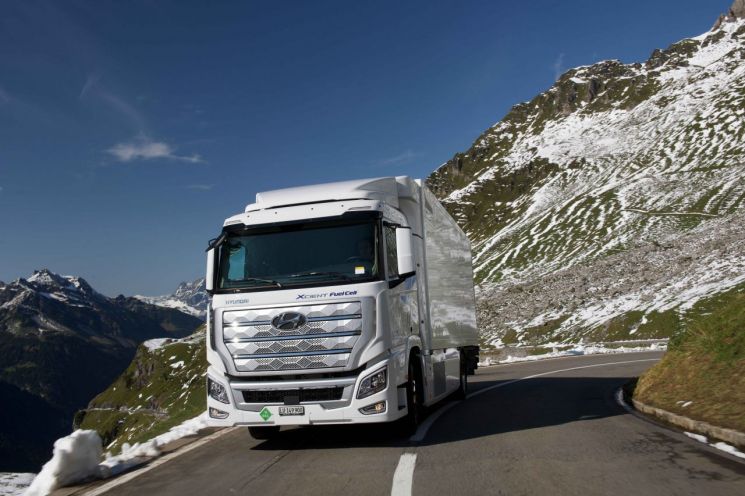
[Asia Economy Reporter Changhwan Lee] As the passage of the Hydrogen Act amendment in the National Assembly is delayed, the future strategies of companies nurturing hydrogen business as a future growth engine, including Hyundai Motor Company, SK, and POSCO, are also being hampered.
Companies are aggressively investing to secure a leading position in the global hydrogen economy, but the delayed legislative support from the National Assembly has put some investments at risk of suspension, creating a desperate situation.
Future Growth Hampered by the National Assembly
According to industry sources on the 30th, Hyundai plans to officially launch the Xcient hydrogen fuel cell truck in the domestic market starting next year. The Xcient hydrogen fuel cell truck is the world's first mass-produced large hydrogen fuel cell truck by Hyundai, and sales have already begun in European regions such as Germany and Switzerland.
Hyundai delayed the domestic launch of the Xcient hydrogen fuel cell truck compared to foreign markets due to the underdeveloped hydrogen infrastructure in South Korea.
South Korea still has a limited number of hydrogen charging stations and lacks a subsidy system for hydrogen trucks, so despite having developed the product, Hyundai has not been able to proceed with a full-scale launch.
The delayed amendment to the Hydrogen Act in the National Assembly is also slowing the spread of hydrogen vehicles. To expand hydrogen vehicles, a stable fuel supply is essential, but the National Assembly has yet to define the concept of clean hydrogen, preventing companies from making active investments.
The National Assembly’s Industry, Trade, Energy, Small and Medium Enterprises Committee has discussed the Hydrogen Act amendment several times this year but ultimately failed to reach an agreement.
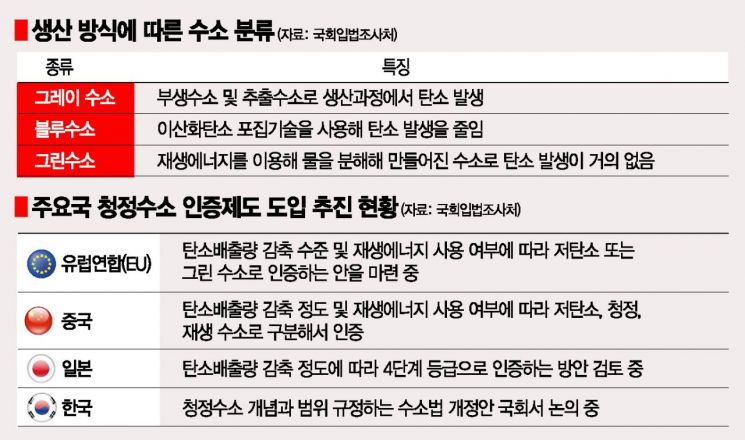
The core of the Hydrogen Act amendment is to include blue hydrogen, in addition to green hydrogen, within the scope of clean hydrogen. Green hydrogen is produced by splitting water using renewable energy sources such as solar and wind power, making it a clean energy with almost no carbon dioxide emissions. However, it is difficult to produce and costly.
Therefore, companies want the National Assembly to amend the Hydrogen Act to include blue hydrogen, which emits some carbon dioxide compared to green hydrogen, as clean hydrogen. However, some ruling party lawmakers and civic groups oppose this, preventing the amendment from passing.
Meanwhile, Europe, China, and Japan broadly recognize the concept of clean hydrogen, raising concerns that South Korea may fall behind in hydrogen energy development.
The delay in amending the Hydrogen Act raises concerns about Hyundai’s strategy to apply hydrogen energy to all mobility sectors, including automobiles, ships, and airplanes, by 2040. Hyundai leads the global hydrogen vehicle market, recording the highest global sales of hydrogen fuel cell vehicles until November this year, but due to insufficient domestic legislative support, it is uncertain whether it can maintain the top position next year.
Not only Hyundai but also companies like SK, POSCO, Lotte, and Hyosung, which have entered the hydrogen business, have announced plans to invest more than 43 trillion won by 2030 to develop the hydrogen economy, but even this is becoming difficult to maintain.
Ryu Kyung-joo, a legislative researcher at the National Assembly Research Service, said, "The European Union (EU), China, Japan, and other countries are establishing clean hydrogen certification standards and grades considering their circumstances, such as carbon dioxide emissions in hydrogen production processes and hydrogen production conditions (production technology level and economic feasibility). South Korea also needs to establish clean hydrogen certification standards suitable for its characteristics."
"Urgent Passage of Hydrogen Act Amendment"... Appeal to the National Assembly
As the National Assembly delays the passage of the Hydrogen Act amendment, hydrogen investments by related companies, including Hyundai, are at risk of suspension. The Korea H2 Business Summit, a private hydrogen-related consultative body consisting of 16 member companies such as Hyundai, SK, and POSCO, urged the prompt passage of the pending Hydrogen Act amendment in the National Assembly on the 21st, reflecting this background.
The Summit emphasized, "Many domestic companies in the automobile, petrochemical, and materials sectors trust the government's commitment to the transition to a hydrogen economy and are investing tens of trillions of won in hydrogen production, distribution, and sales, but delayed legislative support is putting these investments at risk of suspension."
They added, "Our companies have already made massive investments in carbon dioxide capture and removal, hydrogen fuel cell development, hydrogen commercial vehicle development, hydrogen ship development, hydrogen liquefaction plant construction, and charging stations. The Hydrogen Act amendment is the first step, but it has not even passed the threshold of the National Assembly’s relevant standing committee."
Furthermore, they stated, "If the amendment is further delayed and the implementation of the system becomes uncertain, companies’ investments in the hydrogen economy will inevitably be suspended, and South Korea’s strategy to lead the hydrogen economy will face difficulties."
The Korea H2 Business Summit, launched in September to activate the hydrogen economy through cooperation among companies, includes participants such as Hyundai Motor Group, SK Group, Lotte Group, POSCO Group, Hanwha Group, GS Group, Hyundai Heavy Industries Group, Doosan Group, Hyosung Group, and Kolon Group.
© The Asia Business Daily(www.asiae.co.kr). All rights reserved.