Nuriho Launch Investigation Committee to Announce Findings on 29th
Early Shutdown of 3rd Stage Engine Caused by Design Flaws
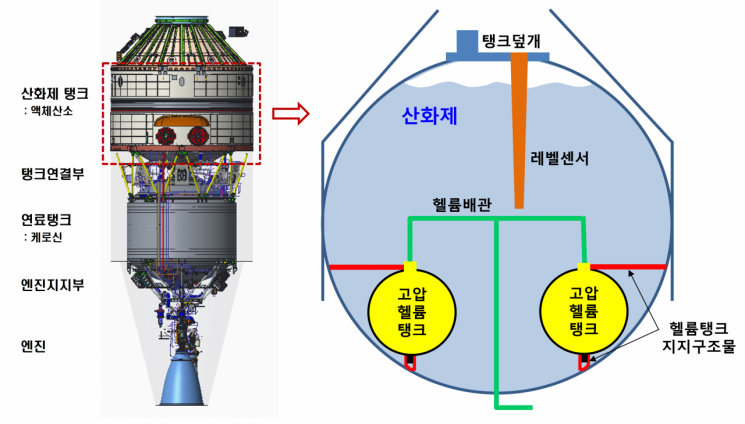
Helium Tank in Oxidizer Tank Poorly Secured, Detached 36 Seconds After Launch
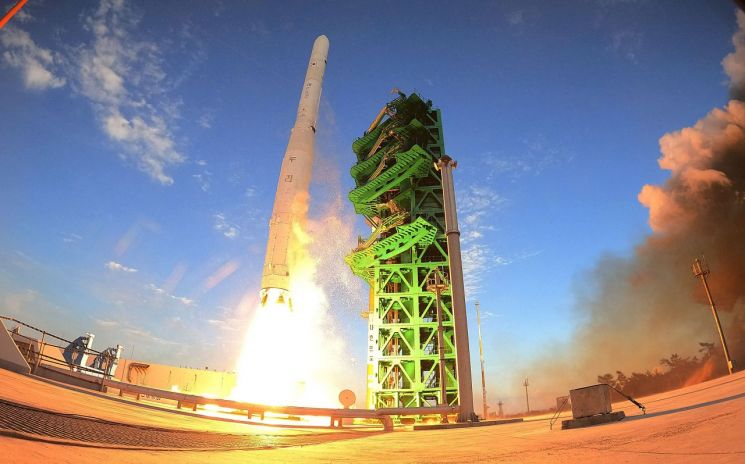 The Korean launch vehicle Nuriho (KSLV-II), designed and manufactured entirely with domestic technology, was launched on October 21 at the Naro Space Center in Goheung-gun, Jeollanam-do. [Image source=Yonhap News]
[Asia Economy Reporter Kim Bong-su] It has been confirmed that the failure of South Korea's first indigenous space launch vehicle, Nuri, launched on October 21, to insert the dummy satellite into orbit due to the premature shutdown of the third stage rocket was caused by a design flaw. Thirty-six seconds after launch, the fixing device of the helium tank inside the oxidizer tank of the third stage engine was improperly designed, causing it to come loose, which lowered the pressure and led to the early shutdown of the engine.
The Ministry of Science and ICT and the Korea Aerospace Research Institute announced the results of the "Nuri Launch Investigation Committee" on the morning of the 29th, revealing these findings.
At the time, all flight operations of Nuri, including ignition, fairing separation, and stage separations, proceeded normally. However, the third stage engine shut down about 46 seconds earlier than expected for unknown reasons, causing the final velocity to fall short of the required 7.5 km/s to place the dummy satellite into orbit, resulting in mission failure to "insert the dummy satellite into orbit." Consequently, the dummy satellite failed to enter orbit and reportedly crashed into the sea south of Australia, approximately 8,000 km away from South Korea.
In response, the Ministry of Science and ICT formed a launch investigation committee at the end of October, including researchers from KARI and external experts, and held five meetings to investigate technical matters. Based on over 2,600 telemetry data points acquired during the flight, they identified anomalies that occurred during Nuri's flight and determined the causes. In particular, during the early stages of the investigation, it was confirmed that the pressure in the third stage oxidizer tank dropped, causing the engine to shut down prematurely, focusing on pinpointing the specific cause.
The investigation confirmed that 36 seconds after launch, unusual vibrations were detected in the third stage tank connecting truss and satellite adapter inside the launch vehicle. Helium began leaking from the helium tank inside the third stage oxidizer tank, causing the gas pressure in the oxidizer tank to rise. Additionally, 67.6 seconds after launch, the gas pressure in the third stage oxidizer tank dropped, and the upper surface temperature sharply decreased. At 115.8 seconds, the helium tank pressure decreased while the gas pressure in the third stage oxidizer tank increased. Through this process, the third stage engine of Nuri shut down 46 seconds earlier than planned.
The investigation committee concluded that the cause of this phenomenon was insufficient consideration of buoyancy increase during flight acceleration when designing the fixing device of the helium tank installed inside the third stage oxidizer tank of Nuri. As a result, during actual flight, when the buoyancy of liquid oxygen applied to the helium tank increased, the fixing device came loose, causing the helium tank to detach from its lower mount. Subsequently, the detached helium tank continued to move, deforming the tank piping and causing helium leakage, which led to cracks in the oxidizer tank and oxidizer leakage. This reduced the amount of oxidizer supplied to the third stage engine, resulting in the premature shutdown of the engine.
Based on these investigation results, the Ministry of Science and ICT and KARI plan to prepare detailed corrective measures and finalize the future schedule. Technical improvements will focus on reinforcing the helium tank fixing device and the structure of the oxidizer tank.
Choi Hwan-seok, Deputy Director of KARI and chair of the launch investigation committee, said, “We regret and apologize for not adequately considering the increase in buoyancy during flight acceleration in the design, which failed to meet the expectations of the public. We will prepare for the second launch through thorough improvements.”
Kwon Hyun-jun, Director of the Mega Public Policy Division at the Ministry of Science and ICT, stated, “We will finalize the future schedule for technical measures through the Project Promotion Committee and the National Space Working Committee.”
© The Asia Business Daily(www.asiae.co.kr). All rights reserved.


















