Ministry of the Interior and Safety's First 'Reality Check'
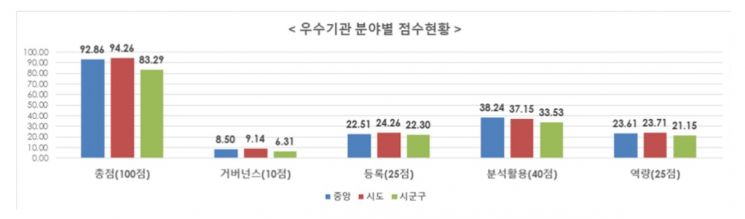
[Asia Economy Reporter Lim Cheol-young] The results of the data-driven administration status inspection showed that central administrative agencies and metropolitan local governments had a good level of data-driven administration operation, while basic local governments were relatively lower.
On the 29th, the Ministry of the Interior and Safety held the 'Data-Driven Administration Activation Committee' and reviewed the results of the data-driven administration status inspection conducted on 288 central administrative agencies and local governments.
The inspection results showed that the operational level of basic local governments was 83.23 points, which was relatively lower compared to 92.86 points for central administrative agencies and 94.26 points for metropolitan local governments. By agency type, central administrative agencies showed excellence in 'Cheo' and 'Bu', while most metropolitan local governments were evenly good, with 'Do' being excellent.
Looking at the inspection results by field, the 'Governance' field, which evaluates internal interest, personnel, and budget for data-driven administration, and the 'Utilization Capability' field, which assesses the data utilization capacity of agency members, were relatively good. The 'Data Registration' field, which evaluates the discovery, registration, and provision of shared data, and the 'Analysis and Utilization' field, which evaluates the discovery and execution of data analysis tasks and policy utilization, showed greater variation among agencies compared to other fields.
In the 'Governance' field, most agencies faithfully implemented the appointment of responsible officers, designation and operation of organizations and personnel, and budget reflection, but the formation and operation of internal and external consultative bodies to spread the atmosphere within the agency were somewhat insufficient. The Ministry of Employment and Labor, Sejong City, Chungnam, Gangdong-gu in Seoul, and Michuhol-gu in Incheon received high scores in the establishment of internal promotion systems.
In the 'Utilization Capability' field, education performance was relatively good, but diagnosis of data-driven administration capabilities by agency and establishment of improvement plans, as well as efforts to spread the culture, were somewhat insufficient. However, the Ministry of Science and ICT, the Legislation Office, Gwangju Metropolitan City, and Tongyeong City actively made efforts to diagnose utilization capabilities, establish improvement plans, operate youth internships, hold competitions, and share best practices to promote data-driven administration within agencies.
In the 'Data Registration' field, most agencies registered the shared data designated by the Ministry of the Interior and Safety, but the discovery and registration performance of shared data by the agencies themselves were insufficient. However, the Ministry of Food and Drug Safety, Busan City, and Gyeonggi Province actively conducted status surveys, department consultations, and target discovery to discover and register shared data, receiving excellent evaluations in registration performance indicators.
In the 'Analysis and Utilization' field, there was a large gap in capabilities among agencies in discovering and performing data analysis tasks and excellent cases of policy utilization, resulting in greater score variation among agencies compared to other fields. However, the Ministry of Oceans and Fisheries, Ministry of Land, Infrastructure and Transport, Incheon City, Geumsan-gun in Chungnam, and Seocho-gu in Seoul were highly evaluated for cases supporting policy issue resolution through data analysis.
The Ministry of the Interior and Safety plans to actively encourage participation in data-driven administration by supporting customized education such as consulting and data utilization capability training to close the capability gap among underperforming agencies, while minimizing document submission and linking with existing evaluation systems to reduce the burden of status inspections on inspected agencies.
Additionally, to promote the spread of data-driven administration atmosphere within agencies, the ministry will improve inspection indicators and procedures, strengthen linkage with central and local government innovation evaluation indicators, and supplement systems and procedures.
Han Chang-seop, Director of the Government Innovation Organization Office, said, “This status inspection, conducted for the first time since the enforcement of the Data-Driven Administration Act, was meaningful in raising awareness of data-driven administration overall and spreading the necessity of data utilization. Next year, we will strive to enhance the effectiveness of policies through data-centered scientific administration and provide public services that citizens can tangibly experience.”
© The Asia Business Daily(www.asiae.co.kr). All rights reserved.

















