Professor Kwon Osang and Professor Jeong Dongil's Team Propose a New Mathematical Model
 Ulsan National Institute of Science and Technology (UNIST) has proposed a behavioral mathematical model that analyzes human behavior in limited sequential decision-making situations. (From left: Professor Jeong Dong-il, Researcher Seon Hee-young, Professor Kwon Oh-sang)
[Asia Economy Yeongnam Reporting Headquarters, Trainee Reporter Lee Seryeong] Why does the standard change when choosing a spouse? Domestic researchers have approached this subjective feeling scientifically and presented interesting research results.
Professors at Ulsan National Institute of Science and Technology (UNIST) provided evidence for why the standard changes when selecting a spouse.
The research team pointed out that the commonality between finding a marriage partner and purchasing a house is realistic constraints, and that one must stop searching and make a choice at a certain point without knowing all the options.
It is experimentally known that irrational choices are made in this situation called limited sequential decision-making, and the research team took on the task of explaining the reason.
The team led by Professors Kwon Osang and Jeong Dongil from the Department of Biomedical Engineering at UNIST analyzed human behavior in limited sequential decision-making situations and proposed a new behavioral mathematical model to explain it.
This model explains why people make irrational decisions with higher expectations than the objective values calculated based on probabilities.
The research team created this mathematical calculation model based on behavioral economics theory that people evaluate gains and losses differently according to their subjective standards.
They explained that if the presented option is higher than an individual's subjective standard, satisfaction or utility becomes positive, but if it is lower than this standard, the utility itself becomes negative.
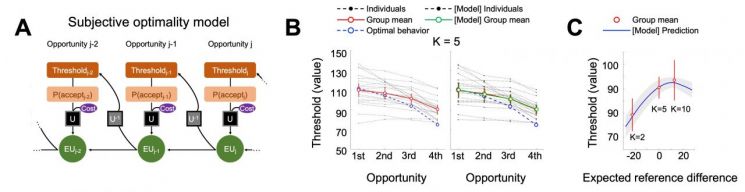 Overview and Experimental Results of the Subjective Rationality Model Proposed by the UNIST Research Team.
The new mathematical calculation model explained the irrational decision-making patterns shown by people in the team's experiment.
Participants chose a number from 1 to 150 in each round, and the sum of the values they selected in each round was converted into money.
The numbers were presented randomly, and there were up to five chances to choose per round; if a number was selected within five attempts, that round ended immediately.
The experiment showed that people's expectations were higher than the objectively optimal values calculated by probability, consistent with other studies.
At the beginning of each round, people had high standards expecting large numbers, but as opportunities were gradually used up, the standard lowered; however, the decline in the standard was more gradual than the change in the objectively calculated expected value.
The model reflecting subjective rationality accurately predicted this pattern of change, meaning that participants did not simply maximize mathematically calculated optimal values but made choices that maximize satisfaction.
Because they do not maximize probabilistic gains, their choices are objectively irrational but rational in terms of maximizing subjective value of satisfaction.
This model well explained the phenomenon where, in situations with many options, participants' expectations decline more gradually than mathematically calculated optimal values.
Although the mathematical optimal values for the fourth chance out of five and the first chance out of two are the same, the experiment clearly showed that the more chances participants had, the less their expectations dropped.
The research team also conducted an experiment measuring participants' pupil sizes to empirically verify the mathematical model.
When numbers close to an individual's subjective standard were presented, strong changes in pupil size were observed. People more sensitive to subjective satisfaction showed greater pupil size changes.
The research team said that the subjective rationality model proposed in this study provides neurophysiological evidence that well represents the information processing occurring in the brain.
Computational mathematical modeling is an approach to overcome the limitations of simply observing behavioral patterns by explaining the causal relationships of information processing in the brain with mathematical functions, useful for understanding individual differences in information processing.
The results of this study were published on the 16th in PLoS Computational Biology, a journal of computational biology.
Professor Kwon Osang said, “Applying the subjective utility function of economic prospect theory to the optimization model of sequential decision-making can explain sequential decision-making behavior, previously considered irrational, well without additional assumptions.”
Professor Jeong Dongil said, “The subjective rationality model also helps understand the subjective value evaluation process occurring in the brain and the misformed personal value standards, and it could explain behaviors such as impulsive decision-making in drug addiction and decision-making delay disorders.”
© The Asia Business Daily(www.asiae.co.kr). All rights reserved.


















