[Asia Economy (Suwon) = Reporter Lee Young-gyu] A study has found that the 'MZ generation' experiences greater job insecurity and depression compared to other generations, and has a lower overall life satisfaction.
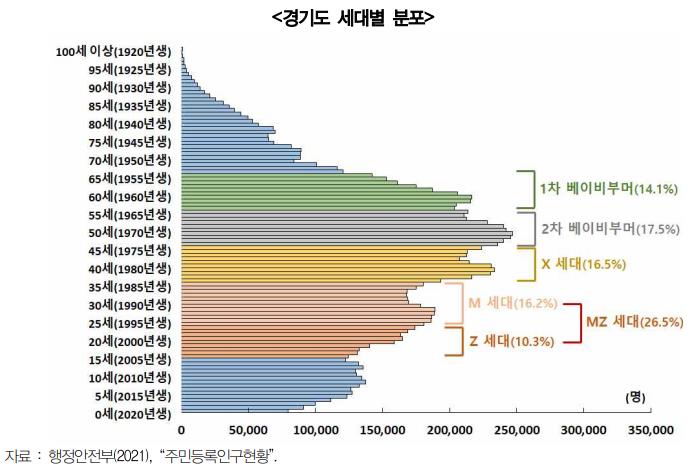
The MX generation is a collective term for the Millennial generation born in the early 1980s to early 2000s and the Z generation born in the mid-1990s to early 2000s.
The Gyeonggi Research Institute announced on the 28th the report "Looking into the MZ Generation," which reanalyzed the "2020 Gyeonggi Residents' Quality of Life Survey" conducted from September to November last year on over 16,000 households in the province by generation.
The institute classified generations as Z generation (born 1997?2005), M(Y) generation (born 1985?1996), X generation (born 1975?1984), second baby boomers (born 1965?1974), and first baby boomers (born 1955?1964). Among these, the MZ generation accounted for 26.2% of the total residents.
In the survey question asking whether respondents felt happy in the past week, 74.9% of the X generation answered they were happy, the highest proportion, while the Z generation had the lowest at 65.3%. The proportion of those who responded that they were unhappy was also highest among the Z generation at 12.6%.
When asked if they felt depressed in the past week, the Z generation recorded 22.6%, second only to the first baby boomers at 23.5%.
In particular, 13.0% of the Z generation responded that they experienced a high level of stress in daily life, which was relatively higher than the M generation (8.6%) and X generation (7.2%).
This was analyzed as being influenced by restrictions on daily life and economic downturns due to COVID-19 and other factors affecting mental health.
Overall, the proportion of respondents satisfied with their life was 71.6% for the Z generation, the second lowest after the first baby boomers at 71.4%.
Among satisfaction surveys (out of 10 points) in nine areas including leisure, household finances, education, housing, and employment, satisfaction in the employment area was lower for the M generation (6.00 points) and Z generation (5.55 points) than for the X generation (6.12 points).
Notably, the employment satisfaction score of the Z generation was the lowest among the nine areas surveyed across all generations.
The generation showing significant job insecurity currently is the group of social newcomers, indicating that securing stable work opportunities is an important practical issue for the MZ generation, the institute explained.
Yoo Jung-kyun, a research fellow at the Gyeonggi Research Institute, analyzed, "The MZ generation commonly experiences high job insecurity and depression, and is the group whose quality of life has declined the most compared to before COVID-19. Strengthening policies for stability and mental health recovery is necessary."
© The Asia Business Daily(www.asiae.co.kr). All rights reserved.

















