"Severe Cases of Omicron Variant Fewer Than Delta"
South Africa's Confirmed Cases Drop from 27,000 to 15,000 Range

[Asia Economy Reporter Hyunwoo Lee] Research results from South Africa, where the COVID-19 Omicron variant was first discovered, and the UK, where the spread is currently most severe, have shown that the risk of hospitalization from the Omicron variant is 70-80% lower compared to the Delta variant. In South Africa, the daily number of COVID-19 cases has sharply declined since last week, raising the possibility that the peak has passed, which is expected to significantly ease the global fear of Omicron.
However, experts pointed out that these research results are still preliminary, and considering the spread of the Omicron variant and the increase in breakthrough infections, the infection patterns of Omicron should be examined more cautiously.
According to the Wall Street Journal (WSJ) on the 22nd (local time), researchers at the University of Edinburgh in Scotland announced in an online report that "after tracking the health records of 5.4 million Scottish residents, the risk of hospitalization for Omicron variant infections was found to be about 70% lower than for Delta variant infections."
The research team compared 23,840 Omicron infection cases and 125,611 Delta infection cases in Scotland from last month’s 1st to this month’s 9th, reporting that there were only 15 hospitalizations among Omicron cases, compared to 856 hospitalizations among Delta cases.
Similar research results were also released in South Africa. According to research published online by the South African National Institute for Communicable Diseases (NICD) on the same day, the risk of hospitalization for Omicron variant infections was 70-80% lower than for Delta variant infections. Professor Cheryl Cohen, who led the NICD study, stated in a press briefing, "Among Omicron variant infections, cases requiring oxygen therapy or intensive care unit treatment due to complications are much fewer compared to Delta variant confirmed cases."
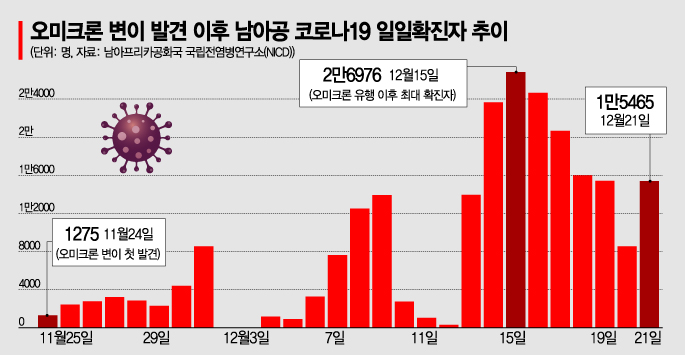
In South Africa, the daily number of COVID-19 cases has also significantly decreased. According to South African health authorities, as of the 21st, the daily number of COVID-19 cases was 15,465, which is more than 10,000 fewer than the 26,976 cases recorded on the 15th. Since the Omicron variant was first discovered on November 24th, the number of confirmed cases surged but began to decline after peaking on the 15th.
Within South Africa, Gauteng Province, known as the epicenter of the Omicron variant, has seen an even larger decrease in cases. According to the Associated Press, daily cases in Gauteng peaked at 16,000 on the 12th and dropped to 3,300 by the 21st. Marta Nunes, a senior researcher at the University of the Witwatersrand in South Africa, told the AP, "These figures indicate that the peak of the Omicron wave in this region, which has been the center of the outbreak for the past few weeks, has passed," adding, "The numbers of hospitalized patients and deaths are also not as severe compared to the previous Delta variant."
While welcoming these research results, experts warned against excessive optimism, noting that these are still early-stage findings. Dr. James Naismith, Professor of Structural Biology at the University of Oxford and Director of the Rosalind Franklin Institute, stated in a statement distributed through the UK Science Media Centre, "The studies released from South Africa and Scotland are encouraging but come from early research stages, and the figures and results may change in the future." He added, "Although Omicron causes milder symptoms, breakthrough infections are occurring even among those who have completed their second vaccination, so if Omicron infections increase exponentially, there could be more hospitalizations than with the Delta variant."
© The Asia Business Daily(www.asiae.co.kr). All rights reserved.
!["The Woman Who Threw Herself into the Water Clutching a Stolen Dior Bag"...A Grotesque Success Story That Shakes the Korean Psyche [Slate]](https://cwcontent.asiae.co.kr/asiaresize/183/2026021902243444107_1771435474.jpg)

















