Dow, S&P 500, and Nasdaq All Fall Over 1% Compared to Previous Day
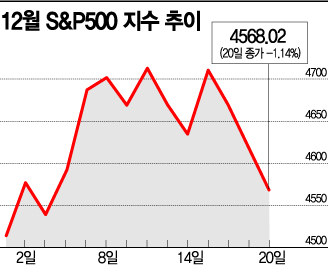
S&P 500 Index Drops for 3 Consecutive Days, Largest Decline Since Last September
China Cuts Benchmark Interest Rate...Interpreted as a Measure to Prevent Economic Slowdown
[Asia Economy New York=Correspondents Baek Jong-min and Ji Yeon-jin] Major indices on the New York Stock Exchange fell for the third consecutive day, unable to overcome fears of the spread of the Omicron variant. Instead of the anticipated Santa rally ahead of Christmas and year-end, a fear rally suddenly struck the market. The crisis of the collapse of the social infrastructure investment bill by the Joe Biden administration compounded the situation, causing forecasts for next year's U.S. economic growth to plummet.
On the 20th (local time), the Dow Jones Industrial Average fell 433.28 points (1.23%) to close at 34,932.16, the S&P 500 dropped 52.62 points (1.14%) to 4,568.02, and the Nasdaq fell 188.74 points (1.24%) to 14,980.94. The S&P 500 recorded a decline of around 1% for three consecutive days. Bloomberg reported that the three-day drop was the largest since last September.
As European countries expanded lockdown measures to curb the spread of Omicron, investor sentiment was severely dampened. The previous day’s near collapse of the social infrastructure bill pushed by U.S. President Joe Biden also had a negative impact.
The potential failure of the social infrastructure bill is expected to drag down U.S. economic growth as well. Investment bank Goldman Sachs, reflecting the bill’s collapse, lowered its forecast for U.S. economic growth in the first quarter of next year by 1 percentage point to 2%.
Electric vehicle companies such as Tesla and Rivian, as well as solar power-related firms that were expected to benefit from the social infrastructure bill, also plunged one after another. Tesla dropped to the $800 range, earning the nickname “800Sla.”
The market also viewed negatively China’s 0.05 percentage point cut in the Loan Prime Rate (LPR), which serves as its benchmark interest rate, from 3.85% to 3.80%. Concerns grew that this could be a prelude to a global economic downturn. China’s economic growth rate sharply slowed from 18.3% in the first quarter to 7.9% in the second quarter and 4.9% in the third quarter. Bloomberg forecasted that the fourth quarter growth rate would be only 3.2%. In response, the People’s Bank of China took the unprecedented step of cutting the benchmark interest rate to prevent further economic slowdown.
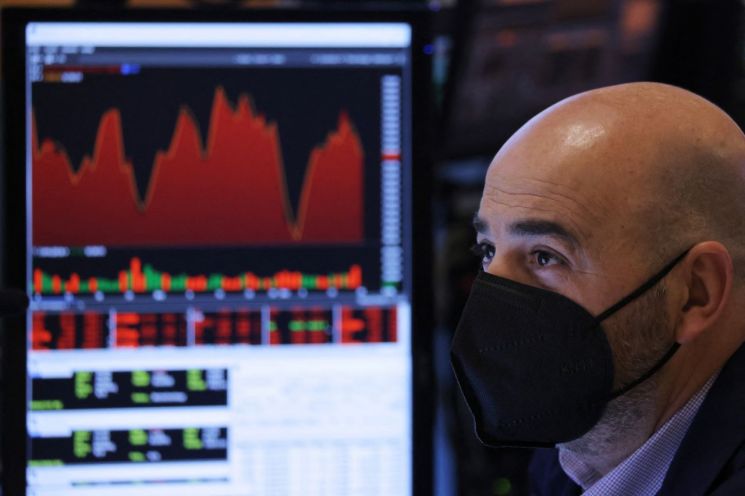 On the 20th (local time), a trader wearing a mask is seen staring at a monitor on the floor of the New York Stock Exchange (NYSE). On this day, the New York stock market declined following news of strengthened lockdown measures by various countries due to the spread of the COVID-19 Omicron variant. The Dow Jones Industrial Average fell 1.23% compared to the previous session, with all three major indices showing a downward trend.
 [Photo by Reuters]
As anxiety spread, the Chicago Board Options Exchange (CBOE) Volatility Index (VIX), known as the “fear index,” rose 1.30 points (6.03%) to 22.87.
The U.S. 10-year Treasury yield, reflecting a flight to safe assets, reached 1.39% during the day but recovered to the 1.4% range in the afternoon. Although Treasury yields rose slightly, bank stocks also failed to avoid declines. JP Morgan and Goldman Sachs were among those that fell.
COVID-19 vaccine stocks, which were expected to benefit from the spread of Omicron, also plunged. Moderna initially surged nearly 10% after announcing that its booster shot increased neutralizing antibodies against the Omicron variant by 37 times compared to the second dose, but later reversed course and closed down 6%.
Jim Paulsen, Chief Investment Strategist at Roy Holt Group, explained, “With the combined impact of the Omicron spread and the collapse risk of the social infrastructure investment bill, the S&P 500 broke below its 50-day moving average.”
Despite the sharp drop in the New York stock market, the domestic market on the 21st showed relatively strong resilience, supported by Samsung Electronics and SK Hynix. The KOSPI, which had closed down 1.81% the previous day, fluctuated around the flat line.
The KOSPI started at 2,981.67, up 0.63%, but fell 0.24% to 2,955.90 at 10:10 a.m. As of 10:20 a.m., the index was up 0.15% at 2,967.55. Although the index was slightly positive, the market atmosphere was not good, with 581 stocks declining?more than twice the 257 stocks that rose.
The index was supported by the top two market cap stocks, Samsung Electronics and SK Hynix. Influenced by a 7% surge in U.S. semiconductor company Micron the previous day, Samsung Electronics rose nearly 1%, and SK Hynix climbed more than 3%.
The main buyers defending the index were institutional investors. Within the first 1 hour and 30 minutes of trading, institutions net bought over 280 billion KRW, mainly in financial investments (225 billion KRW). In contrast, individual investors sold about 240 billion KRW, and foreigners sold about 40 billion KRW.
Lee Jae-man, a researcher at Hana Financial Investment, explained, “Because the global stock market situation is very poor, the domestic index could see larger declines overall, but Samsung Electronics and SK Hynix, which attracted buying due to Micron’s strong earnings report in the U.S. the previous day, are providing support.”
© The Asia Business Daily(www.asiae.co.kr). All rights reserved.
![Clutching a Stolen Dior Bag, Saying "I Hate Being Poor but Real"... The Grotesque Con of a "Human Knockoff" [Slate]](https://cwcontent.asiae.co.kr/asiaresize/183/2026021902243444107_1771435474.jpg)

















