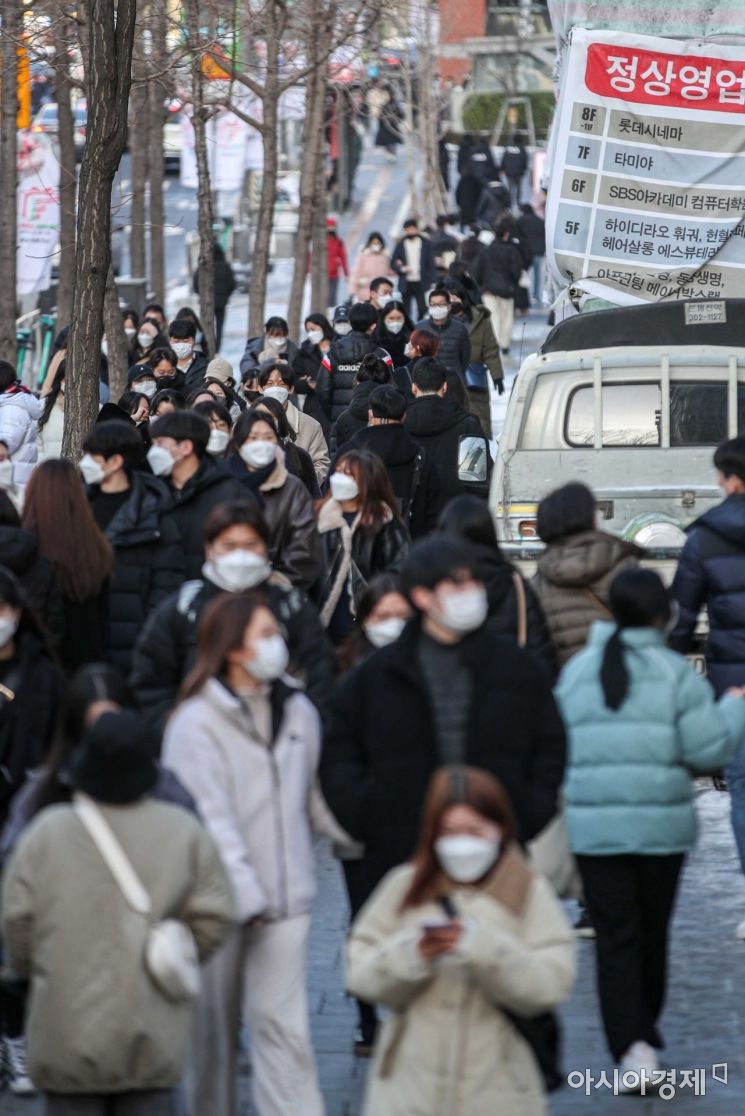
 As COVID-19 cases increased, the first weekend under the strengthened social distancing measures on the 19th saw the streets near Hongdaeipgu Station in Seoul crowded with citizens. Photo by Jinhyung Kang aymsdream@
[Asia Economy Reporter Kim Daehyun] The Central Disease Control Headquarters (CDCH) announced on the 20th that the weekly COVID-19 risk assessment for the 3rd week of December (from the 12th to the 18th) rated the risk level as 'Very High' nationwide, in the metropolitan area, and in non-metropolitan areas.
The nationwide risk level has been evaluated as 'Very High,' the highest level, for four consecutive weeks from the 4th week of November through last week. The CDCH assesses COVID-19 risk based on 17 evaluation indicators across three domains: response capacity, incidence status, and vaccination. Each week, the risk is rated on a five-level scale: Very Low, Low, Moderate, High, and Very High.
According to the CDCH on this day, the average daily confirmed cases in the 3rd week of December reached 6,866, maintaining a rapid increase trend, but the number of hospitalized patients slightly decreased compared to the previous week. The average daily number of critically ill patients in care surged to 945, and the number of deaths was 434, increasing by 138 and 33 respectively compared to the previous week.
A CDCH official stated, "The nationwide intensive care unit bed occupancy rate increased in both the metropolitan and non-metropolitan areas. The metropolitan area continues to exceed medical response capacity, and the non-metropolitan areas are also reaching their limits."
The CDCH positively evaluated the increase in the third-dose vaccination rate among the elderly aged 60 and above. Although the securing of hospital beds has not kept pace with the speed of case increases, leading to limitations in epidemiological investigations, the third-dose vaccination rate for those aged 60 and above rose significantly to 54.8%, up from 31.4% last week.
Meanwhile, the Disease Control and Medical Subcommittee of the Daily Recovery Support Committee analyzed in a meeting on the 19th that "if measures such as expanding the third-dose vaccination are appropriately implemented, there is a possibility of a return to a declining trend." They also emphasized, "It is necessary to rapidly introduce oral antiviral treatments and consider shortening the application period, and to accurately track the trend of Omicron to prevent its spread in the community."
© The Asia Business Daily(www.asiae.co.kr). All rights reserved.

















