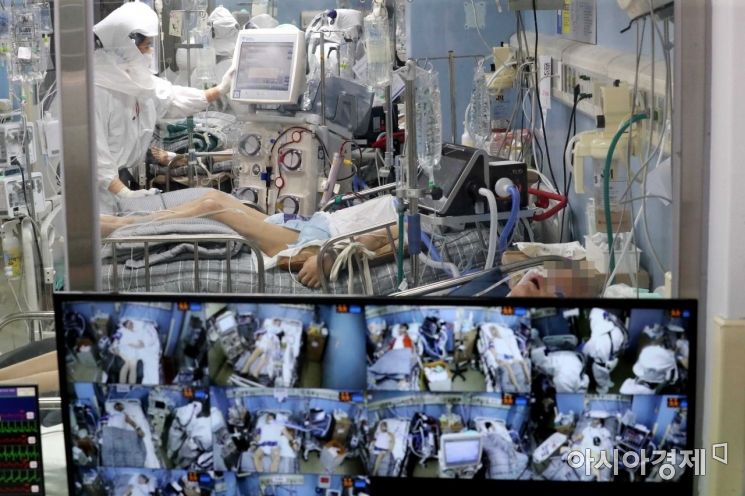
 On the 16th, medical staff are caring for a patient in the intensive care unit of Pakae Hospital, a COVID-19 dedicated hospital in Pyeongtaek-si, Gyeonggi-do. Photo by Moon Honam munonam@
[Asia Economy Reporter Lee Chun-hee] As the number of severe COVID-19 patients fluctuates around 1,000, the intensive care unit (ICU) bed occupancy rate is reaching a critical level daily. However, health authorities have stated that there are still no disruptions in actual treatment.
Son Young-rae, head of the Social Strategy Division at the Central Disaster and Safety Countermeasures Headquarters, said during a COVID-19 briefing on the morning of the 20th, "The bed occupancy rate is still operating at around 80%," adding, "The medical system has not yet reached a limit where it cannot fully treat patients, so there are no issues with actual patient care."
As of 5 p.m. the previous day, the nationwide ICU bed occupancy rate was 80.9%. In particular, in the Seoul metropolitan area, 735 out of 837 beds are in use, reaching an occupancy rate of 87.8%, which is effectively at the exhaustion stage. The rates are 88.9% in Seoul, 91.8% in Incheon, and 85.8% in Gyeonggi Province, fluctuating around dangerous levels. In other regions, all beds are in use in Daejeon (28 beds) and North Gyeongsang (3 beds), and Chungbuk maintains an occupancy rate exceeding 90% at 96.9%.
Son explained, "If problems begin to arise in the medical system, the fatality rate among those aged 60 and older increases." He added, "The current overall increase in fatality rate is due to a higher proportion of confirmed cases among the elderly, causing a shift in the distribution of cases, but the fatality rate by age group remains stable." He further stated, "At present, we are managing to cope under pressure without major disruptions to patient care," and "As long as ICU and semi-ICU units operate within 80%, there should be no significant issues in bed management."
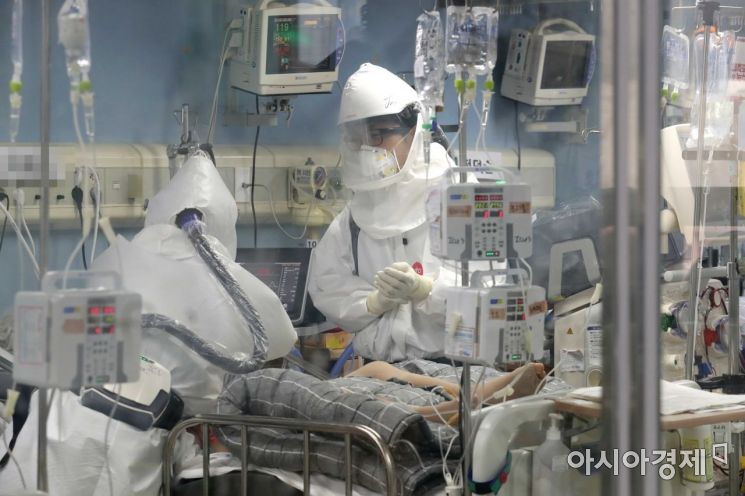 On the 16th, medical staff are caring for a patient in the intensive care unit of Pakae Hospital, a COVID-19 dedicated hospital in Pyeongtaek-si, Gyeonggi-do. Photo by Moon Honam munonam@
Currently, authorities are continuously issuing administrative orders to medical institutions to secure beds. Since the administrative order issued on the 5th of last month, a total of 2,061 beds have been secured in the metropolitan area. This includes 150 severe, 318 semi-severe, and 1,593 moderate cases beds. In non-metropolitan areas, since the administrative order on September 10, a total of 1,822 beds have been secured, including 181 severe, 159 semi-severe, and 1,482 moderate beds.
Regarding demands from the Health and Medical Workers' Union and others to issue administrative orders not only for beds but also for personnel, Park Hyang, head of the Central Disaster and Safety Countermeasures Headquarters' quarantine division, explained, "We are securing as many personnel as possible in the public sector, including public health doctors and military medical officers," adding, "Additionally, through the Medical Association and Nurses Association, the Central Disaster and Safety Countermeasures Headquarters manages additional personnel as a 'pool'." The headquarters stated that through these measures, they are currently supporting 3,523 medical personnel on site, including 241 doctors and 2,270 nurses.
© The Asia Business Daily(www.asiae.co.kr). All rights reserved.


















