KOSDAQ Turns Up... Cheonsdak Recovery
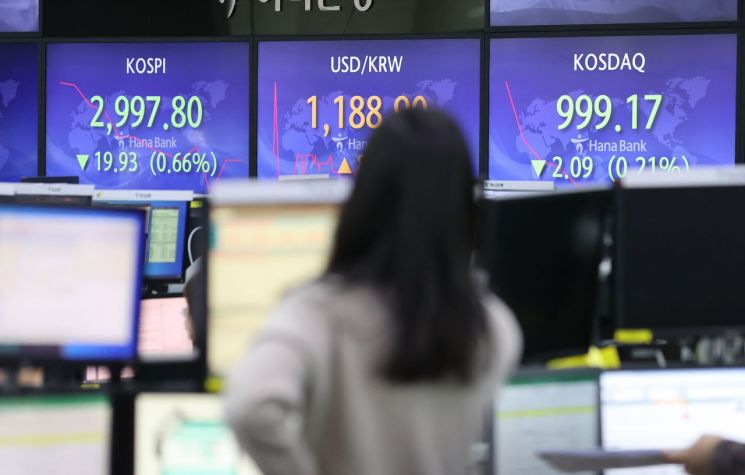
[Asia Economy Reporter Park Jihwan] On the 20th, the KOSPI is maintaining a weak trend influenced by the U.S. stock market, which closed lower due to the spread of the COVID-19 Omicron variant and hawkish remarks from Federal Reserve (Fed) officials. Domestic market experts advised an investment strategy focusing on large-cap stocks and defensive sectors, as volatility is inevitable until the end of the year.
As of 10 a.m. on the day, the KOSPI stood at 2,995.20, down 0.75% (22.53 points) from the previous trading day. The KOSPI opened at 3,001.33, down 0.54% (16.40 points) from the previous day, then widened its losses, falling to the 2,980 level. It later reduced the decline and has currently recovered to the 2,990 level.
Last week, the U.S. New York stock market closed lower across the board. The Dow Jones Industrial Average fell 532.20 points (1.48%) to close at 35,365.44. The Standard & Poor's (S&P) 500 index dropped 48.03 points (1.03%) to 4,620.64, and the Nasdaq index declined 10.75 points (0.07%) to 15,169.68. Seo Sangyoung, a researcher at Mirae Asset Securities, said, "The U.S. stock market closed lower as the number of new COVID-19 cases in the UK exceeded 90,000, raising concerns about economic slowdown, along with hawkish remarks from Fed officials, which dampened investor sentiment. The increased volatility and poor performance in the U.S. market are weighing on the domestic market."
By investor type, foreigners and institutions sold a net 94.5 billion KRW and 193.6 billion KRW, respectively. In contrast, individuals bought a net 280.2 billion KRW.
Among the top 10 stocks by market capitalization, all except SK Hynix (0.82%) were down. Samsung Electronics (-0.64%), Samsung Biologics (-1.47%), NAVER (-2.08%), Kakao (-1.70%), LG Chem (-3.01%), Samsung SDI (-2.35%), Hyundai Motor (-1.43%), and Kia (-0.95%) all declined.
At the same time, the KOSDAQ index was at 1,004.11, up 0.28% (2.85 points) from the previous day. The index started lower and briefly fell below the 1,000 mark but gradually reduced losses and successfully turned positive.
By investor type, individuals alone bought a net 68.9 billion KRW. Foreigners and institutions sold stocks worth 57.8 billion KRW and 9.8 billion KRW, respectively.
Among the top 10 KOSDAQ stocks by market capitalization, most were rising. Celltrion Healthcare (0.97%), Pearl Abyss (2.08%), Kakao Games (0.81%), and L&F (0.75%) increased. In contrast, EcoPro BM (-0.69%) declined.
Domestic market experts analyze that, unlike the U.S. stock market, considering the current valuation level of the Korean market, the possibility of further decline is not significant. Seo Jeonghoon, a researcher at Samsung Securities, said, "Unlike U.S. tech stocks, which have risen nearly threefold since the pandemic, the Korean market overall remains in a relatively undervalued area. Considering that price merit will become a key buying condition as the tightening process becomes clearer, the recent foreign buying trend is likely to continue for some time."
Since index volatility may increase for a while, an investment strategy focusing on large-cap and defensive stocks is expected to be effective. Kim Rokho, a researcher at Hana Financial Investment, emphasized, "As we approach the end of the year, the KOSPI has outperformed the KOSDAQ for four consecutive weeks. Following last week, this week is also a time to respond with large-cap stocks in the KOSPI."
Kim Daejun, a researcher at Korea Investment & Securities, advised, "With the recent normalization of monetary policies by central banks worldwide, economic momentum is slowing, increasing preference for defensive stocks. The spread of Omicron and the strong dollar support defensive stocks, so it is necessary to respond to the market through defensive sectors such as healthcare, telecommunications, and utilities for the time being."
© The Asia Business Daily(www.asiae.co.kr). All rights reserved.
![Clutching a Stolen Dior Bag, Saying "I Hate Being Poor but Real"... The Grotesque Con of a "Human Knockoff" [Slate]](https://cwcontent.asiae.co.kr/asiaresize/183/2026021902243444107_1771435474.jpg)











