'Zero Market' Selling Detergents, Shampoos, and More by Weight in Personal Containers to Operate Pilot Program Until June Next Year
Starting with Homeplus World Cup Branch, Sequential Openings Planned in Accessible Department Stores and Marts
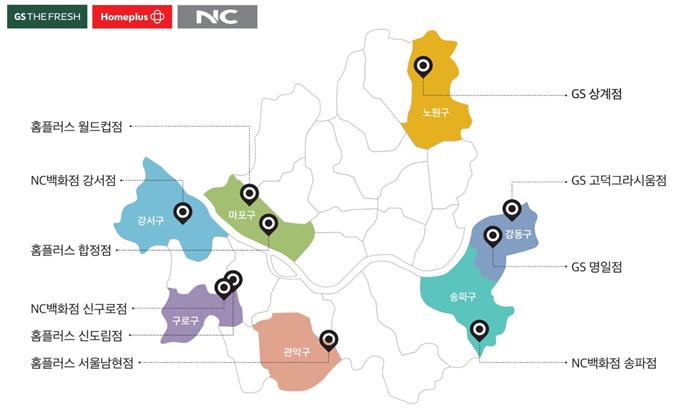
[Asia Economy Reporter Lim Cheol-young] On the 20th, the Seoul Metropolitan Government announced that it will open ‘Zero Market,’ a zero-waste store that does not use disposable packaging, in 10 locations including department stores, chain supermarkets (SSM), and commercial areas within apartment complexes. This is the first time nationwide that a zero-waste store is operated within large retail stores.
‘Zero Market’ is an eco-friendly store where customers can purchase only the amount they need by weighing refillable products such as detergents, shampoos, and cosmetics. Customers can fill products into dedicated containers provided in the store or their own reusable containers. By not using disposable plastic cups or containers, it reduces household waste and protects the environment.
Starting with the first Zero Market at Homeplus World Cup Branch, Seoul plans to sequentially open stores at NC Department Store Gangseo Branch, GS Fresh Godeok Gracium Branch, and others by January next year, conducting a six-month pilot operation. The 10 locations are evenly distributed throughout Seoul so that all citizens can experience and consume zero-waste culture as much as possible.
The Seoul Metropolitan Government aims to promote zero-waste culture by introducing ‘Zero Market’ in department stores and marts with high foot traffic and excellent accessibility and convenience through cooperation with the large distribution industry, targeting both citizens who want to practice zero-waste and those who have not yet experienced it.
‘Zero Market’ will be created as specialized spaces tailored to the characteristics of each retail store, such as department stores, retail stores, and SSM (chain supermarkets). The Homeplus World Cup Branch Zero Market will provide a service to collect and recycle plastic shopping bags in connection with the large mart inside. NC Department Store Gangseo Branch will collaborate with the ready-to-eat food section to hold events packaging products in reusable containers instead of disposable ones. GS The Fresh Godeok Gracium Branch, located in a commercial area within an apartment complex, will operate an unmanned automatic refill station.
Some ‘Zero Markets’ will also be operated as resource circulation hubs within the community. They will collect and recycle items such as earphones and charging cables, which have high recycling value but are often discarded as household waste, and will serve as facilities for collecting and sharing shopping paper bags and glass containers. Additionally, eco-friendly daily necessities such as bamboo toothbrushes, natural scrubbers, reusable straws, kitchen soap, shampoo bars, and handkerchiefs will be sold.
‘Zero Market’ will be operated by existing zero-waste store operators or those wishing to start a Zero Market business. It is expected to become an excellent example of spreading eco-friendly consumption culture through cooperation among large distribution companies, small business owners, and retailers.
After the pilot operation of ‘Zero Market’ ends, each retailer plans to operate ‘Zero Market’ independently. The city will share the pilot operation results with the distribution industry to encourage more retail stores to participate and will discover and support refill shops and small-quantity shops to help expand small-scale zero-waste stores in the region.
In addition, the city plans to promote signing a ‘Business Agreement for the Expansion of Eco-friendly Consumption Culture without Disposable Packaging’ with major distribution companies such as Homeplus, E-Land Retail, and GS Retail. The goal is to lead the most active retail platforms in consumption to join the spread of zero-waste consumption culture and to actively support them administratively and institutionally.
Meanwhile, Seoul has continuously worked to enable citizens to experience and practice packaging-free consumption culture in daily life through spaces like ‘Zero Forest’ (Seoul Upcycling Plaza) where zero-waste can be experienced, and the ‘Smart Seoul Map’ service that provides location information for over 70 zero-waste stores in Seoul.
Yoo Yeon-sik, Head of the Seoul Climate and Environment Headquarters, said, “Seoul’s Zero Market marks the entry of zero-waste markets, which have been operated on a small scale, into large retail stores that are the mainstream of the local economy, serving as an opportunity to popularize zero-waste. We will continue to strive to spread zero-waste culture so that good consumption habits without packaging become normalized in daily life.”
© The Asia Business Daily(www.asiae.co.kr). All rights reserved.

















