Easy Control of Robot Joints Adopted by LG Electronics and Others
Educational Robot Kits Recovering After COVID-19 Impact
Debt Ratio 16.4%... Strong Financials with Ample Cash Reserves
Convertible Bonds to Stocks May Ease Short-Term Supply Pressure
Samsung Electronics, which established a TF (Task Force) under its home appliance division earlier this year to explore the commercialization potential of robots, will actively promote robot commercialization starting next year. Through a year-end organizational restructuring, the robot commercialization TF was elevated to an official organization called the Robot Business Team. With the launch of the Robot Business Team, expectations have grown that Samsung Electronics will invest in the robot business. It is anticipated that various home robots that can be used in connection with smartphones and home appliances will be released. Since 2019, Samsung Electronics has consistently showcased robots and revealed its blueprint through CES, the world's largest IT exhibition. Not only Samsung Electronics but also major domestic companies such as LG Electronics, Hyundai Motor Group, and Naver are increasing investments in the robot market. As core robot-related technologies rapidly develop, the role of robots is expanding not only in industrial sites but also in various other fields. Among small and medium-sized enterprises developing robot technologies and conducting related businesses, we examined the business structure, growth potential, and new business initiatives of Rainbow Robotics and ROBOTIS.
[Asia Economy Reporter Jang Hyowon] ROBOTIS, a robot solution specialist company, is gaining attention. Not only is there an increase in sales of its main product, the robot actuator, but the commercialization of its self-developed indoor and outdoor autonomous robots is also approaching. However, the convertible bonds (CB) conversion date has arrived, and if converted into stocks, it is expected to create short-term supply pressure.
Rising Expectations for Indoor Autonomous Robots
ROBOTIS is a robot-specialized company that researches, develops, manufactures, and sells service robot solutions and robot components. Recognized for its robot-related technology, it received an investment of 9 billion KRW from LG Electronics at the end of 2017 before its KOSDAQ listing. Currently, LG Electronics holds about an 8.5% stake in ROBOTIS.
The main product is a robot actuator called ‘DYNAMIXEL.’ DYNAMIXEL is a modular integrated drive unit combining a motor, reducer, controller, and communication unit, enabling easy control of robot joints. It is known that large corporations such as LG Electronics also use ROBOTIS’s actuators.
Additionally, ROBOTIS operates a business providing solutions necessary for building service robots through software based on Robot Operating System (ROS) and Artificial Intelligence (AI). As a new growth engine, it is promoting the autonomous driving robot sector.
Looking at the sales composition by business segment, actuators and their applied products accounted for 87.3% as of the end of Q3 this year. The remaining 12.7% comes from the autonomous driving robot segment.
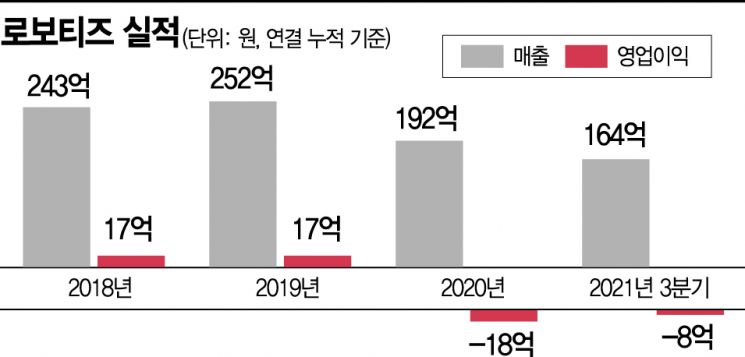
ROBOTIS recorded profits until 2019 but turned to losses last year. In the previous year, ROBOTIS posted consolidated sales of 19.2 billion KRW and an operating loss of 1.8 billion KRW. Sales decreased by 23.8% year-on-year, leading to a decline in operating profit.
The main cause was a decrease in sales of educational robot kits using AI software. ROBOTIS provides creative education solutions focused on coding education and algorithm-based practice, but due to COVID-19, students’ normal classes became difficult, resulting in a 38% drop in sales compared to the previous year.
However, this year shows signs of recovery. In Q3 this year, ROBOTIS recorded an operating profit of 7 million KRW on a consolidated basis, turning profitable compared to the same period last year. It has been profitable since Q2. This is analyzed to be due to increased single-unit sales of the main product, DYNAMIXEL, boosting performance.
It is expected that the profit trend will continue into Q4. However, due to losses recorded in Q1 this year from COVID-19 impacts, ongoing electronic component shortages, and rising raw material prices, it is difficult to predict the overall annual performance.
A ROBOTIS official said, "Next year will be the first full year of commercialization for indoor autonomous robots, which we are promoting as a growth engine. We plan to first supply delivery robots to hotels in the Seoul area and also plan to enter the Japanese and U.S. markets, aiming to supply up to 100 locations."
Strong Cash Reserves... Waiting for 11 Billion KRW CB Conversion
ROBOTIS’s financial condition is sound. As of the end of Q3 this year, the debt ratio stands at about 16.4%. Total borrowings amount to 8.3 billion KRW, but cash and cash equivalents held are 37.7 billion KRW, resulting in net borrowings of negative 29.4 billion KRW. In other words, the company holds more cash than debt. Most of the borrowings are convertible bonds (CB).
The reason for the large cash reserves is that only 41% of the funds raised during the 2018 KOSDAQ listing have been used. ROBOTIS raised about 23 billion KRW at listing. The funds were allocated for R&D (16.7 billion KRW), facility investment (3 billion KRW), operating funds (2.5 billion KRW), and repayment (0.8 billion KRW). Among these, facility investment funds were barely used. Additionally, in December last year, ROBOTIS issued CBs worth 11 billion KRW, of which 6 billion KRW allocated for facility investment is still held.
A ROBOTIS official stated, "As B2B customers for DYNAMIXEL increased, we considered expanding mass production facilities but postponed the timing temporarily due to COVID-19. However, the location review is complete, and preparations continue."
Although the funds raised through CBs have not been fully used, the CBs themselves became convertible into stocks starting from the 17th of this month. Among the total CBs, 30% are subject to a call option exercisable by ROBOTIS until December next year, so only 70%, equivalent to 6.6 billion KRW, can be converted into stocks. However, if bondholders request conversion, the call option period can be advanced to within three months, effectively allowing all to be converted.
The conversion price per share for these CBs is 13,015 KRW. With a 0% interest rate, these CBs are interpreted as being designed with conversion in mind. The number of convertible shares is 845,178, accounting for about 7.5% of the total outstanding shares. As of the 17th, ROBOTIS’s closing price was 18,900 KRW, about 45% higher than the conversion price.
© The Asia Business Daily(www.asiae.co.kr). All rights reserved.

![Clutching a Stolen Dior Bag, Saying "I Hate Being Poor but Real"... The Grotesque Con of a "Human Knockoff" [Slate]](https://cwcontent.asiae.co.kr/asiaresize/183/2026021902243444107_1771435474.jpg)














