Localization of Core Components and Element Technologies at the Pinnacle of Robotics
Sales of Autonomous Mobile Robots Combined with Collaborative Robots
Planned KOSDAQ Listing This Year... Raising 50 Billion KRW via IPO and CB Issuance
Expanding Automated Production Facilities and Preparing Funds for Overseas Expansion
Samsung Electronics, which established a TF (Task Force) under its home appliance division earlier this year to explore the commercialization potential of robots, will officially push forward with robot commercialization starting next year. Through a year-end organizational restructuring, the robot commercialization TF was elevated to a formal organization called the Robot Business Team. With the launch of the Robot Business Team, expectations have grown that Samsung Electronics will invest in the robot business. It is anticipated that various home robots that can be used in connection with smartphones and home appliances will be released. Since 2019, Samsung Electronics has consistently showcased robots and revealed its blueprint through CES, the world's largest IT exhibition. Not only Samsung Electronics but also major domestic companies such as LG Electronics, Hyundai Motor Group, and Naver are increasing investments in the robot market. As core robot-related technologies rapidly develop, the role of robots is expanding not only in industrial sites but also in various fields. Among small and medium-sized enterprises developing robot technologies and conducting related businesses, we examined the business structure, growth potential, and new business initiatives of Rainbow Robotics and Robotis.
[Asia Economy Reporter Hyungsoo Park] Rainbow Robotics, well known for its humanoid bipedal robot ‘HUBO,’ went public on the KOSDAQ market this year to raise funds for growth. Following its initial public offering (IPO) in February, it attracted funds from institutional investors last month through convertible bonds (CB) issuance and a paid-in capital increase. With its technological capabilities and additional funding, Rainbow Robotics plans to expand overseas next year.
Rainbow Robotics is a venture company founded by researchers from the Humanoid Robot Research Center at the Korea Advanced Institute of Science and Technology (KAIST). It possesses internalized core components and elemental technologies necessary for developing humanoid bipedal robots. Just as the automotive industry showcases technology through ‘F1 machines,’ humanoid bipedal robots represent one of the pinnacle platforms in robotics engineering.
On Par with Global Companies
The humanoid bipedal robot HUBO is globally recognized alongside Japan’s ASIMO and the United States’ Atlas platforms. Rainbow Robotics has supplied bipedal robots to numerous domestic and international research institutions, universities, and companies, including the Massachusetts Institute of Technology (MIT), Google, and the U.S. Naval Research Laboratory. Its technological prowess was validated by winning a competition hosted by the U.S. Defense Advanced Research Projects Agency (DARPA) in 2015.
Leveraging the technological expertise gained from developing humanoid bipedal robots, Rainbow Robotics has been actively engaged in the collaborative robot (cobot) business since last year. Cobots, a type of industrial robot, can operate safely alongside human workers in the same space. Demand is increasing not only in traditional production sites but also in service sectors. Quadruped robots, which can be used in harsh outdoor environments, wilderness, construction sites, plant factories, logistics sites, as well as various indoor environments, are also part of Rainbow Robotics’ business scope.
Rainbow Robotics’ technological competitiveness stems from its corporate research institute. Recognized as a research institute in 2011, it succeeded in commercializing collaborative robots within one year of research and development. As of the end of September, 31 researchers are engaged in R&D activities. The company continuously invests in research and development and secures talented personnel to enhance the technology of existing products and develop new ones.
Autonomous mobile robots (mobile manipulators) are also a key development area for the research institute. The elemental technologies used in mobile robots are similar to those planned for collaborative robot technology development. To understand user requirements, about ten first-generation prototypes were developed. These were experimentally applied in various service fields such as research institutions, exhibitions, and museums to identify areas for improvement and determine service directions. In the second half of last year, after interface and functionality enhancements, a second-generation prototype capable of mass production verification was developed. Moving forward, the company plans to optimize mass production and develop commercial products. The goal is to start selling mobile manipulators combined with collaborative robots from the first half of next year.
Expanding Automation Facilities with IPO Funds
The 25.5 billion KRW secured through the IPO is being used to expand automated production facilities. A manufacturing plant capable of producing 2,000 collaborative robots, 10 bipedal robots, 30 quadruped robots, 200 beverage robots, 50 disaster site rescue robots, and 300 precision directional mounts is being constructed. Funds are also allocated for core component development and R&D to enhance the completeness of bipedal robots.
Last month, the company issued convertible shares worth 7 billion KRW to domestic institutional investors and raised 18 billion KRW through CB issuance. The CBs do not include conversion price adjustments in case of stock price declines, and both the coupon rate and maturity interest rate are 0%. This indicates that investors expect Rainbow Robotics to grow. The additional fundraising in the first year after listing appears to be a strategic management decision aimed at overseas expansion next year.
Rainbow Robotics aims to enter overseas markets with its collaborative robots in the first half of next year. The plan is to achieve the number one position in the domestic market based on sufficient experience and then expand abroad. The domestic robot market ranks fifth globally. In terms of robot utilization (density), Korea ranks second after Singapore, which is number one. Being recognized as the top collaborative robot manufacturer domestically will be advantageous for overseas expansion.
The company is also considering entering overseas markets in partnership with domestic and international partners. It plans to establish distributors by country. Among domestic partners, some companies sell systems overseas, and local companies in Japan, China, Russia, Southeast Asia, the United States, Canada, and India have requested cooperation. If Rainbow Robotics collaborates with companies that have diverse experience, visible results are expected to emerge starting next year.
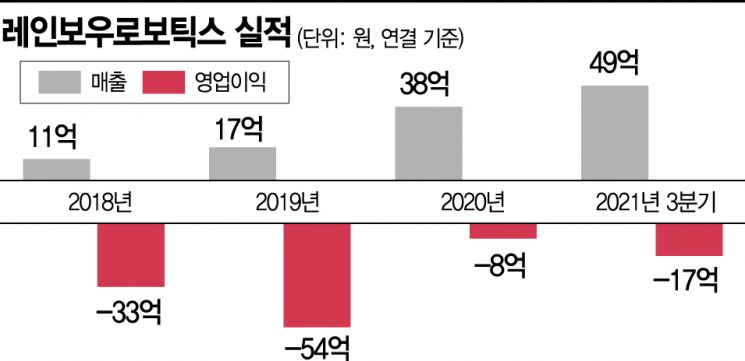
Rainbow Robotics recorded sales of 4.9 billion KRW and an operating loss of 1.7 billion KRW through the third quarter of this year. Sales increased by 29.5% compared to the same period last year, but the loss scale also grew.
© The Asia Business Daily(www.asiae.co.kr). All rights reserved.

















