Opportunities to Expand Exports in Automotive and Machinery Manufacturing
Social Discussions Begin Amid Opposition from Agriculture and Fisheries Sectors
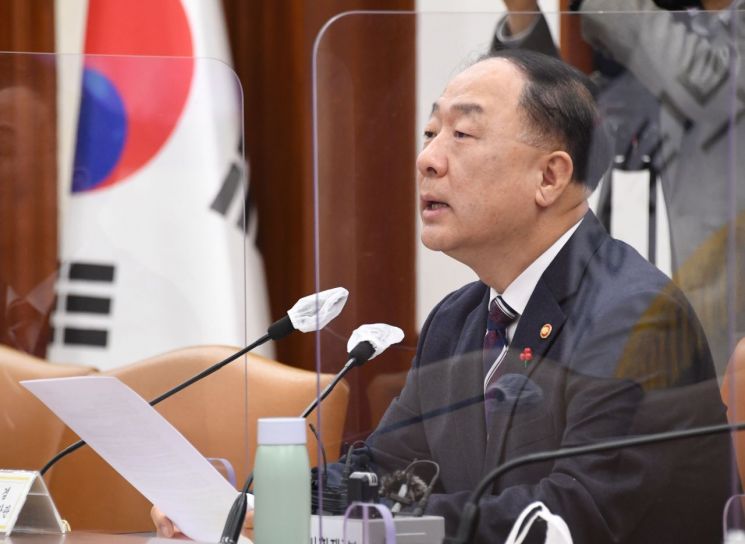 Hong Nam-ki, Deputy Prime Minister and Minister of Economy and Finance, presides over and speaks at the 226th Ministerial Meeting on External Economic Affairs at the Government Seoul Office Building on the 13th. (Photo by Ministry of Economy and Finance)
[Sejong=Asia Economy Reporter Moon Chaeseok] The government has initiated the process of joining the Comprehensive and Progressive Agreement for Trans-Pacific Partnership (CPTPP). It has decided to promote social discussions to advance the accession. Public hearings will be held targeting stakeholders such as the agriculture and fisheries sectors, and related procedures including reporting to the National Assembly will be carried out. However, no specific submission date for the accession application has been announced.
On the 13th, Hong Nam-ki, Deputy Prime Minister and Minister of Economy and Finance, presided over the Foreign Economic Ministers' Meeting at the Government Seoul Office and said, "It is difficult to confine discussions on CPTPP accession to inter-governmental departments only," adding, "We will initiate related procedures, including social discussions with various stakeholders." He further stated, "With China and Taiwan applying for CPTPP membership and the Regional Comprehensive Economic Partnership (RCEP), the world's largest mega free trade agreement (FTA), set to take effect early next year, significant changes in the economic order within the Asia-Pacific region are actively unfolding."
Deputy Prime Minister Hong's remarks are interpreted as meaning that after some degree of consensus among government ministries, the government plans to start full-scale accession discussions with the public and stakeholders. This is because public hearings and National Assembly reports must be conducted before officially submitting the accession application. On the same day, Kwon Chil-seung, Minister of SMEs and Startups, said in an interview with a foreign media outlet, "Although some ministries have concerns, the CPTPP accession issue has been decided internally within the government."
The CPTPP is a multilateral FTA launched at the end of 2018 by 11 countries including Japan, Australia, and Mexico. As of 2019, it accounted for $5.7 trillion in trade volume, representing 15% of global trade. Its level of openness is significantly higher than other trade agreements. The strategic importance has increased since China and Taiwan applied for membership last October.
The government plans to conduct social consultations with stakeholders such as farmers and fishermen on relevant issues until April next year. Afterwards, it intends to report to the National Assembly. However, the submission date for the accession application has not yet been decided. A senior government official said, "Currently, the schedule for submitting the accession application is undecided, and it is difficult to predict the timing."
The government has been preparing for accession with a focus on joining, but the Foreign Economic Ministers' Meeting to approve this was postponed twice. This delay is analyzed to be due to extended inter-ministerial consultations as they sought to assess the impact on and response measures for domestic agriculture, livestock, and fisheries sectors.
Setting the deadline for social discussions until April next year inevitably disrupted the government's original plan to apply for accession next month. Also, depending on the discussion outcomes, it is not unlikely that the matter will be passed on to the next administration.
Deputy Prime Minister Hong also said, "We will carefully prepare to resume FTA negotiations with major countries such as Mexico and the Gulf Cooperation Council (GCC, consisting of six Arabian Peninsula countries)."
Export Diversification, Opportunities for Manufacturing... Inevitable Impact on Agriculture and Fisheries
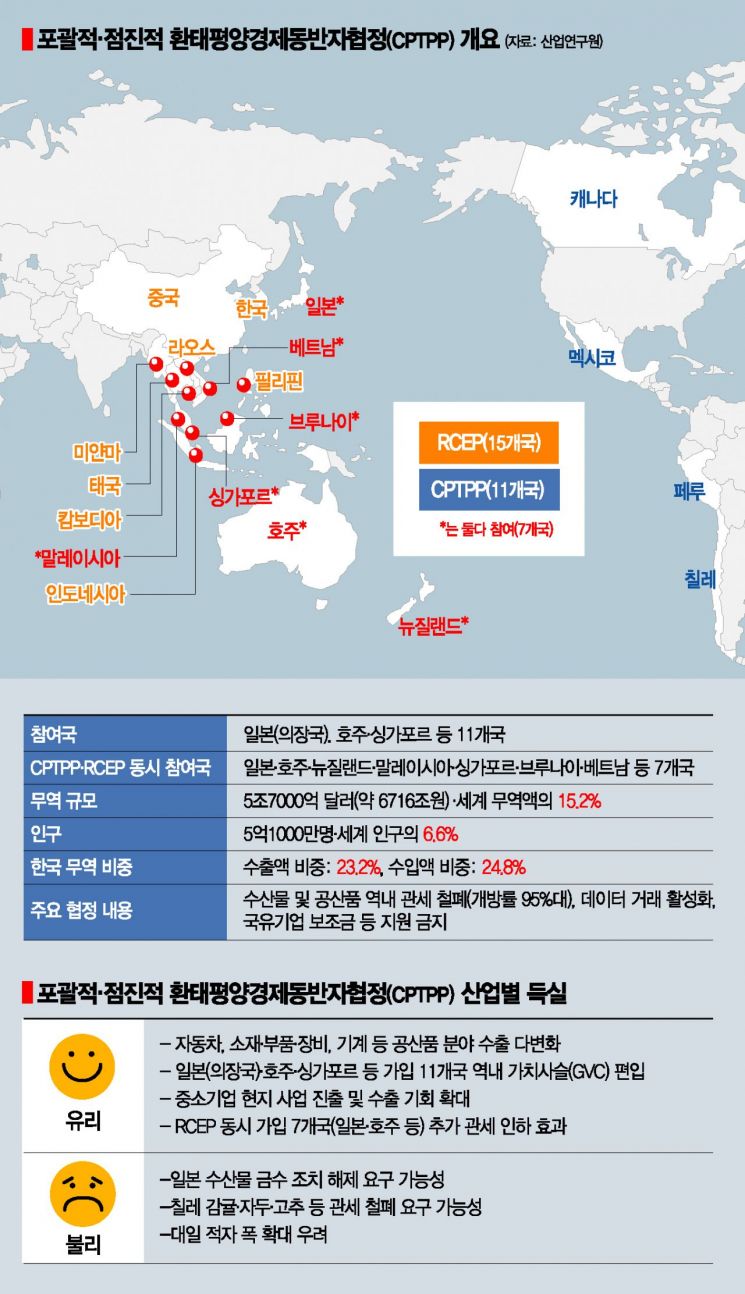
As the government formalizes its push to join the CPTPP, the gains and losses by industry are expected to become clear. Being part of a 'mega FTA' that accounts for 15% ($5.7 trillion) of global trade is positive for Korea's trade, but sectors such as agriculture, livestock, and automobiles, which are at a competitive disadvantage compared to other member countries, are expected to face challenges.
According to the government and related industries on the day, export diversification is expected in manufacturing sectors such as automobiles, materials, parts and equipment, and machinery. Inclusion in the CPTPP regional value chain (GVC) will facilitate local market entry for small and medium-sized enterprises and lower barriers to exporting intermediate goods. Effects of free trade agreements with countries like Japan and Mexico, with which Korea has not previously had bilateral or multilateral FTAs, are also anticipated.
Synergy effects with another mega FTA, the Regional Comprehensive Economic Partnership (RCEP), which joined last November and will take effect in February next year, are also expected to be significant. Seven countries that are members of both RCEP and CPTPP?Japan, Australia, New Zealand, Malaysia, Singapore, Brunei, and Vietnam?will benefit from additional tariff reductions. Although the government has not officially submitted the accession application, considering that working-level officials have been steadily negotiating with existing member countries through unofficial channels, it is also a positive that Korea may gain a voice in decision-making processes on issues such as digital trade and climate change.
Expanding influence in the GVC restructuring process and potential regulatory reforms are also positive aspects. According to the Federation of Korean Industries, upon joining the CPTPP, Korea's average productivity in the manufacturing sector is expected to increase by 0.75%, the number of exporting companies by 38.9%, and real gross domestic product (GDP) by 1.07%. If Korea and China join simultaneously, average productivity is expected to increase by 1.23%, the number of exporting companies by 63.14%, and real GDP by 3.62%.
On the other hand, since the agreement demands a high level of openness close to 'tariff elimination,' concerns arise that domestic agriculture, livestock, and fisheries industries will be adversely affected after accession. The CPTPP's openness rate is about 95%, much higher than the 85% level of RCEP and the 17 existing FTAs Korea has signed. The evaluation units for allowing imports under animal and plant health and quarantine have been subdivided, raising concerns about increased imports of apples, pears, persimmons, and fresh livestock products. There is also a possibility of trade deficits with countries such as Australia, Canada, New Zealand, Chile, Mexico, Vietnam, and Malaysia.
An official from the Ministry of Agriculture, Food and Rural Affairs said, "Since the CPTPP is a mega FTA following RCEP, its impact on the agricultural sector could be significant, so it must be approached cautiously," adding, "It is currently difficult to predict which countries or products will benefit or be disadvantaged, and social discussion procedures including the agricultural sector are necessary."
Concerns also exist regarding Japan's demand to lift the ban on seafood imports. A Ministry of Oceans and Fisheries official said, "The lifting of Japan's seafood import ban is directly related to public health and safety, so we do not consider it negotiable under current conditions." Attention is also focused on China's accession. The official added, "Since China's CPTPP membership is important, after the public hearing and damage impact analysis, supplementary measures at a higher level than RCEP should be introduced."
The automobile sector poses a significant burden for Japan. As the current CPTPP chair country, Japan may demand the removal of the 8% tariff on Japanese car imports from Korea. Concerns about an expansion of Korea's trade deficit with Japan cannot be ignored. The trade deficit with Japan reached $20.93 billion last year. Additionally, Korea faces burdensome requirements to open up significantly in standards and technology, investment, services, intellectual property (IP), and e-commerce.
© The Asia Business Daily(www.asiae.co.kr). All rights reserved.













