Brazil Rio and Over 20 Locations Worldwide Cancel Eve Celebrations
UK Reinstates Full COVID-19 Measures Amid Omicron Surge
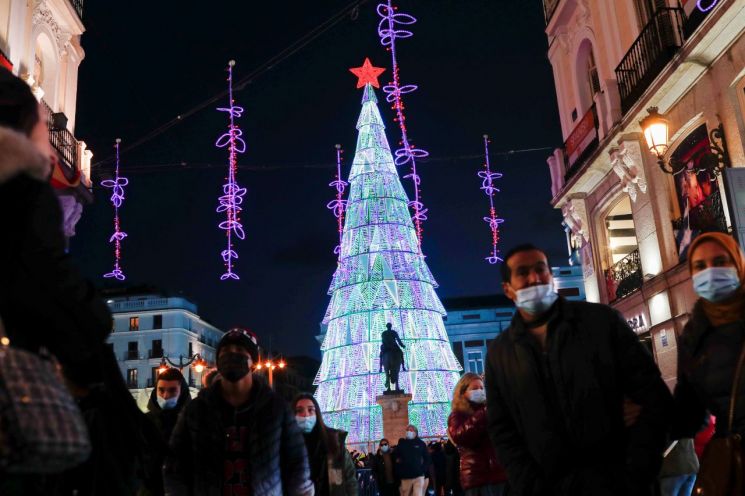
[Asia Economy Reporters Hyunwoo Lee and Hyunui Cho] As the spread of COVID-19 intensifies again and fears of the Omicron variant overlap, New Year's Eve celebrations around the world have been canceled one after another. Although health authorities in various countries have rushed to implement large-scale vaccinations followed by booster shots, returning to normal life remains a distant prospect. Even the UK, which led the "With Corona" (gradual return to normalcy) policy, has announced the reinstatement of quarantine measures.
According to the New York Times (NYT) on the 8th (local time), the authorities of Rio de Janeiro, Brazil, announced the cancellation of this year's New Year's Eve event. The New Year's Eve event held at Copacabana Beach in Brazil was a world-renowned festival attracting over 2 million people annually, but it was canceled due to fears of the Omicron variant.
Eduardo Paes, Mayor of Rio de Janeiro, said, "We respect science. We cannot proceed with the event without the assurance of health authorities." There are subtle differences in views among health authorities, academia, and experts worldwide regarding the risks of the Omicron variant, and thus, large-scale events cannot be held without precise clarification.
According to the Washington Post (WP), more than 20 major cities worldwide, including Rio de Janeiro, have canceled New Year's celebrations on December 31 and January 1 due to the impact of the Omicron variant. Baltimore, Maryland, USA, also canceled its New Year's Eve fireworks event last week. The famous Times Square New Year's Eve countdown event, the "Ball Drop," in New York City has been adjusted this year to allow only fully vaccinated attendees.
Christmas markets held in tourist cities such as Berlin, Cologne, D?sseldorf, and Frankfurt in Germany have been canceled again this year, following last year. Odisha state in northeastern India banned events in hotels, restaurants, parks, and public places for two days starting December 31 due to concerns over the spread of COVID-19.
Despite the reinstatement of lockdown measures in various countries, the UK government, which had been pushing the With Corona policy, announced a shift to reinstating quarantine measures. On this day, UK Prime Minister Boris Johnson announced at a press conference, "We have decided to introduce 'Plan B' due to concerns that Omicron infections will double every 2 to 3 days."
Plan B refers to the UK government's strengthened quarantine measures introduced last September in preparation for worsening COVID-19 conditions, including mandatory mask-wearing, recommendations for working from home, and the introduction of vaccine passports. Since the declaration of "Freedom Day" on July 19, when all quarantine measures were fully lifted, the UK government had maintained that Plan B was unnecessary, but due to the recent rapid increase in Omicron infections and COVID-19 spread, it has decided to implement Plan B.
© The Asia Business Daily(www.asiae.co.kr). All rights reserved.
![Clutching a Stolen Dior Bag, Saying "I Hate Being Poor but Real"... The Grotesque Con of a "Human Knockoff" [Slate]](https://cwcontent.asiae.co.kr/asiaresize/183/2026021902243444107_1771435474.jpg)











