Biden Signs Executive Order for Federal Government Carbon Neutrality by 2050... 763 Trillion Won Invested Annually
100% Zero-Emission Vehicle Ratio by 2050... Government Buildings to Use Eco-Friendly Electricity by 2030
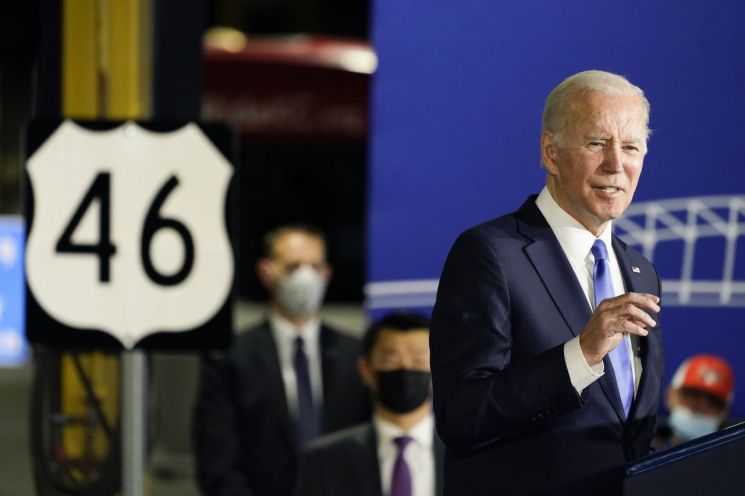 U.S. President Joe Biden is explaining the infrastructure bill he is promoting at an event held on the 8th (local time) in Kansas City, Missouri, USA. On the same day, President Biden signed an executive order aiming for federal government agencies to achieve carbon neutrality by 2050.
 [Photo by AP]
[Asia Economy Reporter Park Byung-hee] On the 8th (local time), U.S. President Joe Biden reaffirmed his commitment to expanding the U.S. electric vehicle market by signing an executive order aimed at achieving carbon neutrality for federal government agencies by 2050. The executive order includes a provision that, after 2035, federal agencies can only purchase zero-emission vehicles. With the federal government driving this initiative, the U.S. electric vehicle market is expected to experience rapid growth. The U.S. plans to invest astronomical amounts in carbon neutrality, which is anticipated to have a significant impact on related industries.
According to The Wall Street Journal (WSJ), with President Biden signing the executive order for federal agencies to achieve carbon neutrality by 2050, an annual expenditure of $650 billion (approximately 762.775 trillion KRW) is expected.
U.S. Government to Purchase ‘0’ Internal Combustion Engine Vehicles After 2035
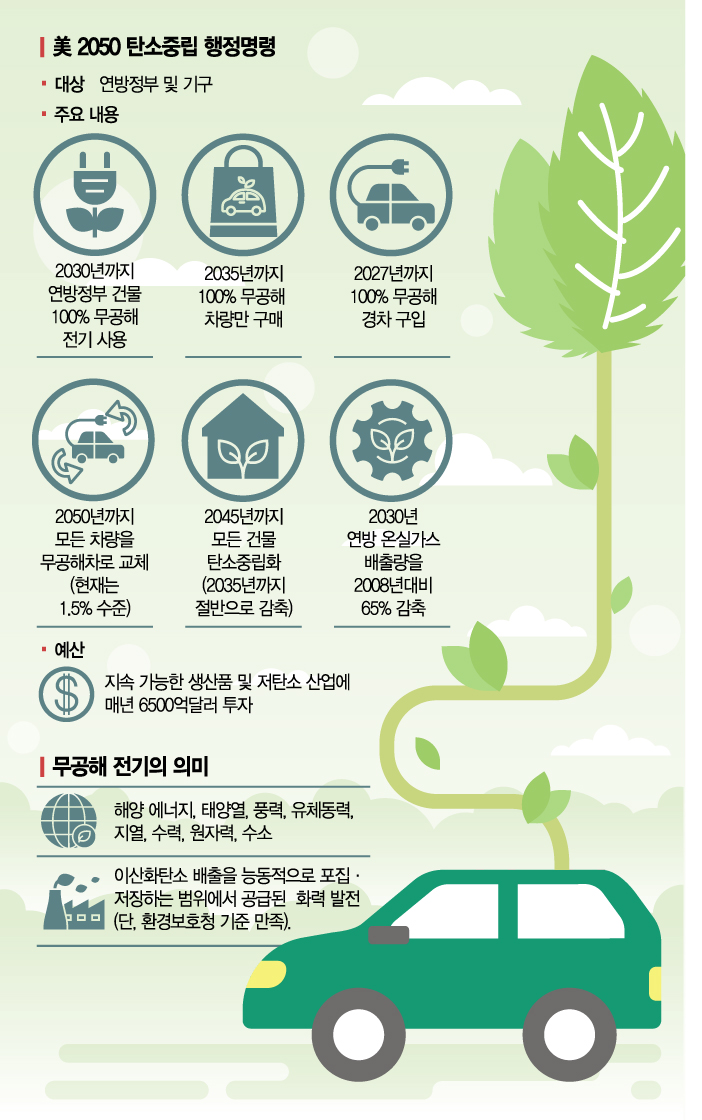
The most notable aspect of this executive order is the expansion of electric vehicle purchases. The order mandates a 100% purchase rate of zero-emission vehicles after 2035, leading federal agencies to sharply increase their acquisition of zero-emission vehicles.
WSJ reported that under this executive order, federal agencies are expected to purchase about 600,000 zero-emission vehicles by the end of fiscal year 2037. By reducing and eventually eliminating purchases of internal combustion engine vehicles, the current 1.5% share of zero-emission vehicles in federal agencies will reach 100% by 2050.
At the 26th United Nations Climate Change Conference of the Parties (COP26) held in Glasgow, UK, earlier last month, developed countries agreed to ban the sale of internal combustion engine vehicles by 2035, and developing countries by 2040. About 30 countries, including the UK and Canada, signed the agreement, but major automobile producers such as the U.S., Germany, and Japan did not participate.
With this executive order, President Biden has effectively banned the purchase of internal combustion engine vehicles in the public sector at least after 2035.
Additionally, the executive order requires all federal government buildings to use environmentally friendly electricity by 2030. The annual electricity bill for U.S. federal agencies is about $4.5 billion, with the current zero-emission power ratio at 40%. Federal buildings must also reduce carbon emissions by 50% by 2032 and achieve carbon neutrality by 2045.
The federal government stated in the executive order, "The federal government is the largest landowner, energy consumer, and employer in the United States," and added, "This executive order will transform the vehicles, buildings, and electricity used by the federal government, as well as its operations, into clean and sustainable methods, thereby promoting private sector investment and growing the U.S. economy and industry."
"Carbon Capture Fossil Fuel Power Also Considered Eco-Friendly"
The executive order also draws attention for its specific definition of eco-friendly energy, which has been a subject of controversy.
‘Zero-emission electricity’ in the executive order refers to ocean energy, solar, wind, hydropower, geothermal, hydroelectric, nuclear, and renewable hydrogen electric energy. Moreover, it includes fossil fuel power generation that actively captures and stores carbon dioxide emissions within the standards set by the U.S. Environmental Protection Agency (EPA). This means that fossil fuel power plants using carbon capture technology are also considered eco-friendly energy.
Since taking office in January this year, President Biden has made environmental policies a key national agenda. Immediately after his inauguration, he signed an executive order to rejoin the Paris Climate Agreement, and in April, he presented the Nationally Determined Contribution (NDC) to reduce greenhouse gas emissions by 50-52% from 2005 levels by 2030, encouraging other countries to strengthen their NDCs. He also formalized the goal of achieving carbon neutrality by 2050. This executive order is expected to be an important turning point in achieving the Biden administration’s 2050 carbon neutrality target.
Lindsey Griffiths, federal policy lead at the nonprofit Clean Air Task Force, commented, "Although it is a challenging commitment to fulfill, the sustainable executive order plan signed this time lays the foundation for the federal government to help the U.S. reach difficult goals."
The White House stated that the funding for this executive order will come from the $1 trillion infrastructure bill and the Build Back Better Act. It also urged Congress to pay more attention to the Build Back Better Act, which has not yet passed in Congress.
© The Asia Business Daily(www.asiae.co.kr). All rights reserved.


















