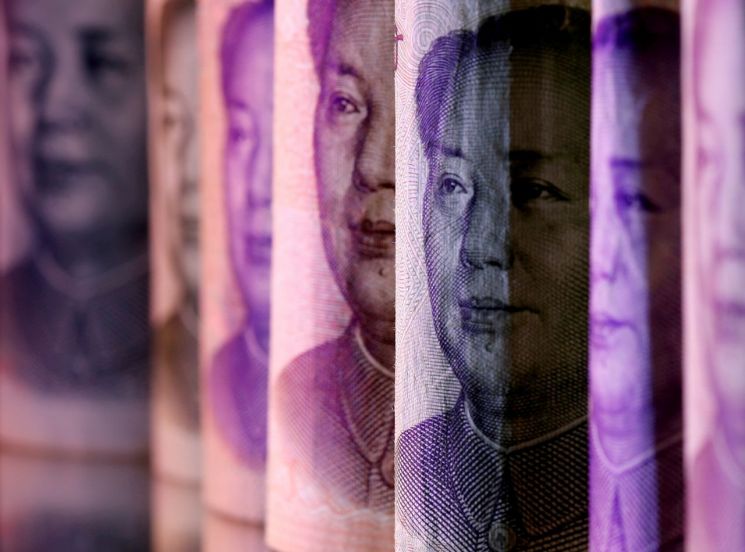
[Asia Economy Reporter Park Byung-hee] Despite the default of Evergrande Group, China's second-largest real estate developer, the Chinese yuan soared to its highest level this year, Bloomberg reported on the 8th.
Bloomberg analyzed that as the risk of the Omicron variant is not considered significant, investors' risk appetite has improved, and emerging market currencies such as the yuan are showing strength.
On that day, the onshore yuan value rose by up to 0.2%, with the dollar-yuan exchange rate reaching 6.3515 yuan per dollar at one point. Bloomberg reported that the yuan surpassed the year's highest level recorded in May.
The dollar-yuan exchange rate started trading in the low 6.5 yuan per dollar range this year. It weakened in March, threatening 6.6 yuan per dollar, and stalled between June and July due to concerns over the spread of the Delta variant, but has been on a strong trend since August. The yuan's value against the dollar has risen about 2.7% this year.
Anthony Fauci, director of the National Institute of Allergy and Infectious Diseases (NIAID), said in an interview with AFP that although the Omicron variant is more contagious than the Delta variant, the severity of symptoms is "almost certainly" less serious than Delta. As concerns about Omicron decrease, risk asset investment sentiment is improving. Not only the yuan but also the Thai baht and Malaysian ringgit rose by 0.6% and 0.4%, respectively.
The Shanghai Composite Index also closed the morning session up 0.86% that day.
Bloomberg analyzed that the fact that the People's Bank of China, the central bank, is not taking active measures to suppress the yuan's strength is also a background factor for the yuan's appreciation.
However, Bloomberg pointed out that the People's Bank of China's decision on the 6th to cut the reserve requirement ratio (RRR) is a variable. The People's Bank of China stated, "The decision to lower the RRR was made to support the development of the real economy and to stably reduce financial costs," and announced that it will lower the bank reserve requirement ratio by 0.5 percentage points starting from the 15th.
This RRR cut by the People's Bank of China is the second this year following July. With this RRR cut aimed at economic stimulus, the directions of monetary policies in the US and China have become opposite. The US central bank, the Federal Reserve (Fed), recently began tapering (reducing asset purchases), thereby starting to reduce market liquidity.
Bloomberg predicted that due to the divergence in monetary policies between the US and China, foreign investor demand for yuan assets may decrease.
© The Asia Business Daily(www.asiae.co.kr). All rights reserved.

















