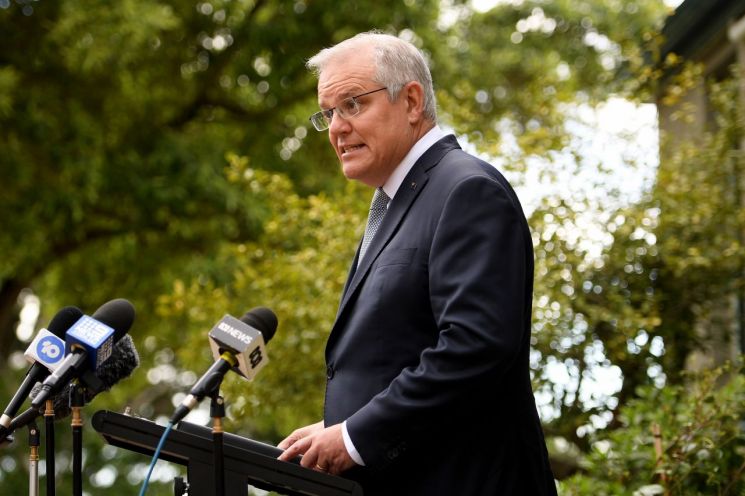
[Asia Economy Reporter Kwon Jae-hee] Australia will also join the 'diplomatic boycott' of the Beijing Winter Olympics in China, scheduled for February next year.
On the 8th (local time), according to AFP and other sources, Australian Prime Minister Scott Morrison announced that the government would not send an official delegation to the Beijing Olympics.
Prime Minister Morrison explained this decision by stating, "The Chinese government has never attempted to respond to various issues raised by Australia, such as human rights abuses in the Xinjiang Uygur region and trade retaliation against Australia."
He added that this decision came after recent 'clashes' with China in several areas, including Australia's acquisition of nuclear submarines.
According to major foreign media, Australian government officials have reportedly not had opportunities to hold talks with the Chinese side over the past few months.
China is Australia's largest export market, and the two countries have been economically close; however, relations deteriorated after Australia joined the US-led sanctions against Chinese company Huawei and demanded an investigation into the origin of COVID-19.
China retaliated by blocking imports of Australian coal, lobster, wine, and other products, while Australia responded by launching the 'AUKUS' alliance with the US and the UK in September to counter China's security threats.
Upon hearing the launch of the AUKUS alliance, China continued to criticize Australia daily, escalating tensions.
A diplomatic boycott means sending athletes to the Olympics but not dispatching the usual official delegation composed of government or political figures.
Amid ongoing US-China conflicts, the US declared a diplomatic boycott of the Beijing Winter Olympics on the 6th.
The White House cited China's human rights abuses as the reason for the diplomatic boycott, stating that participation in the Olympics cannot proceed as usual while human rights abuses continue in China's Xinjiang region.
In response, New Zealand also announced on the 7th that it would not send a government delegation.
However, New Zealand explained that this decision focuses more on various safety issues, including COVID-19, rather than the human rights issues raised by the US.
With Australia joining the boycott, attention is focused on whether this diplomatic boycott will spread across the Western world.
Previously, US allies such as the UK and Canada were also reported to be considering a diplomatic boycott.
Although the UK has not yet announced its position on joining the diplomatic boycott, the New York Times (NYT) reported that there is growing support within the ruling Conservative Party for participation in the boycott.
Meanwhile, German Chancellor-designate Olaf Scholz responded on the 7th to questions about joining the diplomatic boycott by saying he would carefully consider China policy.
Japanese Prime Minister Fumio Kishida also stated, "We will comprehensively consider the significance of the Olympics and our country's (Japan's) diplomacy and make an independent judgment from the perspective of national interest."
© The Asia Business Daily(www.asiae.co.kr). All rights reserved.

















