Mastering the Craft for 40 Years, Recognized as National Intangible Cultural Asset 'Yundojang' Holder
Father Kim Jong-dae Announced as Honorary Holder "Respecting Devoted Contributions"
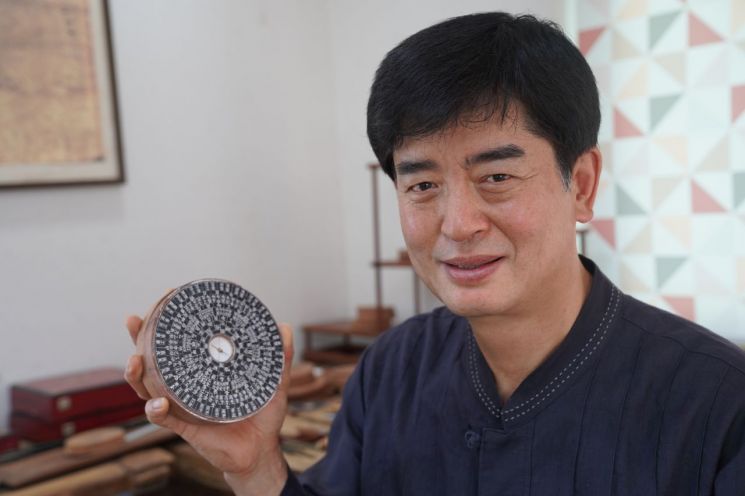
Kim Hee-su (59), who has been making the traditional compass 'Yundo (輪圖)', has joined the ranks of Living National Treasures (holders and honorary holders of National Intangible Cultural Heritage) following his father Kim Jong-dae (87). On the 8th, the Cultural Heritage Administration announced that Kim has been recognized as a holder of the National Intangible Cultural Heritage 'Yundojang'. Kim has produced compasses for about 40 years, passing down techniques inherited through three generations from his great-grandfather to his father. In 2007, he was recognized as a transmission educator, a rank below holder.
Yundo is a traditional scientific instrument reflecting Eastern cosmology and worldview, including astronomy and the philosophy of Yin-Yang and the Five Elements. It is estimated to have been used since the Three Kingdoms period, when astronomy was advanced. It became widely distributed during the Joseon Dynasty. It was mainly used by sailors, travelers, farmers, and geomancers (jigwan, 地官) who sought directions for houses or burial sites.
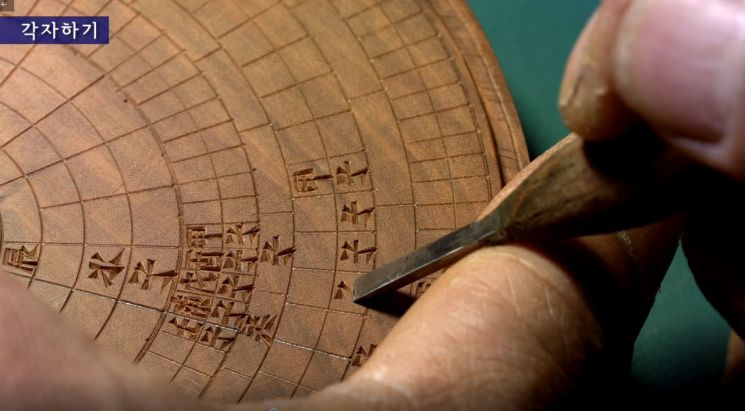
Yundo consists of 1 to 36 concentric layers arranged according to numbers around a central magnetic needle (jachim, 磁針). Each layer is arranged by combining Yin-Yang, the Five Elements, and the Eight Trigrams. The most commonly used Yundo is the 7 to 9-layer Pyeongcheol (平鐵), a flat and broad compass without special decorations. In the Joseon Dynasty, a 2 to 3-layer compass called Seonsu (扇錘), a portable compass attached to a summer fan, was used. Beautiful carvings were engraved on the surface to add practical elegance.
The most typical form, Pyeongcheol, is made through several processes including shaping wood into a cylindrical form, determining the center and number of layers, engraving characters, applying ink, refining the central circle, applying powdered jade, coating with cinnabar (jusa, 朱砂, red stone powder), and making the needle. Especially, engraving characters (gakja, 刻字) is the core technique of Yundojang, requiring a high level of concentration.
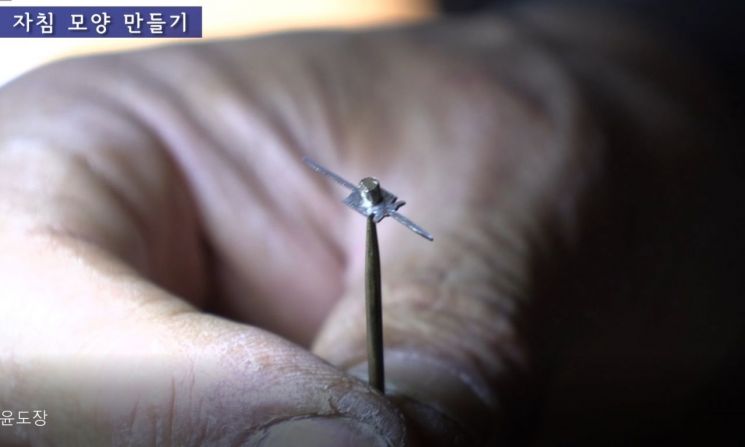
In the recognition investigation, Kim was acknowledged for his authenticity in the use of materials and tools for each process, and for the high skill and completeness of his Pyeongcheol and Seonsu production techniques. Additionally, his delicate and precise work in engraving characters on jujube wood and carving steel to make needles placed on the compass was highly evaluated. His active participation in various intangible cultural heritage education and experience projects to promote Yundo and his commitment to its transmission also influenced the recognition.
Meanwhile, the Cultural Heritage Administration announced the intention to recognize Kim Jong-dae, who was acknowledged as a holder in 1996, as an honorary holder on the same day. An official stated, "Due to his advanced age, it has become difficult for him to produce precise Yundo and conduct transmission education," and added, "This decision was made in respect of his devoted contributions." The recognition will be finalized after collecting and reviewing opinions from various sectors for a month and undergoing a review by the Intangible Cultural Heritage Committee.
© The Asia Business Daily(www.asiae.co.kr). All rights reserved.
![Clutching a Stolen Dior Bag, Saying "I Hate Being Poor but Real"... The Grotesque Con of a "Human Knockoff" [Slate]](https://cwcontent.asiae.co.kr/asiaresize/183/2026021902243444107_1771435474.jpg)


















