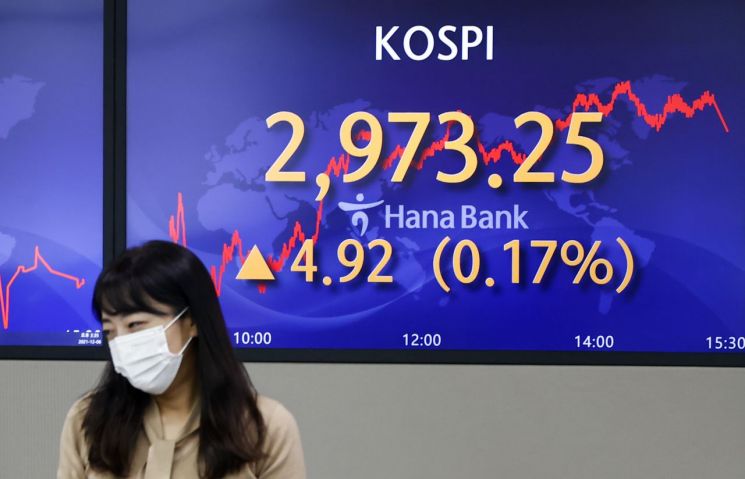
[Asia Economy Reporter Lee Seon-ae] On the 7th, the domestic stock market started higher but has been fluctuating between declines and gains, showing a sideways trend. Supported by the U.S. stock market's positive close, foreign investors' net buying of futures in the early session is helping to defend the index.
On this day, the KOSPI opened at 2,973.84, up 0.59 points (0.02%), and the KOSDAQ started at 996.89, up 5.02 points (0.51%). Around 9:12 a.m., the KOSPI was down 0.18%, while the KOSDAQ remained in positive territory with a 0.51% rise.
The New York stock market's recovery from concerns over the Omicron variant virus was a positive factor. On the 6th (local time), the Dow Jones Industrial Average, a blue-chip club, closed at 35,227.03, up 646.95 points (1.87%) from the previous trading day. The large-cap focused Standard & Poor's (S&P 500) index ended the day at 4,591.67, up 53.24 points (1.17%). The tech-heavy Nasdaq Composite closed at 15,225.15, up 139.68 points (0.93%).
The market was driven by expectations that Omicron would not cause as severe a shock as initially feared.
In the early session, net buying by individuals along with foreign investors' net buying of futures stands out. Individuals showed net buying dominance of approximately 189.7 billion KRW in the KOSPI and 60.3 billion KRW in the KOSDAQ. Both foreign investors and institutions were net sellers. Foreign investors were net sellers of about 65.8 billion KRW and 56.7 billion KRW in the two markets, respectively. Institutions sold approximately 125.3 billion KRW and 1.1 billion KRW in the two markets, respectively. However, both foreign investors and institutions showed net buying dominance in the futures market, with about 89 billion KRW and 12.1 billion KRW, respectively.
Seosangyoung, a researcher at Mirae Asset Securities, said, "The U.S. stock market showed strength supported by report releases, with travel, leisure, and airline sectors surging, along with the People's Bank of China's reserve requirement ratio cut and improvements in employment trend indices, which are positive factors for the Korean stock market. However, considering the possibility of a hawkish stance by the Federal Reserve due to improvements in U.S. employment trend indices and the fact that the Omicron issue, a decisive factor for the U.S. stock market rise, has already been priced in, the upside is expected to be limited." He added, "the process of digesting selling pressure will proceed through China's import-export trends and the results of Australia's monetary policy meeting."
Meanwhile, concerns over China's Evergrande (恒大·Eobeogeulande) real estate crisis appear to have little impact on the U.S. market. The dispatch of a working group by Chinese local governments to Evergrande and the People's Bank of China's surprise cut in the reserve requirement ratio seem to have calmed investors' anxieties.
Han Ji-young, a researcher at Kiwoom Securities, said, "although the default of China's Evergrande Group is becoming visible, it is important to note the Chinese government's strong willingness to minimize the ripple effects of these groups' defaults, such as the People's Bank of China's 50 basis point cut in the reserve requirement ratio. The concerns over Evergrande Group's default, which had been at the center of negative factors for some time, are expected to be perceived as a fading issue in the stock market going forward," she explained.
© The Asia Business Daily(www.asiae.co.kr). All rights reserved.

















