Korea Federation of SMEs Conducts Survey on 2050 Carbon Neutrality for SMEs
"Customized Support Measures Needed, Including SME-Exclusive Electricity Rates and Delivery Price Linkage System"

[Asia Economy Reporter Kim Heeyoon] As the government's carbon neutrality scenario gains momentum, it has been found that less than two out of ten small and medium-sized enterprises (SMEs) have established response plans.
The Korea Federation of SMEs announced the results of the '2050 Carbon Neutrality Related SME Survey' on the 6th. This survey was conducted from November 9 to 19, targeting 352 manufacturing SMEs.
Among the responding companies, 48.6% were aware of carbon neutrality. However, only 13.9% had response plans, with 7.1% of companies responding that they already had plans and 6.8% planning to establish them.
Regarding the mandatory greenhouse gas reduction system, 42.2% of applicable companies had established response plans, whereas only 7.7% of non-applicable companies had such plans, revealing differences in awareness and response levels to carbon neutrality depending on the business environment.
The main reason companies could not establish response plans for carbon neutrality was 'lack of funds and personnel to respond to new environmental changes (58.7%)'. This was followed by 'lack of time to understand and review carbon neutrality (18.5%)' and 'lack of incentives for low-carbon product production/process transition (14.9%)'.
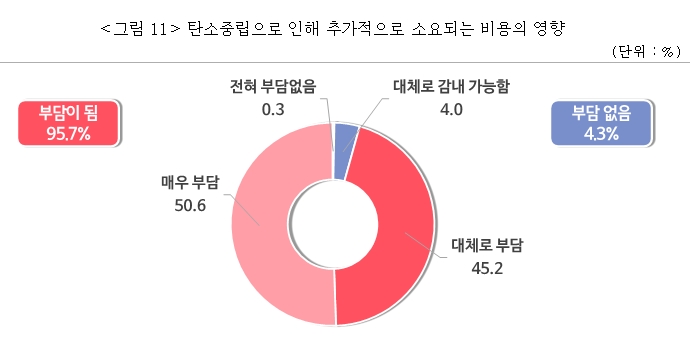 Response graph showing the impact of additional costs incurred due to carbon neutrality. Table = Korea Federation of Small and Medium Business Associations
While 64.2% of companies felt the need to participate in carbon neutrality, 79.8% responded negatively to the government's 2030 greenhouse gas reduction target of 40% (11.6% said both reduction and achievement timing are possible + 68.2% said reduction is possible but not by 2030). This indicates the need for support policies that can bridge the gap between SMEs' willingness to implement carbon neutrality and policy goals.
Most responding companies (95.7%) said that additional costs for carbon neutrality are burdensome. The areas expected to incur the highest costs were ▲facility replacement and installation costs (63.1%), followed by ▲raw material price increases (18.5%) and ▲electricity bills (12.5%).
SMEs identified the most necessary government support policy as ▲establishing a differentiated (exclusive) electricity rate system for SMEs (59.1%). Next were ▲support for emergency operating funds and replacement costs for aging facilities (28.1%) and ▲introduction of a delivery price linkage system reflecting cost increases (26.7%).
In particular, the mining and cement industries and the steel and metal industries responded that 61.5% and 45.8%, respectively, needed support for aging facility replacement costs, while the machinery and shipbuilding industries and the chemical, plastics, and textile industries answered that 68.8% and 59.6%, respectively, considered the establishment of a differentiated (exclusive) electricity rate system as the most necessary support measure.
Yang Chanhoe, Head of Innovation Growth Division at the Korea Federation of SMEs, said, “In Germany, various support measures such as electricity fee reductions and environmental tax exemptions for steel and other industries are being implemented to reduce energy cost burdens and maintain industrial competitiveness due to carbon neutrality.” He added, “Since the response levels to carbon neutrality vary among companies, it is necessary to introduce SME-exclusive electricity rate systems and delivery price linkage systems to reduce the overall green gap among SMEs for the successful completion of carbon neutrality.”
© The Asia Business Daily(www.asiae.co.kr). All rights reserved.


















