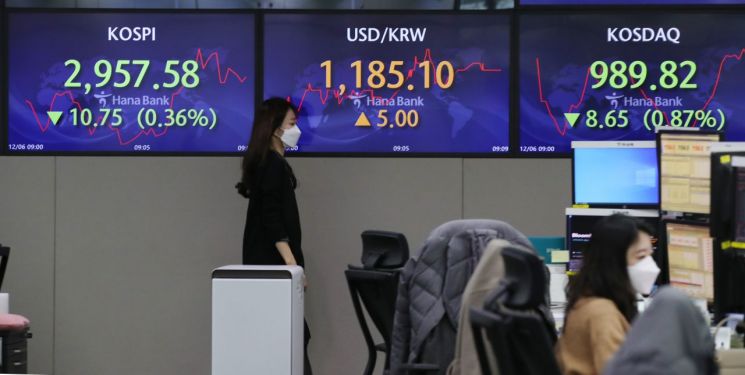
[Asia Economy Reporter Ji-hwan Park] On the 6th, the KOSPI fell over 1% in early trading due to selling by foreigners and institutions, dropping to the '2930 level,' but gradually narrowed the decline and recovered to the 2940 level. Market experts analyze that concerns over the spread of Omicron and fears of accelerated tapering (asset purchase reduction) by the U.S. Federal Reserve will negatively affect investor sentiment for the time being, leading to continued volatility.
As of 10:06 a.m. that day, the KOSPI stood at 2940.44, down 27.49 points (0.93%) from the previous trading day. The index opened at 2954.82, 13.51 points (0.46%) lower than the previous close. It then dropped to the 2930 level but showed signs of narrowing the decline gradually.
On the 3rd (local time), the New York stock market plunged, especially in tech stocks, as November employment figures fell far short of expectations and concerns over the Omicron variant persisted. Hawkish remarks by Fed Chair Jerome Powell, suggesting the tapering pace could accelerate due to inflation concerns, also contributed to negative investor sentiment. Additionally, China's second-largest real estate company, Evergrande, effectively warned of a default on its debt on the 3rd, adding to market burdens.
By investor type, individual investors defended the index with net purchases of 221.7 billion KRW. Foreigners and institutions sold net amounts of 61.8 billion KRW and 160.4 billion KRW, respectively. Among the top 10 market capitalization stocks, Samsung Electronics (-0.26%), SK Hynix (-1.27%), Naver (-2.99%), Samsung Biologics (-1.67%), Kakao (-2.02%), LG Chem (-1.12%), and Hyundai Motor (-1.21%) declined. Kia (0.12%) was the only gainer.
At the same time, the KOSDAQ was at 984.01, down 14.46 points (1.50%) from the previous close. The index opened at 990.07, down 8.40 points (0.84%) from the previous close, and continued its downward trend.
On the KOSDAQ, individual investors net bought 300.6 billion KRW. Foreigners and institutions net sold 234.2 billion KRW and 66.9 billion KRW, respectively. The top 10 KOSDAQ stocks by market capitalization also showed notable declines. Celltrion Healthcare (-2.29%), EcoPro BM (-5.04%), Pearl Abyss (-2.62%), L&F (-4.60%), and Kakao Games (-4.62%) were among the losers.
Among market experts, there is a forecast that the KOSPI may continue to show a sluggish trend for the time being. Ji-young Han, a researcher at Kiwoom Securities, said, "The Korean stock market is expected to continue a phase of increased volatility due to uncertainties around Omicron and renewed concerns over Evergrande Group's default. However, it is important to note that positive factors such as a favorable domestic foreign exchange market environment, expectations for semiconductor industry improvement, and improved foreign investor conditions are increasing."
Byung-hyun Cho, a researcher at Yuanta Securities, said, "The domestic stock market is facing negative factors more prominently as the outlook for corporate profits and economic conditions is poor, and the U.S. Federal Reserve is trying to tighten monetary policy faster due to inflation despite the resurgence of Omicron, creating overlapping adverse conditions."
© The Asia Business Daily(www.asiae.co.kr). All rights reserved.

















