Gwangju Institute of Science and Technology Research Team Newly Identifies Core Process of Double-Stranded DNA Cleavage by Major Gene Editing Tools
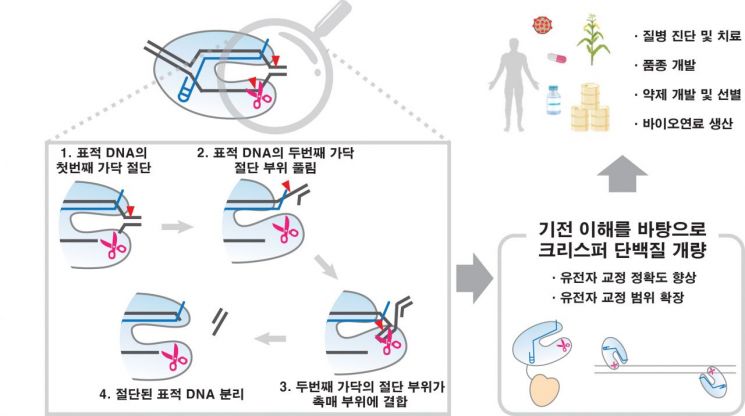 The core process of the gene-editing tool CRISPR-Cas12a cutting target DNA and its expected effects. Image provided by Gwangju Institute of Science and Technology
[Asia Economy Reporter Kim Bong-su] Domestic researchers have developed a core technology that overcomes the limitations of existing gene scissors. By using single-molecule fluorescence imaging technology, they have found a clue to developing new gene scissors that can be revolutionarily applied to next-generation gene editing and ultra-sensitive gene detection technologies.
The research team led by Principal Researcher Lee Sang-hwa at the Advanced Photonics Research Institute (APRI) of Gwangju Institute of Science and Technology (GIST) announced on the 6th that they have elucidated the molecular mechanism by which Cas12a CRISPR gene scissors completely cut double-stranded DNA with only a single catalytic active site.
Cas12a gene scissors are attracting attention as an attractive alternative to the representative gene scissors Cas9 due to their distinct characteristics such as relatively low off-target effects and indiscriminate single-stranded DNA cleavage activity. In particular, the ability to indiscriminately cleave single-stranded DNA has recently been utilized in technologies that detect extremely small amounts of specific nucleotide sequences, playing a decisive role in the development of COVID-19 diagnostic kits approved by the U.S. Food and Drug Administration (FDA).
However, despite these advantages, Cas12a gene scissors have not been properly utilized in cutting-edge gene editing technologies such as base editing and prime editing because, unlike Cas9, they lack technology to precisely control DNA cleavage activity.
In a previous study published in Nature Communications three years ago, the research team revealed that unlike Cas9 gene scissors, which independently cleave double-stranded DNA with two catalytic active sites, Cas12a gene scissors sequentially cleave the double-stranded target DNA through a single catalytic active site. As a result, unlike Cas9, whose DNA cleavage activity can be relatively easily controlled by mutations in each of the two catalytic active sites, it is difficult to precisely control DNA cleavage activity in Cas12a gene scissors that sequentially cleave double-stranded target DNA with a single catalytic active site in the same way. Therefore, to enhance the versatility of Cas12a gene scissors by precisely controlling DNA cleavage activity, it was necessary to elucidate the key processes and regulatory mechanisms of the complete double-stranded DNA cleavage reaction by the single catalytic active site of Cas12a gene scissors.
The research team used single-molecule fluorescence imaging technology (single-molecule fluorescence resonance energy transfer, smFRET) to observe in real time the structural changes of the Cas12a gene scissors-DNA complex occurring during the process in which Cas12a gene scissors completely cleave double-helix DNA after cutting the first DNA strand with a single catalytic active site. Through this, they observed for the first time that the Cas12a gene scissors-DNA complex undergoes two consecutive structural rearrangements to complete double-helix DNA cleavage with a single catalytic active site. In particular, they revealed that the essential step for target DNA cleavage is the local unwinding at the cleavage site, and magnesium ions play a decisive role in stabilizing this structure. This is the first time it has been proposed that magnesium ions, previously understood to contribute to cleavage activity at the catalytic site, also influence essential structural changes for CRISPR function.
Based on these research results, the team plans to pursue the discovery of various gene scissors with finely controlled DNA cleavage activity. The study was published online on the 1st in the international academic journal Proceedings of the National Academy of Sciences (PNAS).
© The Asia Business Daily(www.asiae.co.kr). All rights reserved.












