[Asia Economy Reporter Kim Hyewon] It is forecasted that the global trend of rising car prices will continue into next year. This is the result of a combination of factors including the shortage of automotive semiconductors, increased manufacturing costs, and demand recovery.
According to the Korea Automotive Technology Institute on the 5th, car prices have been soaring worldwide, including in the United States, since the second half of last year. In the U.S., the average transaction price of new cars reached $45,000 in September, marking an approximately 12% increase over the past year. The average price of used car listings was $29,000 in November, rising nearly 30% year-on-year.
In Europe, due to delays in new car supply, the average price of used car listings rose by up to 28.3% compared to the beginning of the year as of last October, while in Japan, used car auction prices increased by 11% during the same period.
In Korea, new car prices have risen sharply mainly for some imported cars, and used car prices have surged steeply for both domestic and imported vehicles. Notably, used cars that are only a few months old have absorbed new car demand and are being traded at prices higher than new cars.
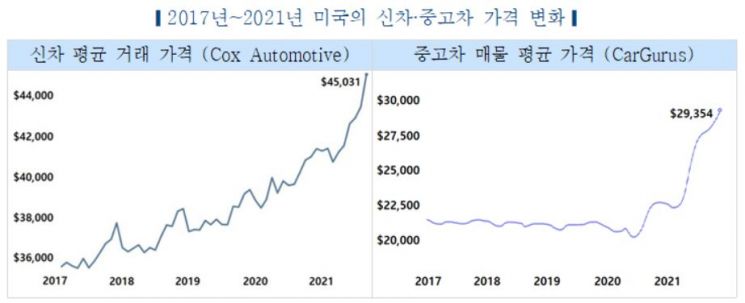
The institute analyzed that the background of the car price increase includes the coexistence of factors such as semiconductor supply shortages, rising manufacturing costs, and demand recovery.
In the case of automotive semiconductors, following the first supply shortage in the second half of last year, the supply-demand imbalance caused by the second supply shortage in mid-this year is still ongoing, and automakers are unable to produce and sell on time. The global price increase of automotive and electric vehicle battery materials, combined with logistics and labor costs in major countries, is also pushing up manufacturing costs. For example, compared to January last year, the price increase rates per ton for lithium and magnesium reached 249% and 146%, respectively, as of last month.
Senior Researcher Lee Hojung said, "It is expected that the upward trend in new car prices will continue domestically and internationally next year," adding, "Since the cost of battery materials for electric vehicles continues to rise, despite industry efforts to reduce production costs, a sharp price reduction in sales is unlikely in the near term."
He continued, "If domestic car price increases become full-scale, the burden on livelihood drivers and ordinary citizens will grow, so discussions related to tax reforms such as the individual consumption tax imposed on new cars may be reignited to alleviate this," and added, "Also, with the likelihood of delayed price parity between electric vehicles and internal combustion engine vehicles increasing, issues such as the review of the electric vehicle subsidy roadmap and the development of lithium iron phosphate (LFP) battery technology may arise."
© The Asia Business Daily(www.asiae.co.kr). All rights reserved.

![A Woman with 50 Million Won Debt Clutches a Stolen Dior Bag and Jumps... A Monster Is Born [Slate]](https://cwcontent.asiae.co.kr/asiaresize/183/2026021902243444107_1771435474.jpg)















