Amendment to the Venture Business Act Approved by the National Assembly Industry Committee on the 2nd
Allows Multiple Voting Rights for Unlisted Venture Companies
Industry: "Necessary for Stable Management and Sustainable Growth"
Civic Groups and Opposition: "Opens the Door to Chaebol Succession"
[Asia Economy Reporter Kim Bo-kyung] A bill allowing multiple voting rights (differential voting rights) for unlisted venture companies has passed the National Assembly's standing committee. While the venture industry unanimously welcomed the passage of the bill, concerns remain among civic groups and opposition parties that multiple voting rights could be exploited as a means for chaebol succession.
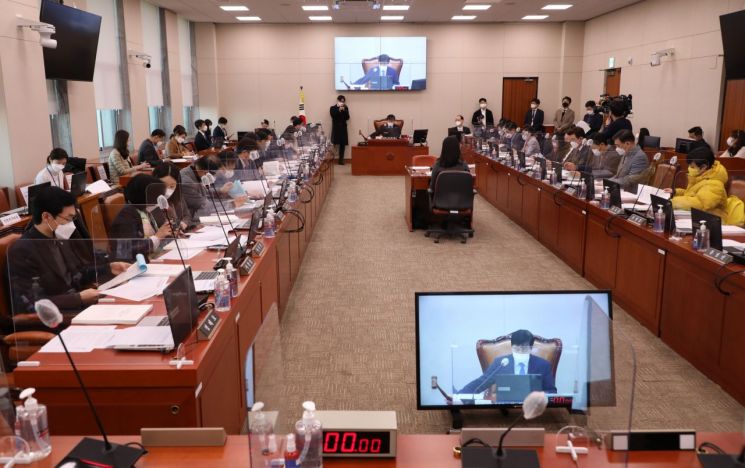
The National Assembly's Industry, Trade, Energy, Small and Medium Venture Business Committee held a plenary session on the 2nd and deliberated and approved the amendment to the "Special Measures for the Promotion of Venture Businesses Act (Venture Business Act)" introducing a multiple voting rights stock system exclusively for unlisted venture companies. If it passes the plenary session in the future, it will come to light about a year after the Ministry of SMEs and Startups submitted the bill to the National Assembly in December last year.
Venture Industry Unanimously 'Welcomes'... "Expecting Activation of Domestic Listing and Investment"
Multiple voting rights refer to assigning different voting rights to each share, used as a management defense tool to prevent founders from being swayed by external capital. Major overseas stock exchanges such as the New York Stock Exchange and NASDAQ allow multiple voting rights. Earlier this year, Coupang's submission of a registration statement for listing on the New York Stock Exchange became an issue as Chairman Kim Beom-seok was granted 29 times more voting rights for his Class B shares compared to Class A shares.
The bill passed by the standing committee includes provisions to allow founders of unlisted venture companies to have up to 10 multiple voting rights per share, but requires conversion to common stock upon inheritance or transfer, limits the duration to a maximum of 10 years, and mandates conversion to common stock three years after listing.
Upon the bill's approval, the venture-related industry immediately expressed their welcome. Korea Startup Forum, a startup organization, emphasized, "Multiple voting rights secure stable management rights, preserving the value of entrepreneurship even after a company's IPO and are necessary for sustained growth." They added, "Globally, the multiple voting rights system is spreading, encouraging the listing of innovative companies and revitalizing the digital economy. It is fortunate that the introduction of multiple voting rights has become visible before it is too late."
The Korea Venture Capital Association stated, "If this legislation passes, a systemic foundation will be established for more innovative venture companies to receive large-scale investments and exit (recover investment funds)." The association added, "We expect that allowing multiple voting rights will enable innovative venture companies to actively attract investment and implement growth strategies, further activating the venture investment ecosystem."

Opposition and Civic Groups Express Concerns: "Bill Has No Practical Benefit and Could Become a Tool for Chaebol Succession"
Some opposition parties maintained their opposition, citing concerns over potential abuse of multiple voting rights. Ultimately, Chairperson Lee Hak-young of the Industry Committee processed the bill through a standing vote with 14 in favor, 2 opposed, and 1 abstention out of 17 members present. Opposition lawmaker Cho Jung-hoon of the Transition Era party argued, "If this bill passes, it opens a big door for chaebol succession," and warned, "There will be various demands for multiple voting rights from startups beyond just venture companies." He also criticized the bill as benefiting only the 15 domestic unicorn companies, stating, "The difficulties faced by the 40,000 venture companies are not related to differential voting rights but rather market development, technology commercialization, and initial funding support." Justice Party lawmaker Ryu Ho-jeong also opposed the bill, saying, "I oppose it because the bill could be abused for chaebol and large corporate succession, which would have a significant social impact."
Civic groups and labor unions also condemned the committee's handling of the bill. Economic Reform Solidarity, the two major labor unions, and People's Solidarity for Participatory Democracy issued a joint statement saying, "The introduction of multiple voting rights is a serious issue that shakes the foundation of Korea's corporate system," and "It has no practical benefit for venture activation and could be abused as a tool for chaebol succession in the future." They urged, "We call for a reconsideration of what is truly needed to revitalize the venture market, companies, and investment," emphasizing, "What the venture market needs first is a fair playing field to bring about innovation."
Minister Kwon Chil-seung of the Ministry of SMEs and Startups supported the necessity of introducing multiple voting rights. At the Industry Committee plenary session, Minister Kwon said, "If shareholders do not recognize the founder's entrepreneurial spirit or management ability, multiple voting rights themselves are impossible," adding, "This is not for unicorn companies but to provide an additional tool to become a unicorn." He also stated, "When a company issues multiple voting rights shares, it is required to report to the Ministry of SMEs and Startups," and "Considering the transparency level in Korea, it would not be easy for chaebol companies to disguise themselves."
Regarding concerns that second- and third-generation chaebol could start ventures, receive multiple voting rights, list the company, and incorporate it into their affiliates, he rebutted, "If a venture company that has issued multiple voting rights shares is incorporated into a publicly disclosed business group, the shares are immediately converted to common stock."
© The Asia Business Daily(www.asiae.co.kr). All rights reserved.













