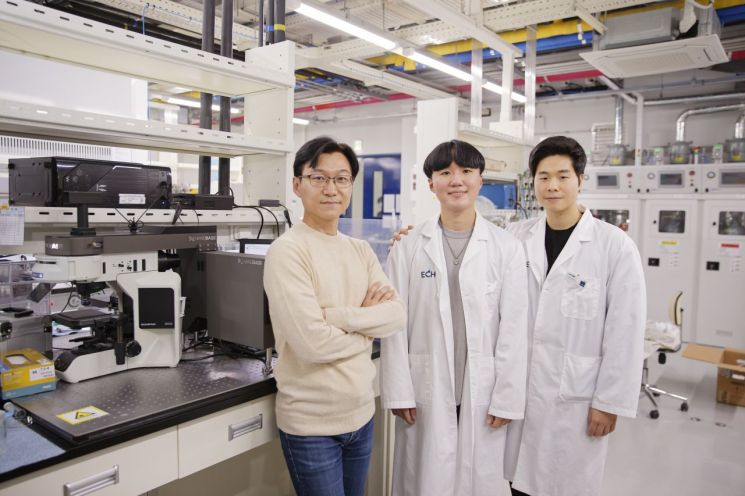
 Professor Kwon Young-guk (from the left), first author Researcher Lee Ho-jung, Researcher Choi Han-saem.
[Asia Economy Yeongnam Reporting Headquarters, Trainee Reporter Hwang Duyul] A catalytic technology that converts carbon dioxide into formic acid, an industrial raw material, has been developed. Formic acid refers to a 'carboxylic acid' with one carbon atom and is named after ants and bees, as it is found in their bodies.
Ulsan National Institute of Science and Technology (UNIST) announced on the 3rd that Professor Kwon Young-guk's team from the Department of Energy and Chemical Engineering, in collaboration with researchers from Sungkyunkwan University and DGIST, developed a high-performance tin oxide catalyst using a special technology.
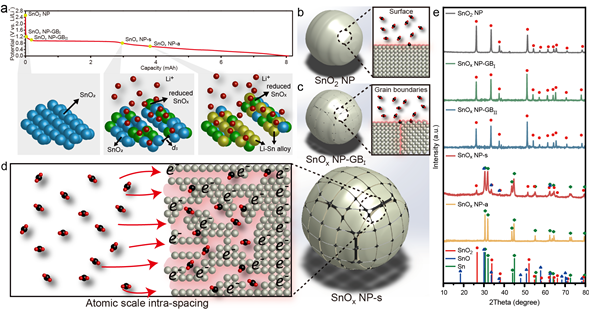
The special technology involves creating ultrafine cracks in catalyst particles that are finer than one hundred-thousandth the thickness of a human hair.
To create ultrafine cracks in the tin catalyst particles, a cation injection technique was used.
Professor Kwon Young-guk's team designed an inexpensive and high-performance catalyst in response to the growing attention on technologies that convert carbon dioxide into high value-added compounds or fuels through electrolysis.
The research team transformed a cheap, non-precious metal tin-based catalyst into a high-performance catalyst for producing formic acid. Formic acid is used in the food, leather processing, and pharmaceutical industries and is also gaining attention as a fuel cell fuel and hydrogen storage material.
The developed catalyst consumes less energy compared to commercial tin oxide materials and improved the production rate of formic acid by more than 19 times. The generation of reaction byproducts was also reduced by 70%.
The research team identified the ultrafine crack size that enhances the formic acid production rate and selectivity while effectively suppressing byproduct formation.
Professor Kwon Young-guk stated, "The technology has great significance as it can be expanded to the field of electrochemical catalyst research."
The research was jointly conducted with Researcher Lee Ho-jung from UNIST as the first author, Professor Jung Hyung-mo's team from Sungkyunkwan University, and Professor Stephan Ling's team from DGIST.
The research results will be published online in Advanced Functional Materials, a world-renowned journal in the fields of materials engineering and electrochemistry.
The research paper has been selected as a cover article and is scheduled for formal publication.
© The Asia Business Daily(www.asiae.co.kr). All rights reserved.
![Clutching a Stolen Dior Bag, Saying "I Hate Being Poor but Real"... The Grotesque Con of a "Human Knockoff" [Slate]](https://cwcontent.asiae.co.kr/asiaresize/183/2026021902243444107_1771435474.jpg)

















