The Growth Rate Forecast for This Year Remains at 4.0%
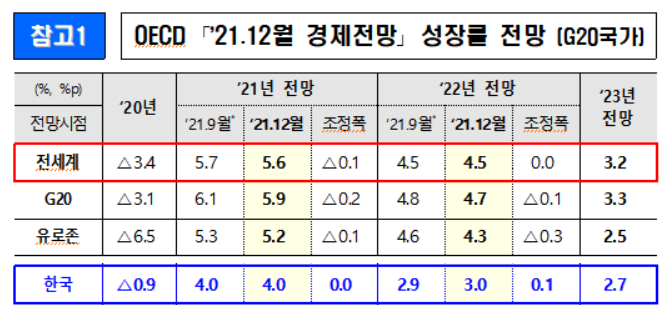
[Sejong=Asia Economy Reporter Son Sun-hee] The Organisation for Economic Co-operation and Development (OECD) has maintained its forecast for South Korea's economic growth rate this year at 4.0%. It raised the growth rate forecast for next year by 0.1 percentage points from the previous 2.9% to 3.0%.
The OECD projected that South Korea's inflation rate this year will be 2.4%. This is 0.2 percentage points higher than the forecast of 2.2% released last September, reflecting recent global inflation trends.
According to the Ministry of Economy and Finance, the OECD announced this global economic outlook on the same day. Regarding the decision to maintain this year's growth forecast for South Korea at the September level, the OECD evaluated that "the recovery trend will continue due to the easing of social distancing following rapid vaccination, favorable export and investment trends, and policy effects."
The OECD raised South Korea's economic growth forecast for next year consecutively, from 2.8% in May to 2.9% in September, and now to 3.0%. It also projected a growth rate of 2.7% for 2023, assessing that a stable growth trend will continue. The OECD stated, "Consumption and employment recovery centered on the service sector will expand, and export and investment growth is expected to continue due to increased external demand and government support."
It further recommended policy measures, stating, "Fiscal support for groups affected by COVID-19 should continue until full economic recovery, but it should be more targeted and help job transitions." Additionally, it added, "Public investment should focus on promoting digitalization, green growth, and reducing social inequality as an extension of the New Deal policy, and efforts to strengthen soundness policies for household debt management and to stabilize housing prices through increased supply are necessary."
The Ministry of Economy and Finance analyzed this OECD outlook and stated that compared to before the COVID-19 crisis, South Korea's economic growth rate is the fastest among the Group of 20 (G20) countries. It forecast that the recession during the COVID-19 crisis was minimized and that the subsequent recovery process will continue at a faster and stronger pace than initially expected, concluding that "this once again demonstrates successful crisis response compared to major countries."
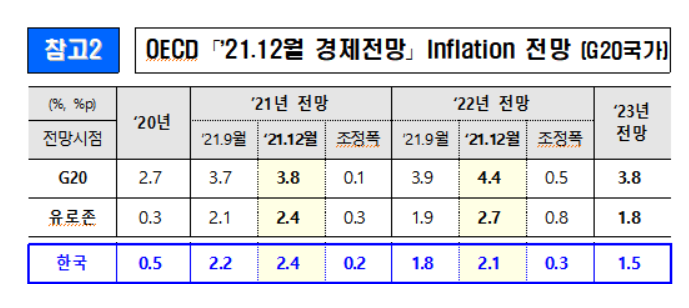
The OECD raised its inflation forecasts for both this year and next year. Compared to the September forecast, inflation this year was raised by 0.2 percentage points to 2.4%, and next year by 0.3 percentage points to 2.1%. This means that inflation is expected to remain higher than anticipated next year as well.
The global economic growth rate is projected at 5.6% this year and 4.5% next year. The forecast for this year was lowered by 0.1 percentage points compared to September, while the forecast for next year remained unchanged. The OECD added, "Recently, the global economy's growth momentum has slowed due to supply chain disruptions, rising raw material prices, and renewed COVID-19 outbreaks."
Furthermore, it forecasted, "The global economy will continue its recovery over the next two years, but the growth pace will moderate and differences in recovery patterns among countries will persist."
The OECD also emphasized, "Distributing vaccines worldwide is the top priority, and international cooperation to achieve this should be encouraged," and issued policy recommendations stating, "Given the high uncertainty in short-term economic forecasts, macroeconomic policy support should continue, and policy mixes appropriate to economic conditions should be used."
© The Asia Business Daily(www.asiae.co.kr). All rights reserved.


















