-IBS Center for Cognition and Sociality Develops Optogenetics Technology 'Opto-vTrap'
-Expected Applications in Brain Circuit Mapping, Epilepsy and Muscle Spasm Treatment, and Skin Expansion Technology
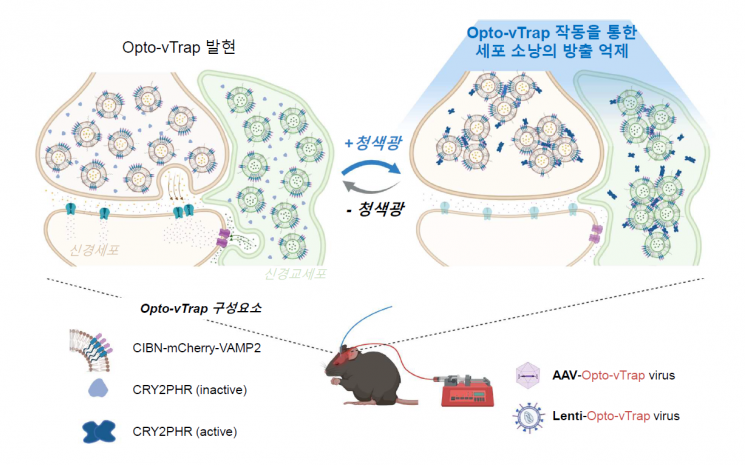 Schematic diagram of the optogenetic extracellular vesicle secretion inhibition system Opto-vTrap. Provided by IBS.
[Asia Economy Reporter Kim Bong-su] A technology has been developed that not only activates brain cells with light but also controls memory, emotions, and behavior.
The Institute for Basic Science (IBS) announced on the 1st that the research team led by Lee Chang-jun, head of the Cognitive and Sociality Research Center, in collaboration with Professor Heo Won-do of the Korea Advanced Institute of Science and Technology (KAIST), developed an optogenetics technology called 'Opto-vTrap' that freely controls brain functions and behavior using light. Furthermore, through animal experiments, the team confirmed that it is possible to regulate not only brain activation but also activity and emotions.
Brain activation is regulated by brain cells such as neurons and glial cells communicating with each other. This interaction occurs through the secretion of neurotransmitters contained within 'vesicles' inside brain cells. Vesicles act as commanders controlling brain activation. Controlling brain activation is an essential technology for brain research. By promoting or inhibiting the activation of specific brain regions or cells, it is possible to clarify the functions of specific brain areas, the roles of interactions between various brain regions, and how different brain cells operate under specific conditions.
However, existing brain activation control technologies have struggled to freely regulate the activation of specific brain cells at desired times. Until now, methods controlling cell membrane potential have been used, but these methods have limitations such as altering the acidity of the surrounding environment, causing unwanted stimuli, and being ineffective for cells that do not respond to potential changes. The newly developed Opto-vTrap technology can specifically and directly control vesicles in cells, making it usable in various types of brain cells at desired times.
The research team applied their proprietary core technology, which creates a trap-like structure inside cells when exposed to light, to vesicles in order to directly control neurotransmitter secretion. When cells or tissues expressing Opto-vTrap are exposed to light (blue light), photoreceptor proteins inside the vesicles aggregate, capturing the vesicles within the trap and suppressing neurotransmitter secretion. In short, Opto-vTrap directly controls neurotransmitter secretion from vesicles, allowing free regulation of brain activation. The team confirmed through cell and tissue experiments, as well as animal experiments using Opto-vTrap virus, that it is possible to control not only brain cell signaling but also memory, emotions, and behavior.
Using Opto-vTrap is expected to be useful for elucidating the complex interaction principles between various brain regions and studying the effects of different brain cell types on brain function. Additionally, it is anticipated to be applied in neuroscience fields such as completing brain function circuit maps and treating epilepsy, as well as in technologies for muscle spasms and skin muscle expansion.
The research results were published on the same day in the neuroscience journal Neuron (IF:17.173).
© The Asia Business Daily(www.asiae.co.kr). All rights reserved.
!["The Woman Who Threw Herself into the Water Clutching a Stolen Dior Bag"...A Grotesque Success Story That Shakes the Korean Psyche [Slate]](https://cwcontent.asiae.co.kr/asiaresize/183/2026021902243444107_1771435474.jpg)
















