Real-time Measurement of Fine Dust Concentration and Composition from December to February Next Year
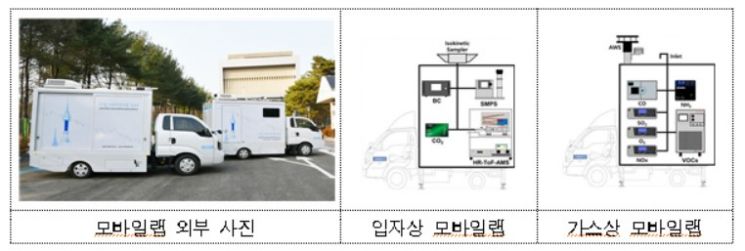
[Asia Economy Reporter Lim Cheol-young] Starting next month, a 'mobile lab' that measures real-time fine dust concentration and components on site will run on roads throughout Seoul.
On the 1st, the Seoul Metropolitan Institute of Health and Environment announced that from December to February next year, it will conduct intensive research on areas with concerns about high concentrations of fine dust using the mobile lab for three months.
This is to more precisely track the causes of fine dust in Seoul and prepare effective reduction measures. The target measurement areas were selected as Jung-gu, Geumcheon-gu, and Gangnam-gu, where the influence of local emission sources was significant based on the analysis of mobile lab measurement data earlier this year. Additionally, the impact of automobile-related air pollution will be evaluated on Teheran-ro in Gangnam-gu, which has heavy traffic.
The Seoul Metropolitan Institute of Health and Environment analyzed the characteristics of fine dust occurrence using the mobile lab during the fine dust seasonal management period from January to March and confirmed that when high concentrations of fine dust occurred, the influence of local emission sources was high.
The institute conducted measurements at 13 points in areas designated as intensive fine dust management zones and regions with dense traffic and industrial sites where high concentrations of fine dust are a concern. Through this, they identified the characteristics of air pollution by region and created detailed spatiotemporal pollution maps. The institute explained, "We confirmed that when high concentrations of fine dust occur, the concentration increases further due to the influence of emission sources within the area," adding, "This suggests that not only foreign influences but also local emission sources have a significant impact."
Meanwhile, the Seoul Metropolitan Institute of Health and Environment operates a dense fine dust measurement network across the city, including 50 fixed monitoring stations such as urban air monitoring stations in 25 autonomous districts, four mobile measurement vehicles, and since last year, about 300 simple fine dust measuring devices installed throughout Seoul. Using this data, they provide real-time air quality information and carry out tasks such as fine dust forecasting and cause analysis during high concentration fine dust events through air quality modeling.
Shin Yong-seung, director of the Seoul Metropolitan Institute of Health and Environment, said, "Through research using the mobile lab, we have revealed that managing pollutants emitted locally is important to mitigate the intensification of fine dust to high concentrations," and added, "We will continue to support the establishment and implementation of scientifically based and effective fine dust reduction policies by utilizing the institute’s cutting-edge technologies such as the mobile lab."
© The Asia Business Daily(www.asiae.co.kr). All rights reserved.
![Clutching a Stolen Dior Bag, Saying "I Hate Being Poor but Real"... The Grotesque Con of a "Human Knockoff" [Slate]](https://cwcontent.asiae.co.kr/asiaresize/183/2026021902243444107_1771435474.jpg)
















