Meeting Held with Vocational High School Students to Gather Opinions
Same Labor Demands for Employees and Interns
Concerns Raised About Difficulty in Objecting to Unfair Orders
"Education Needed to Improve Understanding of System Among Internship Company Representatives"
Ministry of Education to Announce On-Site Internship System Improvement Plan Within the Year
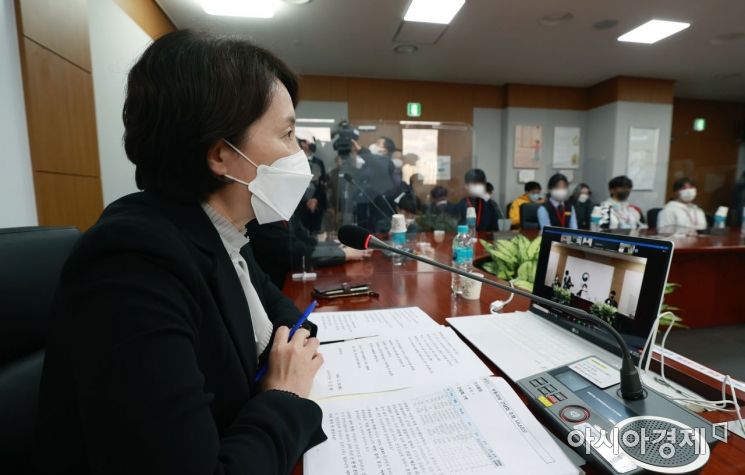 Deputy Prime Minister and Minister of Education Yoo Eun-hye held a meeting on the 30th at the Government Sejong Complex with vocational high school students to discuss improvements to on-site training.
[Asia Economy Reporter Han Jinju] There is growing demand for system improvements following the death of a vocational high school intern in Yeosu. Current students expressed that during their internships, they are often required to work at the same intensity as regular employees and find it difficult to refuse unfair instructions.
On the 30th, the Ministry of Education held an online and offline meeting with vocational high school students at the Government Complex Sejong. Deputy Prime Minister and Minister of Education Yoo Eun-hye arranged this meeting to fulfill her promise to meet with Hong’s friends and to gather opinions from vocational high school students across various regions regarding internships.
Students who have experienced internships commonly reported that the workload for interns is often the same as that of regular employees, and even when they recognize problems, it is difficult to raise objections.
Shin, a student from a vocational high school in Pohang, said, "The labor intensity is the same for both regular employees and interns, so high school students sometimes find it hard to keep up," adding, "Since internships are meant to be a learning experience, it is important to reduce the workload and provide prior training at the site to prevent incidents like what happened to Hong."
Seo, a student from a vocational high school in Jeonnam, said, "Although students receive various training before internships, once they are on site, they cannot refuse or reject unfair instructions, nor do they have the courage to do so," explaining, "Because internships are linked to employment and returning to school can cause problems."
Hwang, who interned in Daejeon, said, "Even if students seek advice from teachers, it is difficult to resolve issues, and teachers find it awkward to intervene."
There was also criticism that because wages for interns are shared between companies and the government, companies tend not to view internships as educational opportunities.
Choi, a student attending a vocational high school in Jeonbuk, said, "Internships should be learning-centered, but since companies bear 70% of the internship wages, interns end up doing work that benefits the company rather than learning," adding, "If the government paid the internship wages, companies could focus on learning-centered internships without making unreasonable demands."
In response, Jeong Byeong-ik, Director of the Lifelong Education Bureau at the Ministry of Education, said, "Assuming the internship wage is 1.8 million KRW per month, companies pay 1.2 million KRW and the government pays 600,000 KRW. Since companies bear the cost, they may expect interns to provide necessary labor in return," adding, "We are considering this issue as well."
Additionally, many students endure discomfort during internships due to concerns that raising issues might negatively affect their employment prospects.
Kim, a student from a vocational high school in Gwangju, explained, "If students return to school after experiencing unpleasant situations during internships, they may be deprioritized during job placement or receive unfavorable recommendations," adding, "If the school gives them a hard time, it becomes difficult to prepare for other companies, and some students who could not become regular employees after internships ended up leaving the company."
There was also a call for company representatives to improve their understanding of the internship system to prevent interns from receiving unfair instructions.
Kim, a student from the same school as Hong, said, "I hope this incident leads to education for internship company representatives to enhance their understanding of internships so that safe internships can be conducted." Another student from the same school, Choi, said, "Students do not have the power to refuse adults’ requests," adding, "I hope adults receive more education on what should and should not be asked of students."
The Ministry of Education plans to announce improvements to the internship system by the end of the year after collecting opinions from students, parents, teachers, and experts. The system improvements, focusing on protecting interns’ rights, supporting companies participating in internships, and strengthening safety management and supervision, will be implemented after March next year.
Deputy Prime Minister Yoo said, "Rather than discussing the abolition of internships due to accidents, it is important to create tangible changes through revising industrial safety laws, expanding budgets to support schools and companies, and improving systematic management systems to ensure internships are conducted safely," adding, "We will do our best to ensure safe and beneficial internships."
© The Asia Business Daily(www.asiae.co.kr). All rights reserved.
![Clutching a Stolen Dior Bag, Saying "I Hate Being Poor but Real"... The Grotesque Con of a "Human Knockoff" [Slate]](https://cwcontent.asiae.co.kr/asiaresize/183/2026021902243444107_1771435474.jpg)
















