Professor Kwanghyun Cho's KAIST Team Develops System Biology-Based Method
Successfully Converts Most Aggressive Triple-Negative Breast Cancer Cells into Treatable Luminal-A Breast Cancer Cells
[Asia Economy Reporter Kim Bong-su] A cancer cell reprogramming technology that reverses malignant breast cancer cells to a treatable state has been developed by a domestic research team.
The Korea Advanced Institute of Science and Technology (KAIST) announced on the 30th that Professor Kwanghyun Cho's research team from the Department of Bio and Brain Engineering succeeded in developing a cancer cell reprogramming technology that reverses malignant breast cancer cells to a treatable state through systems biology research.
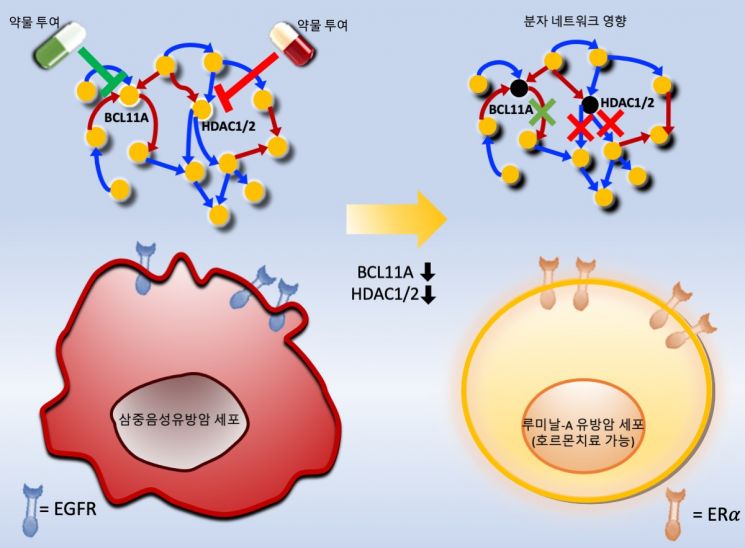
The research team analyzed the gene networks of patients with triple-negative breast cancer (basal-like or triple negative), known as the most malignant subtype of breast cancer, and patients with hormone-treatable luminal-A breast cancer through computer simulation. They identified key factors necessary to convert triple-negative breast cancer cells into luminal-A breast cancer cells. By regulating these factors, they developed a new treatment principle that reprograms triple-negative breast cancer cells into luminal-A breast cancer cells and then applies hormone therapy.
Currently, chemotherapy applied to triple-negative breast cancer patients works by attacking and killing rapidly dividing cancer cells that cause metastasis, thereby suppressing cancer cell proliferation. However, it also kills normally dividing cells in the body, causing severe side effects such as vomiting, diarrhea, hair loss, bone marrow dysfunction, and fatigue. Additionally, triple-negative breast cancer cells either have innate resistance to these toxic anticancer drugs or acquire new resistance, eventually evolving into cancer cells highly resistant to drugs. Therefore, current chemotherapy for triple-negative breast cancer has a significant limitation in that it requires sacrificing more normal cells to eliminate resistant cancer cells.
To overcome this, targeted anticancer therapy that specifically attacks only cancer cells and immunotherapy that utilizes the body's immune system have gained attention. However, each has very limited effectiveness and applicable targets, and resistance still occurs during long-term treatment. These currently developed anticancer therapies share a fundamental limitation because they aim to kill cancer cells.
The research team developed a new therapeutic strategy that converts malignant triple-negative breast cancer cells into hormone-treatable luminal-A breast cancer cells and then treats them, using systems biology research techniques. To this end, they developed a mathematical model of the gene network and applied large-scale computer simulation analysis and complex network control technology, identifying two key molecular targets: 'BCL11A' and 'HDAC1/2.'
The team demonstrated through molecular cell experiments that inhibiting BCL11A and HDAC1/2 can effectively convert triple-negative breast cancer cells into luminal-A breast cancer cells. When these key factors were inhibited in triple-negative breast cancer cells, cell division decreased, the activity of factors related to the 'EGFR' pathway?a major cell growth signaling pathway in triple-negative breast cancer cells?was reduced, and the activity of factors in the 'ERa' signaling pathway?a major cell growth signaling pathway in luminal-A breast cancer cells?was restored.
Among the molecular targets identified in this study, no small molecule compound capable of inhibiting the activity of the BCL11A protein has yet been developed. It is expected that through future drug development and clinical trials, a new therapeutic technology that safely and effectively treats malignant breast cancer cells by reprogramming them into a treatable cell state will be realized. In particular, if this new therapeutic strategy based on cancer cell reprogramming, which reverses or transforms the nature of cancer cells, is realized clinically, it is expected to fundamentally solve many side effects and resistance issues of current anticancer treatments, minimizing patient suffering and greatly improving quality of life.
The research team previously succeeded in reverting colon cancer cells to normal colon cells in January 2020, making this study the second achievement in developing reversible technology through cancer cell reprogramming.
Professor Cho explained, "Among breast cancers, triple-negative breast cancer is the most malignant and had no treatment options other than highly toxic chemotherapy that causes severe side effects," adding, "We have opened a new possibility to effectively treat it by reprogramming it into hormone-treatable and less malignant luminal-A breast cancer cells."
The research results were published on the 30th in the international journal Cancer Research, published by the American Association for Cancer Research (AACR).
© The Asia Business Daily(www.asiae.co.kr). All rights reserved.

















