Hospitalization Policy Only for Specific Reasons
Preventing Healthcare System Overload While Maintaining 'With Corona'
Outpatient Clinics and Patient Monitoring Implemented
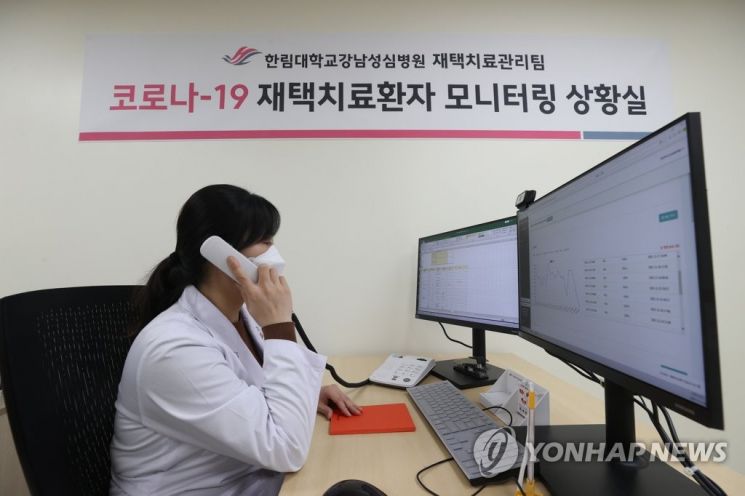 On the afternoon of the 18th, medical staff are working in the COVID-19 home treatment patient monitoring room set up at Hallym University Kangnam Sacred Heart Hospital in Yeongdeungpo-gu, Seoul. / Photo by Yonhap News
[Asia Economy Reporter Lim Juhyung] Going forward, COVID-19 confirmed patients will be treated at home as a principle. As the number of confirmed cases increased during the transition to 'gradual daily recovery (With Corona),' and the available hospital beds gradually decreased, the government has prepared countermeasures.
This plan was established to prevent the healthcare system from overheating due to too many critically ill patients, but opinions are divided among citizens. While some say that a little inconvenience must be endured for a smooth transition to With Corona, others point out concerns about what would happen if an emergency occurs and timely emergency treatment is not received.
◆Preventing Healthcare System Overheating... 'Home Treatment' as a Principle Going Forward
On the 29th, Kwon Deok-cheol, Minister of Health and Welfare, stated at a joint briefing of the COVID-19 response special quarantine inspection meeting held at the government Seoul office, "All confirmed patients will be treated at home as a basic principle, and hospitalization will only be provided when there are hospitalization indications or specific reasons such as a residential environment vulnerable to infection."
Until now, home treatment was the principle for asymptomatic or mild confirmed patients under their 70s without hospitalization indications who agreed to home treatment. However, from now on, home treatment will be the basic approach, and only those who need hospitalization will receive inpatient care.
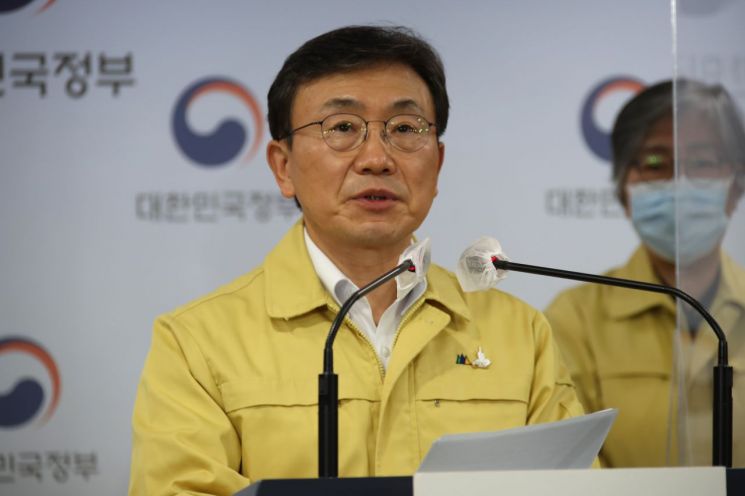 Minister of Health and Welfare Kwon Deok-cheol is announcing the comprehensive quarantine measures through a joint briefing with related ministries after the special COVID-19 quarantine inspection meeting chaired by President Moon Jae-in on the afternoon of the 29th. / Photo by Yonhap News
This shift in treatment policy appears to be aimed at preventing the healthcare system from overheating due to an increase in critically ill patients.
Minister Kwon explained, "The increase in critically ill patients leads to a rise in intensive care unit bed utilization rates and longer waiting times for bed allocation, bringing the medical response system closer to its limits," adding, "We have established a medical and quarantine follow-up response plan that can actively respond to risk factors to continue the gradual daily recovery."
◆"If Healthy, Must Endure Some Inconvenience" vs. "What About Emergencies?"
Opinions are divided among citizens. Some say healthy people must endure some inconvenience for a smooth transition of quarantine policies, while others raise concerns about what happens if an emergency occurs during home treatment.
A 20-year-old office worker, Mr. A, said, "If asymptomatic or mild, isn't it enough to rest well at home? It's absurd that such people should occupy precious hospital beds," adding, "Healthy people should endure some inconvenience, and treatment should focus on vulnerable groups."
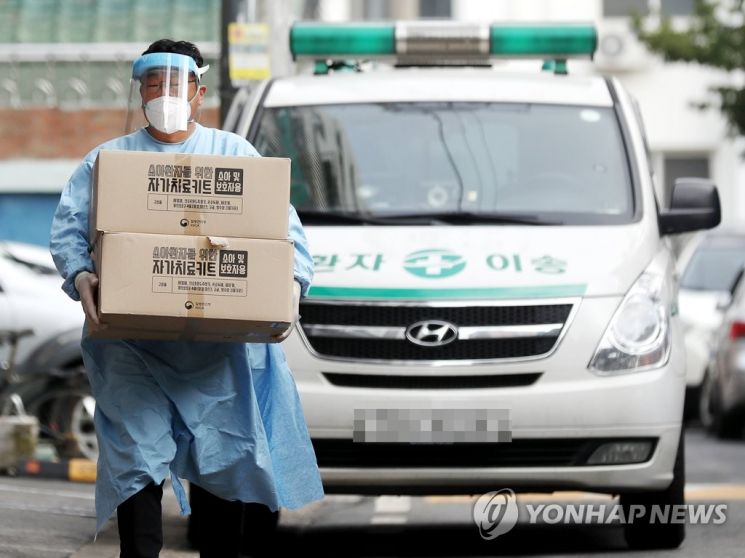 On the morning of the 19th of last month, a Bupyeong-gu Public Health Center official in Bupyeong-gu, Incheon, is moving to deliver a self-treatment kit to a home treatment patient in an alley. / Photo by Yonhap News
Mr. B, who works in the medical field, said, "Since the COVID-19 outbreak began, medical institutions have always been overworked. If home treatment becomes routine, the burden will be somewhat reduced," expressing hope, "I believe patients who really need urgent help will receive more intensive treatment."
However, some expressed anxiety about the shift to home treatment. Ms. C, a housewife in her 50s, pointed out, "What if the condition suddenly worsens to severe while being treated at home? Is there any guarantee that an ambulance will arrive on time?"
In fact, there have been cases where patients died while being treated at home after testing positive for COVID-19. On the morning of the 20th of last month, Mr. D, in his 60s, who was notified of a positive test result around 9 a.m., was receiving home treatment but his condition worsened with decreased strength the next morning. While being transferred to the hospital, he suddenly suffered cardiac arrest and eventually died around 9:30 a.m. after hospital transfer.
◆Government Plans to Strengthen Support for Home Treatment Patients
Given this situation, the government plans to make every effort to strengthen support for home treatment patients.
First, home treatment kits (oxygen saturation meter, thermometer, antipyretics, disinfectant) will be provided, and short-term outpatient clinics will be established to allow testing and medical care if symptoms change during treatment.
A 24-hour hotline capable of consultation and treatment will also be set up to respond to emergencies. Additionally, under the responsibility of local government heads, an appropriate level of dedicated personnel will be assigned, and periodic monitoring will be conducted.
© The Asia Business Daily(www.asiae.co.kr). All rights reserved.



















