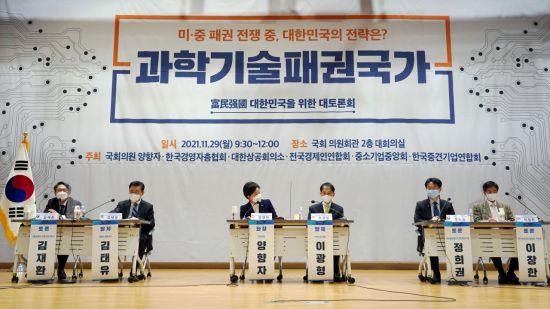
[Asia Economy Honam Reporting Headquarters Reporter Yoon Jamin] A grand forum for a prosperous and strong Korea was held to review the current status of South Korea's science and technology policies and to explore ways to advance as a science and technology hegemon.
On the 29th, according to National Assembly member Yang Hyang-ja (Gwangju Seo-gu Eul), the grand forum for a prosperous and strong Korea as a science and technology hegemon, co-hosted by the Korea Employers Federation, the Korea Chamber of Commerce and Industry, the Federation of Korean Industries, the Korea Federation of Small and Medium Business, and the Korea Association of Mid-sized Enterprises, was held at the National Assembly's main conference hall.
The forum was attended by political, business, and academic circles as well as government officials, and was held to review the current status of South Korea's science and technology policies amid the US-China hegemony struggle centered on semiconductors and to explore ways to become a science and technology hegemon.
The first part of the forum, chaired by Lee Young, a member of the People Power Party, began with an opening address by Yang Hyang-ja, followed by a welcoming speech by Son Kyung-sik, chairman of the Korea Employers Federation. Congratulatory remarks were delivered by Ahn Cheol-soo, presidential candidate of the People’s Party, Yoon Hoo-duk, chairman of the National Assembly’s Budget and Accounts Committee, Lee Won-wook, chairman of the National Assembly’s Science, ICT, Broadcasting and Communications Committee, and National Assembly members Ahn Min-seok, Lee Yong-seon, Ko Young-in, Lim Ho-seon, Yoon Jae-gap, Kim Young-sik, Choi Yeon-sook, and Yang Jeong-sook.
Also attracting attention were numerous figures from academia and the economy, including Lee Woo-il, president of the Korea Federation of Science and Technology Societies; Lim Tae-hwan, president of the National Academy of Medicine of Korea; Ha Sung-do, vice president of the Institute for Basic Science; former SKT vice chairman Lim Hyung-gyu; Choi Hee-moon, executive director of the Korea Association of Mid-sized Enterprises; Jung Seok-hyun, chairman of Susan Heavy Industries; and Ko Do-won, chairman of the Morning Letter Culture Foundation.
In the second part, chaired by Yang Hyang-ja, KAIST President Lee Kwang-hyung gave a keynote presentation titled “South Korea’s Strategy in the Era of Tech-geopolitics,” followed by a presentation by Seoul National University Professor Emeritus Kim Tae-yoo on “The Essence of the US-China Hegemony War.”
President Lee emphasized in his presentation that “the 21st century is an era where ‘tech-geopolitics,’ based on technology, surpasses the traditional ‘geopolitics’ paradigm as the most important factor,” and stressed that ‘technological armament’ is becoming the most powerful weapon to protect a nation, surpassing ‘military armament.’
Meanwhile, Professor Emeritus Kim Tae-yoo stated, “The US-China hegemony war could present new opportunities for South Korea, which holds semiconductor technology hegemony,” adding that the US hegemonic order is based on the principles of co-growth and prosperity, and that the Fourth Industrial Revolution will offer South Korea opportunities to dominate monopoly or oligopoly hegemony.
Following this, Kim Jae-hwan, policy coordination officer at the Ministry of Economy and Finance; Jung Hee-won, director of the Science and Technology Policy Bureau at the Ministry of Science and ICT; and Lee Chang-han, vice chairman of the Korea Semiconductor Industry Association, participated as panelists to share their views on science and technology policy tasks for the next government.
After the panel discussion, Yang Hyang-ja conducted a public inquiry directed at presidential candidates from both ruling and opposition parties on five key areas: ▲strategic industry development ▲science and technology policy ▲regional and SME co-prosperity ▲regulatory reform ▲climate change response. Responses from each campaign are scheduled to be publicly released to the media three weeks later.
With the presidential election scheduled for March 9 next year, the responses from the candidates to the public inquiry are expected to serve as valuable indicators for gauging the next government’s direction in science and technology policy.
Yang Hyang-ja emphasized, “Regardless of party lines, what everyone should aim for is economic growth, the core of which is industry, and the core of industrial development is science and technology,” adding, “Now, science and technology are both the economy and national security.”
She further criticized, “The essence of the US-China hegemony war is also science and technology, but this presidential election is rife with mudslinging and yellow journalism, while science and technology policies are missing.”
She continued, “To overcome national challenges such as the pandemic economic crisis, low birthrate and aging population, and polarization, industry and science and technology must become the main themes of the presidential election,” and added, “I hope this forum will serve as a cornerstone for creating a science and technology hegemon Korea, a prosperous and strong nation where each citizen prospers and the country grows stronger, by seeking solutions to the longstanding issues in industrial technology fields.”
Meanwhile, last October, Yang Hyang-ja and the three major economic organizations (Korea Employers Federation, Korea Federation of Small and Medium Business, Korea Association of Mid-sized Enterprises) jointly conducted a survey targeting CEOs and executives related to science and technology, urging presidential candidates from both ruling and opposition parties to develop science and technology pledges and policies.
© The Asia Business Daily(www.asiae.co.kr). All rights reserved.

















