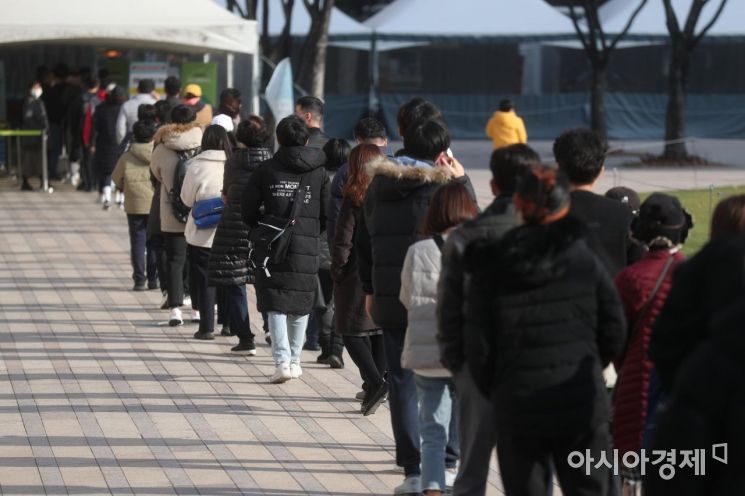
 On the 28th, the temporary COVID-19 screening clinic at Seoul Plaza is crowded with citizens seeking testing. Photo by Mun Ho-nam munonam@
[Asia Economy Reporter Seo So-jeong] As the spread of COVID-19 continues, the government has decided to postpone the transition to the second phase of 'gradual daily recovery' and maintain the current level of phase 1 for the next four weeks. Due to a shortage of hospital beds, COVID-19 patients will primarily receive home treatment, with hospitalization only allowed when necessary.
On the 29th, the Ministry of Health and Welfare announced this medical and quarantine follow-up response plan at the 'COVID-19 Response Special Quarantine Inspection Meeting' presided over by President Moon Jae-in.
On the same day, Kwon Deok-cheol, Minister of Health and Welfare, stated, "All confirmed cases will primarily receive home treatment, but hospitalization will be provided only in specific cases such as when there are hospitalization factors or when the living environment is vulnerable to infection."
Until now, home treatment was implemented only for asymptomatic or mild confirmed patients under 70 without hospitalization factors who agreed to home treatment, but now home treatment will be the principle, and only those who need hospitalization will be admitted.
The government plans to expand medical institutions centered on community medical institutions in preparation for the increase in home-treated patients. Short-term and outpatient treatment centers will be established where patients can receive tests and treatment if symptoms change during home treatment or if home-treated patients require it.
To ensure rapid response in emergencies, a 24-hour hotline capable of consultation and treatment will be established, and medical institutions for transfer will be designated in advance to secure at least one emergency transfer bed per institution at all times.
Support for the daily lives of home-treated patients will also be expanded. Considering the additional costs incurred during home treatment compared to admission to living treatment centers, additional living support funds will be reviewed.
Additionally, to alleviate the burden on co-isolators such as cohabitants living in the same space, outings will be permitted for essential reasons such as hospital visits or waste disposal.
Minister Kwon explained the background, saying, "The increase in severe and critical patients leads to a rise in ICU bed utilization rates and waiting times for bed allocation, bringing the medical response system closer to its limits. We have established a medical and quarantine follow-up response plan that can actively respond to risk factors to continue the gradual daily recovery in the future."
© The Asia Business Daily(www.asiae.co.kr). All rights reserved.

















