Principle of In-Person Classes with Regional Density Adjustments
Strengthen School Quarantine and Expand Vaccination for Ages 12-17
Coordinate with Education Offices and Local Governments to Link Schools and Vaccination Centers
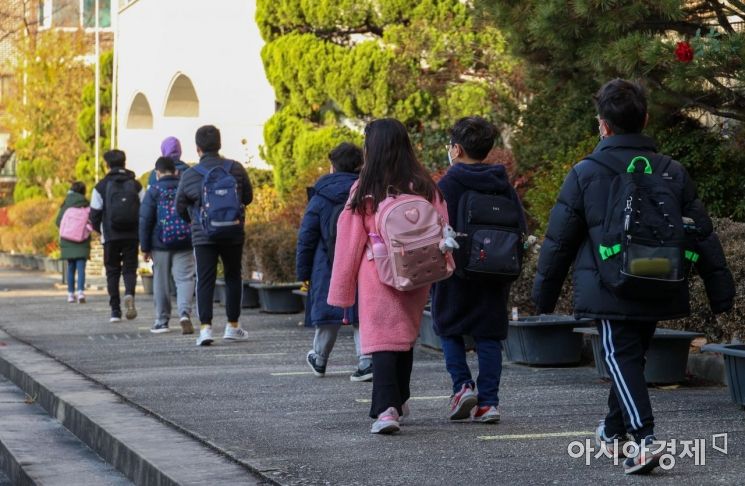 On the morning of the 22nd, when full in-person attendance begins for kindergartens, elementary, middle, and high schools in the Seoul metropolitan area, students are attending school at Changwon Elementary School in Chang-dong, Dobong-gu, Seoul. Photo by Joint Press Corps
[Asia Economy Reporter Han Jinju] The Ministry of Education has decided that if the COVID-19 infection situation worsens and an emergency plan is activated, in-person classes will be the principle, but school density adjustments will be pursued regionally. Vaccination for children and adolescents will also be 'strongly recommended' in preparation for an increase in student infections.
On the 29th, in the 'Medical and Quarantine Follow-up Response Plan for the Gradual Recovery of Daily Life from COVID-19' jointly announced by government ministries, the Ministry of Education stated that if an emergency plan is implemented, school density will be adjusted differently according to regional infection situations. Detailed plans are currently under consultation with education offices.
The application of the quarantine pass system in the education sector will be reviewed in consultation with relevant ministries, considering the infection situation and the vaccination status of children and adolescents.
As the number of unvaccinated adolescent confirmed cases rapidly increases and the possibility of transmission rises due to full in-person classes and university-specific exams, the government has strongly recommended vaccination for children and adolescents.
In addition to same-day vaccinations, advance reservations will be resumed, and convenience will be promoted by linking schools and vaccination centers through consultations with education offices and local governments.
The Korea Disease Control and Prevention Agency will prepare a basic plan to diversify vaccination methods, after which local governments (public health centers) and education offices will proceed regionally through consultations.
Currently, vaccination rates based on first doses are ▲12?15 years old 34.0% ▲16?17 years old 70.9%. Vaccinations for ages 12 to 17 have been extended until January 22 of next year.
Additionally, 94.8% of education and childcare workers, 96.8% of special and health teachers, and 96.1% of high school seniors’ staff and university entrance exam candidates have completed vaccination. ▲96.9% of high school seniors have completed their second dose.
Deputy Prime Minister and Minister of Education Yoo Eun-hye said, "Despite maintaining a thorough quarantine system in educational facilities such as schools and academies, there are limits to reducing the increasing infection trend. Now is the time to actively participate in vaccination, the most effective quarantine measure." She added, "Since the government has prepared various vaccination methods to improve convenience and accessibility, active participation from students and parents is necessary."
Furthermore, joint inspections will continue until the end of the year targeting student-use facilities inside and outside schools in cooperation with relevant ministries and local governments. In the Seoul metropolitan area, where infection trends are high, education support offices will operate ‘School Life Quarantine Guidance and Inspection Teams’ to strengthen quarantine measures in facilities frequently used by students, focusing on areas with dense schools and academies.
© The Asia Business Daily(www.asiae.co.kr). All rights reserved.

















