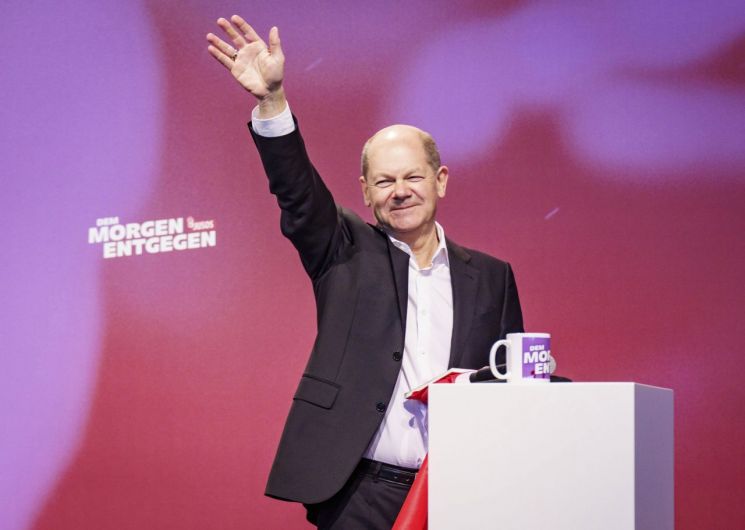
 Olaf Scholz, Deputy Prime Minister and Finance Minister, who will take office as Germany's new Chancellor in early next month
 [Photo by AP Yonhap News]
[Asia Economy Reporter Park Byung-hee] Germany's new coalition government, set to launch early next month, is expected to distance itself from China.
The Social Democratic Party (SPD) narrowly won the general election on September 26, and Olaf Scholz, the current Vice Chancellor and Finance Minister and SPD's chancellor candidate, agreed on the 24th to form a coalition government with the Green Party and the Free Democratic Party (FDP). As a result, Finance Minister Scholz is scheduled to be elected as the new German Chancellor in the Bundestag on October 6.
Since Chancellor candidate Scholz played a key role as Finance Minister in the Merkel administration, domestic politics generally expect him to continue the previous administration's policies. However, with the progressive Green Party taking the Environment and Foreign Ministries, significant changes in foreign policy are anticipated.
During coalition negotiations, the Green Party emphasized a "values-based" foreign policy and took a tough stance toward China and Russia. The Green Party is particularly expected to raise its voice on China's human rights issues.
In the coalition agreement announced on the 24th, China was mentioned with references to sensitive issues such as human rights in the Xinjiang Uygur Autonomous Region and Hong Kong, the Taiwan issue, and territorial disputes in the South China Sea, signaling that these sensitive matters will not be avoided. The coalition stressed that cooperation with China must be based on human rights and clearly stated that Germany's policy will be conducted within the framework of the European Union's (EU) China relations. Notably, within the EU's "One China" policy framework, the coalition expressed support for Taiwan's participation in international organizations, peace and stability in the Taiwan Strait, and hopes for enhanced friendly cooperation between Germany and Taiwan, directly addressing the Taiwan issue. The coalition also added that the current situation in the Taiwan Strait can only change through peaceful means agreed upon by both sides (China and Taiwan).
A spokesperson for Taiwan's Ministry of Foreign Affairs welcomed the new German government, expressing hope for strengthened friendly cooperation and expanded mutually beneficial relations across various fields, and wished for the maintenance of the current situation in the Taiwan Strait and the guarantee of international peace and prosperity.
On the other hand, China's Ministry of Foreign Affairs emphasized that Taiwan, the South China Sea, Xinjiang, and Hong Kong are all internal matters of China, rebutting by stating, "All previous German governments have adhered to the 'One China' policy." China, which considers Taiwan its territory, reacts very sensitively to any moves that contradict the "One China" principle.
With Chancellor Merkel, who had played a diplomatic balancing role between the U.S. and China, stepping down, China, whose relationship with the EU is now strained, cannot help but be concerned about a "Europe without Merkel."
During her 16 years in office, Chancellor Merkel visited China 12 times, demonstrating her emphasis on China and implementing a pragmatic China policy that secured economic cooperation.
Germany has valued its relationship with China and made efforts to reduce dependence on the U.S. In this process, it sometimes appeared to avoid addressing China's human rights and Taiwan issues.
This background also explains why Chinese President Xi Jinping expressed special affection during a farewell video conference with Chancellor Merkel last month, calling her "Lao Pengyou," meaning "old friend," and saying, "China's door is always open to you."
Recently, Rafael Glucksmann, a member of the European Parliament who visited Taiwan, pointed out that Germany and other EU countries have not properly voiced concerns about China's authoritarian regime and human rights issues. The French human rights activist Glucksmann argued, "German political leaders want to enhance cooperation with China, their largest trading partner, and German major companies like Volkswagen are lobbying for China's interests, which is not unrelated to this situation."
© The Asia Business Daily(www.asiae.co.kr). All rights reserved.
![User Who Sold Erroneously Deposited Bitcoins to Repay Debt and Fund Entertainment... What Did the Supreme Court Decide in 2021? [Legal Issue Check]](https://cwcontent.asiae.co.kr/asiaresize/183/2026020910431234020_1770601391.png)
















