Bank Sector Time Deposits Balance 653.1354 Trillion KRW
Deposit and Savings Interest Rates Rise Simultaneously After Base Rate Hike
Accelerated Movement of Funds from Stock Market to Banks Expected
[Asia Economy Reporters Sunmi Park and Kiho Sung] In the domestic financial market where the 'zero interest rate' era has ended, signs of a full-scale 'money move' phenomenon?where funds that had poured into the stock and real estate markets are shifting to banks?are emerging. With an additional base rate hike this month and the emergence of the new COVID-19 variant Omicron, it is expected that risk-asset avoidance will intensify, accelerating the speed of capital flow.
According to the financial industry on the 29th, as of the 24th of this month, the balance of time deposits at the five major commercial banks?KB Kookmin, Shinhan, Hana, Woori, and NH Nonghyup?stood at KRW 653.1354 trillion. Since the Bank of Korea raised the base rate on August 26, market funds had shown no clear movement, but last month, a large amount of lump-sum money flowed into banks. The net increase in time deposits in October alone was KRW 20.4583 trillion, marking the largest increase in the past three years.
In particular, the pace is expected to accelerate after the Bank of Korea raised the base rate by 0.25 percentage points on the 25th. Commercial banks rapidly raised savings and deposit interest rates by up to 0.40 percentage points, enhancing the previously meager appeal of deposit interest rates.
NH Nonghyup Bank decided to raise savings and deposit interest rates by 0.25 to 0.4 percentage points starting next month. Earlier, the fund inflow to Hana Bank accelerated further. Hana Bank increased interest rates on five installment savings products, including the 'Main Hana Monthly Compound Interest Savings,' by 0.25 to 0.40 percentage points starting from the 26th, and from this day, also raised interest rates on seven installment savings and six time deposit products by 0.25 percentage points. Woori Bank also raised interest rates on 19 time deposit and 28 savings products by up to 0.40 percentage points.
Shinhan Bank raised interest rates on 36 types of time deposits and installment savings by up to 0.40 percentage points starting today, and KB Kookmin Bank also increased interest rates on 17 types of time and marketable deposits and 26 types of installment savings, including the 'KB Exciting Travel Savings,' by up to 0.40 percentage points. Bank officials reported that inquiries related to savings and deposits at bank counters have more than doubled compared to usual.
What is the background of the money move?
The preference for safe assets due to recent intensified domestic and international uncertainties such as the U.S. tapering (asset purchase reduction) and the emergence of new COVID-19 variants is also considered a factor driving the money move. A bank official said, "Raising the loan threshold has made it harder to invest with borrowed money (debt investment), which has also influenced the flow of funds," adding, "Money continues to flow into bank deposits this month as well, and the increase is expected to grow further with the base rate hike."
The representative safe asset, the U.S. dollar, is also accumulating in banks. According to the Bank of Korea, resident dollar deposits increased by USD 5.37 billion to USD 87.52 billion at the end of October this year, marking the highest level since related statistics began. Dollar deposits have been on an increasing trend for three consecutive months through August (USD 80.38 billion), September (USD 82.15 billion), and October.
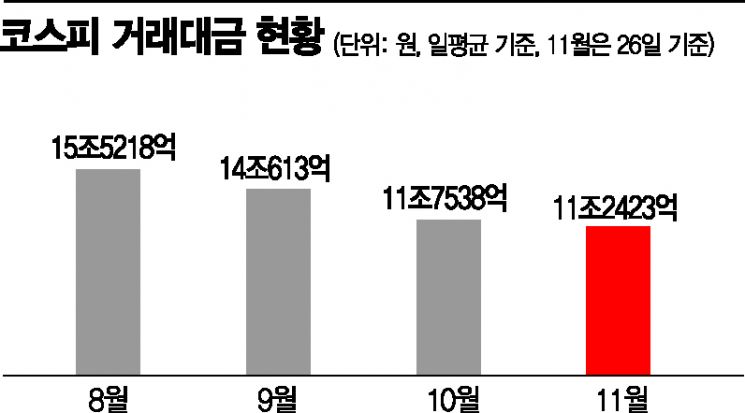
On the other hand, funds are rapidly flowing out of the stock market. According to the Korea Exchange, the KOSPI opened at 2,906.15, down 30.29 points (-1.03%) from the previous trading day, and as of the morning of this day, the average daily trading value of the KOSPI in November shrank to KRW 10.7952 trillion. This is the lowest level in one and a half years since May last year. Compared to KRW 26.4778 trillion at the beginning of the year, it has dropped by about 60%.
The KOSPI trading value has been declining for three consecutive months since recording KRW 15.5218 trillion in August. As the stock market loses momentum, demand deposits at banks, which can be used as standby funds for investment, decreased by about KRW 10 trillion from KRW 637.5782 trillion at the end of September to KRW 627.3916 trillion at the end of October.
Professor Oh Jung-geun of Konkuk University’s Department of Economics said, "Due to increased uncertainty in the capital market, lump-sum funds are flowing into stable banks," and predicted, "The money move phenomenon, where funds continuously flow out of the stock market into bank deposits, will persist for a considerable period."
© The Asia Business Daily(www.asiae.co.kr). All rights reserved.


















