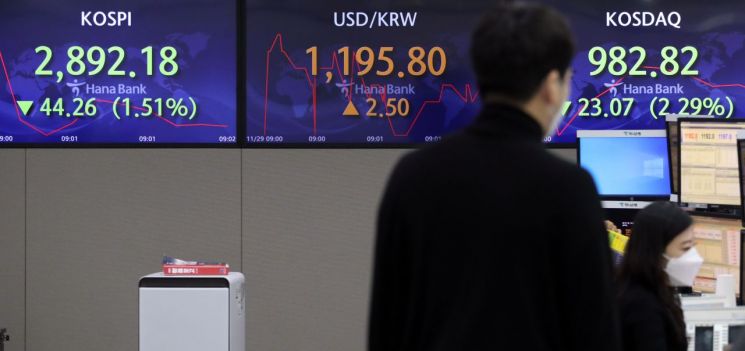
[Asia Economy Reporter Lee Seon-ae] Even in the afternoon of the 29th, the KOSPI index is maintaining a trend of recovering losses by holding the 2920 level.
As of 1:36 PM on the day, the KOSPI is at 2923.37, down 0.45% from the previous trading day. After starting the day with a drop of over 1%, it fell below the 2900 level during the session and even touched the 2890 level. It is the first time in about 10 months since January 4th (2869.11) that the KOSPI fell below 2900 during trading hours. However, it then reduced its losses and rose back to the 2920 level, and this trend has continued into the afternoon.
Individual investors have continuously shown a selling bias since the market opened, but both institutions and foreigners have been absorbing these volumes. At this time, individuals are net selling about 743 billion KRW and 237.1 billion KRW in the KOSPI and KOSDAQ markets respectively. On the other hand, institutions are net buying about 705.2 billion KRW and 62 billion KRW in the two markets respectively. Foreigners are also net buying about 63 billion KRW and 166.5 billion KRW in the two markets respectively.
It is interpreted that individuals are tense about the spread of the Omicron variant. Seo Sang-young, a researcher at Mirae Asset Securities, said, "We need to continuously monitor whether it spreads to Southeast Asia and China, as this could affect supply chain issues," adding, "In the worst case, if this spreads, panic selling could expand."
However, there is a strong voice cautioning against excessive concern at this point. Researcher Seo said, "Since factory shutdown measures have not yet been implemented globally, volatility expansion is expected to be limited."
Chae Hyun-gi, a researcher at Cape Investment & Securities, said, "Lockdown policies in Europe or the US due to the Omicron variant are not negative factors for the domestic stock market; rather, if it spreads to Southeast Asian countries or China causing factory shutdowns, that would be a negative factor," emphasizing, "We need to watch whether the Omicron variant spreads in the Asian region."
Meanwhile, the weak sectors in KOSPI are machinery (-5.02%), steel and metal (-2.18%), and medical precision (-2.07%), while the strong sectors are transportation and warehousing (+0.41%), pharmaceuticals (+0.20%), and finance (+0.20%). In KOSDAQ, the weak sectors are broadcasting services (-3.10%), telecommunications services (-2.79%), and finance (-2.21%), while the strong sectors are digital content (+3.26%), publishing and media reproduction (+2.50%), and paper and wood (+2.32%).
© The Asia Business Daily(www.asiae.co.kr). All rights reserved.

















