 On the 29th, banners related to the Korea Sale Festa were hung on the streets of Myeongdong, Seoul. Next to the banners, there are rows of closed stores. The Korea Sale Festa, the largest shopping event in the country, will be held both online and offline from the 1st to the 15th of next month. Photo by Mun Ho-nam munonam@
[Asia Economy Reporter Lee Junhyung] Small business owners have voiced their opposition after the passage of the Online Platform Fairness Act was postponed in the National Assembly's Political Affairs Committee and the Legislation and Judiciary Committee's Subcommittee on Bills. The small business owners expressed that they "cannot hide their sense of frustration" and urged the enactment of the Online Platform Fairness Act.
On the 29th, the Korea Federation of Small and Medium Business (KSMB) stated in a commentary, "The ruling party, government, and Blue House had agreed to pass the Online Platform Fairness Act within the regular session of the National Assembly ending on the 9th of next month, but this plan is now at risk of collapse," adding, "A red light has been lit on the legislation, and we express serious concern."
The KSMB pointed out the differences between the ruling party-government agreement on the Online Platform Fairness Act and the existing government proposal. The KSMB said, "The ruling party-government agreement defines the regulatory targets of the Online Platform Fairness Act as platforms with intermediary revenue exceeding 100 billion KRW and intermediary transaction amounts exceeding 1 trillion KRW, raising the criteria more than tenfold compared to the existing government proposal," and "It is predicted that only about 20 platform companies will be subject to regulation." They continued, "Online platform companies that specialize in specific industries and are rapidly increasing, targeting niche markets, will be excluded from the scope of application, inevitably creating blind spots."
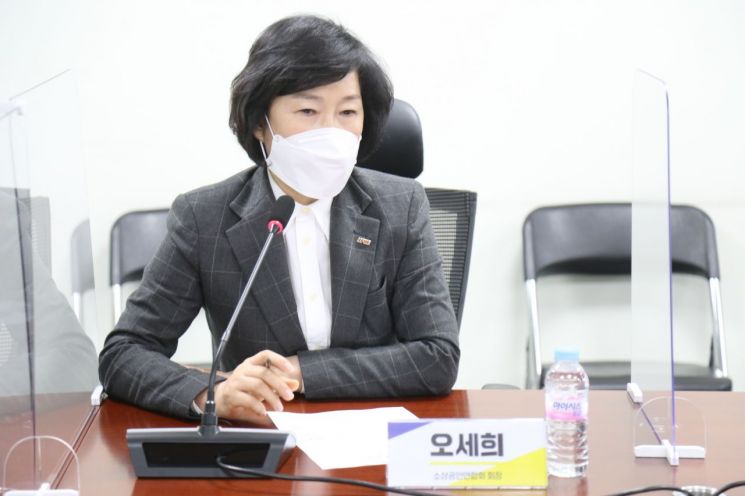 O Sehee, President of the Korea Federation of Micro Enterprise.
 [Photo by Korea Federation of Micro Enterprise]
Additionally, the KSMB claimed that the invasion of local markets by companies such as Kakao and Yanolja is a serious issue. The KSMB stated, "Unlike offline products, the online market has no regulations, allowing online conglomerates wielding monopolistic power to exercise unchecked authority," and "These companies unilaterally set fees and terms, forcing small business tenants to become victims." They added, "The government and National Assembly must deeply recognize the reality that the reckless invasion of local markets by online giants like Kakao and Yanolja is severely threatening the survival of small business owners."
There were also opinions that collective bargaining rights for tenant businesses should be reflected in the bill. The KSMB said, "To prevent unfair price setting, collusion, and abuse of monopolistic status by platforms, the enactment of the Online Platform Fairness Act is essential," and "We hope that lowering the criteria for companies subject to the bill, granting tenant businesses the right to organize and bargain collectively, and providing opportunities for class-action lawsuits will be reflected in future legislative discussions."
© The Asia Business Daily(www.asiae.co.kr). All rights reserved.
!["The Woman Who Threw Herself into the Water Clutching a Stolen Dior Bag"...A Grotesque Success Story That Shakes the Korean Psyche [Slate]](https://cwcontent.asiae.co.kr/asiaresize/183/2026021902243444107_1771435474.jpg)

















