KAIST Professors Byung-Guk Park and Yeon-Sik Jung, Department of Materials Science and Engineering, and Gap-Jin Kim, Department of Physics Research Team
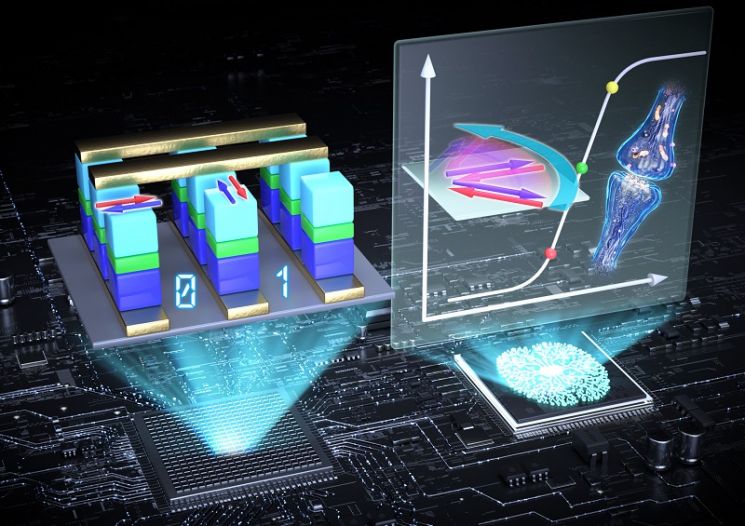 Schematic of antiferromagnetic-based spin device applications (left) and brain-inspired computing applications utilizing multilevel. Image courtesy of KAIST
[Asia Economy Reporter Kim Bong-su] Domestic researchers have developed a core technology for next-generation memory that operates at ultra-high speed by mimicking brain functions.
The Korea Advanced Institute of Science and Technology (KAIST) announced on the 29th that a research team led by Professors Park Byung-guk and Jung Yeon-sik from the Department of Materials Science and Engineering, and Kim Gap-jin from the Department of Physics, developed a material capable of electrically controlling the magnetization direction of an antiferromagnetic material, which can be used as a core electrode material for high-speed magnetic memory.
An antiferromagnetic material has a structure where the magnetic moments of adjacent atoms are aligned in opposite parallel directions. Unlike ferromagnetic materials that exhibit magnetism when an external magnetic field is applied, antiferromagnetic materials do not show net magnetization, resulting in no stray magnetic fields and possessing high-speed switching characteristics.
In this study, the research team increased the feasibility of developing antiferromagnetic-based devices, which are expected to have higher integration density and operate more than 10 times faster than conventional ferromagnetic-based magnetic devices. They also developed a technology to electrically control the magnetization direction of antiferromagnetic materials, which was previously difficult due to the absence of net magnetization. By continuously controlling the magnetization direction of the antiferromagnetic material, they demonstrated multi-level memory characteristics that go beyond traditional binary systems. This can mimic synaptic operations in the brain and is expected to be applied to neuromorphic computing.
Magnetic Random Access Memory (MRAM) is being developed as a next-generation non-volatile memory device. Conventional magnetic memory is based on ferromagnetic materials, but in highly integrated devices, stray magnetic fields generated by ferromagnets cause interference between adjacent magnetic devices. In contrast, antiferromagnetic materials do not exhibit net magnetization, so no stray magnetic fields occur, enabling the development of ultra-high-density magnetic memory devices when applied to magnetic components. For this, the development of technology to electrically control the magnetization direction of antiferromagnetic materials is required.
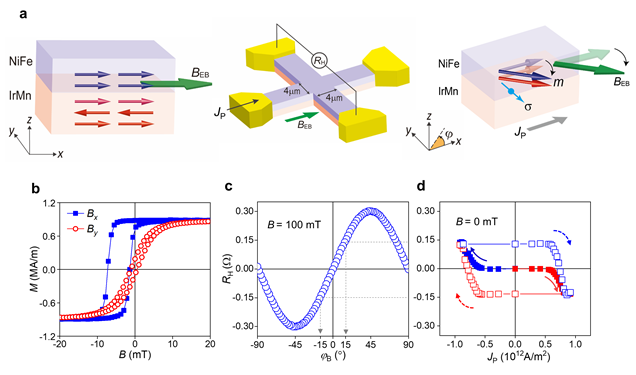
The research team fabricated an antiferromagnetic/ferromagnetic bilayer structure with exchange bias and experimentally demonstrated that the magnetization direction of the antiferromagnetic material reversibly rotates depending on the magnitude and polarity of the current by utilizing spin current generated in the antiferromagnetic material. They showed that continuous control of the magnetization direction of the antiferromagnetic material enables multi-state memory configuration.
By utilizing the antiferromagnetic control technology and multi-state switching behavior developed by the research team, it is expected to be used as a core technology for antiferromagnetic-based magnetic memory and neuromorphic devices capable of ultra-high integration and ultra-high-speed operation.
Researcher Kang Jae-min stated, "This study experimentally demonstrated that the magnetization direction of antiferromagnetic materials can be controlled by spin current," adding, "It is expected to be applied to the development of spintronics electronic devices, considered next-generation semiconductor technology based on antiferromagnetic materials."
The research results were published online on the 5th in the international academic journal Nature Communications.
© The Asia Business Daily(www.asiae.co.kr). All rights reserved.


















