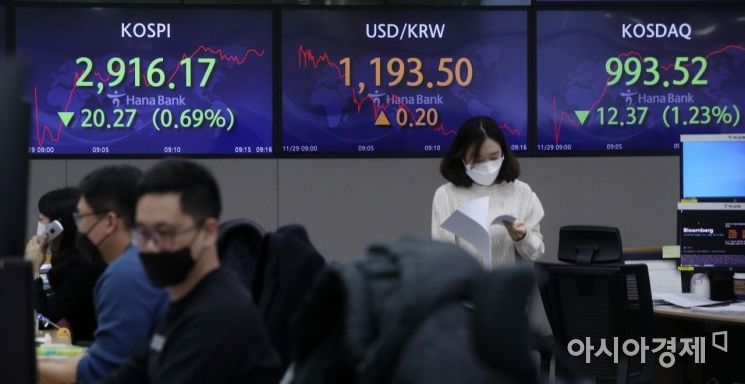
 On the 29th, when the KOSPI started lower due to fears of the Omicron variant of COVID-19, the dealing room of Hana Bank in Jung-gu, Seoul was seen. On that day, the KOSPI opened at 2,906.15, down 30.29 points (1.03%). The won-dollar exchange rate opened at 1,195.5 won, up 2.2 won. Photo by Kim Hyun-min kimhyun81@
[Asia Economy Reporter Lee Seon-ae] On the 29th, it seems that only individual investors are gripped by fear of the new COVID-19 variant 'Omicron.' They have been continuously net selling since the market opened, showing signs of panic selling. The net selling amount is approaching 1 trillion won.
As of 11 a.m., individuals are showing net selling dominance of approximately 764.4 billion won and 213.8 billion won in the KOSPI and KOSDAQ markets, respectively. In contrast, foreigners and institutions are net buyers. Institutions are buying about 759 billion won and 59.6 billion won in the two markets, respectively. Foreigners are also recording net purchases of about 38.8 billion won and 158 billion won in both markets.
It is interpreted that individuals are tense about the spread of Omicron. Seo Sang-young, a researcher at Mirae Asset Securities, said, "We need to continuously monitor whether it spreads to Southeast Asia and China, as this could affect supply chain issues," adding, "In the worst case, if this spreads, panic selling could expand."
However, there is a growing voice cautioning against excessive concern at this point. Researcher Seo predicted, "Since no factory shutdown measures have yet been announced globally, volatility expansion is expected to be limited."
Chae Hyun-gi, a researcher at Cape Investment & Securities, said, "If Europe or the U.S. implements lockdown policies due to the Omicron variant, it would not be negative for the domestic stock market. Rather, if it spreads to Southeast Asian countries or China leading to factory shutdowns, that would act as a negative factor," emphasizing, "We need to watch whether the Omicron variant spreads in the Asian region." He added, "Even during the spread of the Delta variant, the stock market was shocked but only in the short term," and "Unless the supply chain shock caused by this variant becomes prolonged, the decline is expected to be limited, so buy recommendations for the semiconductor and automobile sectors remain meaningful."
Meanwhile, at this time, the KOSPI is recovering losses and is recording 2,927.02 points. After starting at the 2,900 level and falling to the 2,980 level during the session, it is recovering losses due to net buying inflows from institutions.
© The Asia Business Daily(www.asiae.co.kr). All rights reserved.

















